CN10 - Vagus Nerve
Return to Nervous System Menu
Videos
The Vagus Nerve

How the Vagus Nerve Heals Your Gut
Neurosurgeon: The Only 2 Ways To Stimulate Your Vagus Nerve

The connection between the heart, the stomach and the vagus nerve
How to Heal the "Vagus Nerve" to Heal Your Mind & Body
How to stimulate your vagus nerve and why you should try it.
How does yoga affect the nervous system?
Cranial Nerve X - Vagus Nerve | Introduction + Origin from Medulla
Cranial Nerve X - Vagus Nerve Part 2a- Structure & Functions of UQ & Thoracic Branches
Cranial Nerve X - Vagus Nerve Part 2b -Structure & Functions of UQ & Thoracic Branches
Cranial Nerve X - Vagus Nerve Part 3 Structure & Functions of Abdominal Branches
Vagus Nerve Reset To Release Trauma Stored In The Body (Polyvagal Exercises)
Overview
The vagus nerve is a very diverse nerve. It has both sensory and motor functions, including:
- communicating sensation information from your ear canal and parts of your throat
- sending sensory information from organs in your chest and trunk, such as your heart and intestines
- allowing motor control of muscles in your throat
- stimulating the muscles of organs in your chest and trunk, including those that move food through your digestive tract (peristalsis)
- providing a sense of taste near the root of your tongue
Out of all of the cranial nerves, the vagus nerve has the longest pathway. It extends from your head all the way into your abdomen. It originates in the part of your brainstem called the medulla and then extends into every chest and abdominal organ from the neck to the transverse colon with the exception of the adrenal glands. This nerve also regulates some skeletal muscles. The vagus nerve involves both afferent neurons (sensory neurons) and efferent neurons (motor neurons), although the majority of its neurons (65% to 80%) are afferent neurons,which send sensory information about the status of our organs to the central nervous system.Efferent vagus nerve fibers supply the pharynx and back of the throat with nerves and initiate the gag reflex. It was once thought that the vagus nerve affected only the stomach and heart, but now we know that it casts a much wider net in the body and that it has a considerable number of functions far beyond what was initially thought.
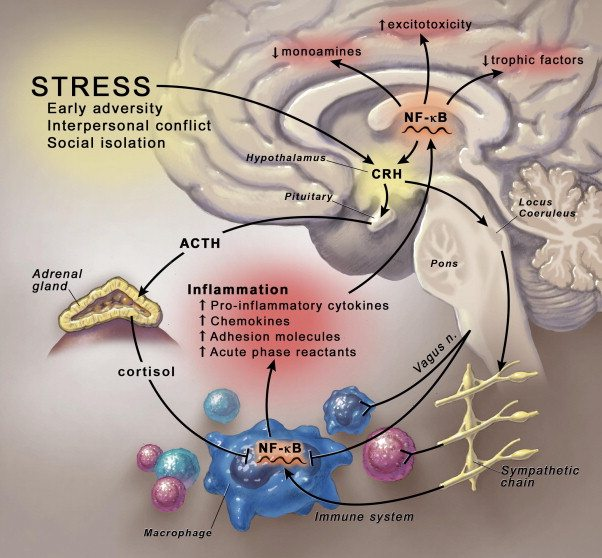
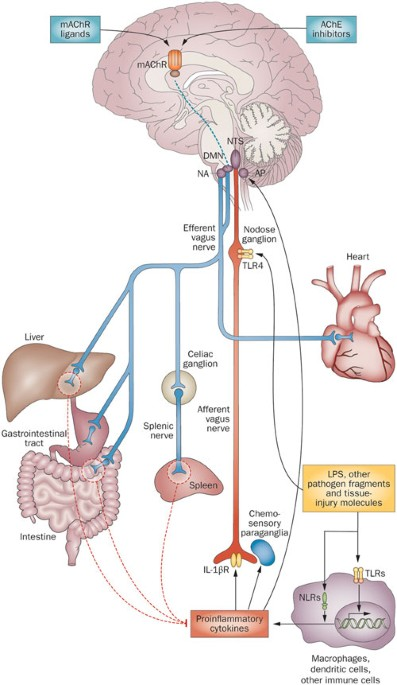
Reaction of the vagus nerve to infection may be responsible for chronic fatigue syndrome. When an infection lands on immune cells' radar, they release pro-inflammatory cytokines, which are detected by receptors of the vagus nerve. The receptors signal the brain to initiate fatigue. VanElzakker contends that chronic fatigue symptoms are a more prolonged version of those normal sickness symptoms and that chronic fatigue symptoms are triggered when any virus or bacterium infects the vagal ganglia (a structure containing nerve cells). These virus- or bacteria activated cells can assault the vagus nerve with proteins known as pro-inflammatory cytokines and other substances that signal the development of sickness symptoms. This hypothesis proposed that any infection of the vagus nerve can lead to chronic fatigue syndrome and that not just one virus or bacterium is responsible for chronic fatigue but rather that any pathogen can cause the disorder.
Depression, ADHD, and Other Cognitive Disorders
The vagus nerve is involved in cognitive health and emotional well-being. Vagal nerve stimulation is commonly used to treat drug-resistant epilepsy and depression.
It also is used to eliminate fear and anxiety and is involved in our response to traumatic events. The vagus nerve determines how likely you are to be affected emotionally by a trauma long after it has concluded.
A marker of increased emotional sensitivity to trauma is reduced heart rate variability, an indicator that the vagal nerve is not working properly. The vagus nerve slows the heart rate during safe, nontraumatic conditions. However, in response to threats, the heart-rate inhibiting effect of the vagus nerve stops, allowing the sympathetic nervous system to mobilize defense responses and heart rate increases. Ongoing exposure to conflict and threats may impair vagal system function over time. This results in a reduced ability of the body to adapt to stressful events. . A vagus nerve that is operating optimally is thought to reflect psychological flexibility, emotional self-regulation, and positive adaptation.
The vagus nerve also plays a role in reducing aggressive behavior in attention-deficit hyperactivity disorder (ADHD). In ADHD, the autonomic nervous system does not
work properly, resulting in poor control of the heart. The means by which the vagus nerve affects mental health may be due to its involvement in the gut–brain axis. The vagus nerve is one of the primary means of communication between the gut and the brain. The microbiota may interact with the vagus nerve to send signals to the brain.
Weight Management and Food Intake
In the gastrointestinal tract, afferent vagus nerves control food intake. However, in obesity, GI vagal responses to stimuli are modified leading to a shift away from satiety toward increased food intake. Vagal pathways that aren't operating properly are involved in the development of obesity and the inability to lose weight already gained. Many studies have shown that the gut microbiota is involved in weight maintenance. The gut microbiota assists in the production of short chain fatty acids (SCFAs), which in turn results in the production of substances that can then act on afferent vagus nerves to increase satiety. Specifically, the SCFA butyrate can directly activate vagal afferent nerves in the small intestine.
Gut hormones activate vagal afferent neurons, the primary neural pathway by which information about ingested nutrients reaches the central nervous system (CNS) to play a role in both GI function and satiety. Vagal afferent neurons can also become resistant to the hormone leptin, which regulates appetite. Furthermore, in a rodent model, a high-fat diet produced changes in the gut microbiota and this imbalance resulted in gut inflammation and "leaky gut." Through toxins escaping into the bloodstream, this led to changes in the function of vagal neurons.
The vagus nerve can counteract the inflammation that occurs as a person gains weight. The vagus nerve also has the ability to reduce insulin resistance.
,An overly active vagus nerve can play a role in bulimia nervosa. Increases in vagal afferent activity are linked to binge-eating and vomiting in this condition.
Inhibiting vagal afferent activity in subjects with severe bulimia nervosa results in a rapid and pronounced decline in binge-eating and vomiting compared with controls as well as reduced depressive symptoms.
Role of the vagus nerve in the development and treatment of diet-induced obesity
Cardiovascular
Vagus nerve stimulation normalizes autonomic function and improves cardiovascular function and heart failure symptoms.
Stroke
Research has shown that stimulation of the vagus nerve is beneficial in stroke. Recombinant tissue-type plasminogen activator is used within 4.5 hours of a stroke. This results in a rapid reintroduction of cerebral blood flow. While this has its advantages it also leads to an excessive inflammatory response that worsens ischemic injury, which can be harmful to the patient. In animal models of endotoxemia (toxins in the blood), stimulation of vagus nerve efferents results in a significant decline in systemic levels of pro-inflammatory mediators such as tumor necrosis factor alpha (TNF-α), interleukin 6 (IL-6), interleukin 1 beta (IL-1β), and the DNA-binding protein, high-mobility group box 1 (HMGB-1). Stimulation of the vagus nerve also is neuroprotective leading to a decrease in infarct volume during the acute phase of ischemic stroke. Researchers induce strokes in rodents by blocking the middle cerebral artery. When vagal nerve stimulation is begun within 30 minutes after blocking the artery, infarct volume is reduced by nearly 50%, and there is an improvement in neurological score.
Immune Support
The vagus nerve's regulation of inflammation is involved in immune system activity. During infection or injury, sensory input triggered by inflammation travels through the afferent vagus nerve to the brainstem, from which efferent nerves send signals that terminate in the spleen and other tissues. This assists in communication between immune cells, indicating that the vagus nerve is important for optimal functioning of the immune system.
Vagal Activation
Episode 472: Vagus Nerve Activation: Separating Fact from Fiction w/ Dr. Navaz Habib Vagus Nerve Activation: Summary In this episode, Vagus Nerve Activation, host Evan Transue (aka Detective Ev) welcomes Dr. Navaz Habib, a bestselling author and host of The Health Upgrade Podcast, to discuss the importance and functions of the vagus nerve. Dr. Habib shares his journey from dealing with significant health challenges, including obesity and high blood […]
Buccal Fascia Expansion
It’s called a Buccal Fascia Expansion. You fill your cheeks with air and hold. The pressure activates deep cranial fascia and resets tension stored in the jaw, sinuses, and even behind the eyes.
Why this works: This activates the vagus nerve—your body’s master reset button. It moves you out of fight-or-flight …and back into peace, breath, and healing.
•Your face holds trauma
•Your jaw stores stress
•Your tongue connects to your diaphragm
When you decompress the face, you reset your entire body from the top down.
Add this daily:
•Inhale through your nose
•Fill cheeks with air
•Hold 10–20 seconds
•Exhale slowly
•Repeat x3 rounds

This activates the vagus nerve—your body’s master reset button. It moves you out of fight-or-flight …and back into peace, breath, and healing. Do this barefoot, grounded, and eyes open. You’ll notice more clarity, emotional release, and even relief from TMJ, brain fog, and jaw tension.
ARTICLES/STUDIES
Revealing Communications Between Brain and Body Study reveals how different signals in the brain are coded in the vagus nerve, finding three key features that are independently coded by vagal sensory neurons.
Gut Vagal Afferents Differentially Modulate Innate Anxiety and Learned Fear” Vagal afferents are an important neuronal component of the gut–brain axis allowing bottom-up information flow from the viscera to the CNS. In addition to its role in ingestive behavior, vagal afferent signaling has been implicated modulating mood and affect, including distinct forms of anxiety and fear.
Vagus nerve stimulation attenuates the systemic inflammatory response to endotoxin
The vagus nerve and the nicotinic anti-inflammatory pathway
Vagal activities are involved in antigen-specific immune inflammation in the intestine The intestinal vagus nerve in mice expresses a high-affinity IgE receptor. An antigen-specific immune response can activate the vagus nerve in the intestine and induces the release of transmitters to modulate dendritic cell phenotypes that facilitate the development of skewed Th2 polarization in the intestine.
The Vagus Nerve's Role in Chronic Fatigue, Depression, Obesity, and Other Common Diseases
HOW TO STRENGTHEN YOUR VAGUS NERVE TO UPGRADE YOUR WHOLE BODY