Meadowsweet
See also Filipendula (genus)
Videos
Meadowsweet herb: Filipendula ulmaria - YouTube
Meadowsweet + Meadowsweet Pain Relief Tea recipe - YouTube
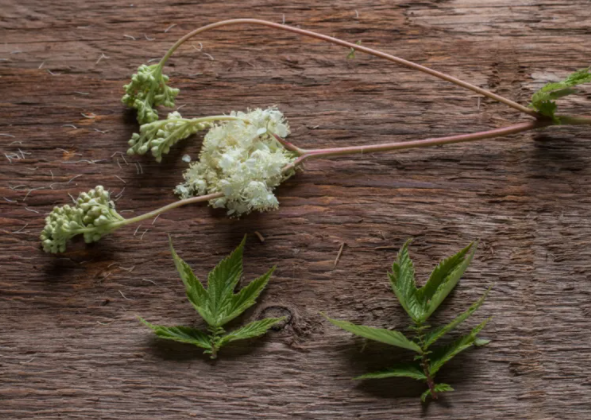
For identification purposes pay attention to the shape of the leaves, the ropey,evenly pink stem, and the shape of the flowers. The long ropey and pinkish red flower stalk void of blotches, long distance between the leaves on the stem, ultra sweet aroma and irregularly shaped flower clusters that aren’t in an umbel shape like wild carrot are dead giveaways. In Northern areas of the United States they can be found along rocky coasts, and tree lines filled with pine and birch. Flowers are harvested the month of July.
Overview
"Meadowsweet was one of the three most sacred herbs used by ancient Celtic Druid priests. It is mentioned in the Knight’s Tale by Geoffrey Chaucer (fourteenth century C.E.), and described in old European herbals, including those of John Gerard (The Herball, 1597) and Nicholas Culpepper (The English Physitian, 1652)."
–Commission E Monograph
Medicinal Parts: the dried flowers, the dried aerial parts of the flowering plant, and the fresh underground and aerial parts of the flowering plant.
Qualities: sweet, bitter, salty, astringent, cool, moist/dry; stimulating, dispersing, astringing, decongesting, dissolving
Properties Analgesic (anodyne), antacid, anti-inflammatory, and stomachic
Tropism: stomach, intestines, gallbladder, liver, kidneys, bladder, joints, connective tissue, skin
Ground: Phlegmatic and Choleric krases; all biotypes and constitutions
Constituents
FLOWER:
Flavonoids; chief components - spiraeoside (quercetin-4'- O- glucosides, 3-4%), further including among other kaempferol-4'- O- glucosides, hyperoside, rutin
Volatile oil (0.2%): chief components salicylaldehyde and methyl salicylate (yielded through dehydration from monotropitin-salicylaldehyde primveroside - and spiracine - salicylic acid ester primveroside), futher, a little vanillin and heliotropine
Tannin; ellagic tannins
Meadowsweet has a higher concentration of salicin than does white willow
Meadowsweet (Filipendula ulmaria) contains a diverse range of phenolic compounds.
These include significant amounts of total phenolic acids, particularly in the aerial parts, and flavonoids. HPLC analysis has also identified spiraeoside in the aerial part extract. Flavonoids such as quercetin, kaempferol, hyperoside, avikulyarin, and ellagic acid have been identified in the leaves of meadowsweet. The flowers and leaves of *F. ulmaria* contain flavonols, with flowers having up to 9.7% and leaves up to 5.7%. Tannins are also present, reaching up to 50.5% in flowers. Water-soluble polysaccharides, including galactans and/or arabinogalactans, with minor amounts of glucans and galacturonans, are found in the flowers. Essential oils from *Filipendula* species, including *F. ulmaria*, contain 19 phenolic and isoprene compounds, with methyl salicylate and salicylaldehyde being dominant.
Effects of the flowers
Flowers have antiphlogistic and astringent effects. The drug, which contains salicylate, has an antimicrobial, antipyretic and diuretic effect. In animal tests the flavonoid fraction had a positive effect on the healing of stomach ulcers and a tone-increasing effect on smooth muscle was observed.
LEAF:
Etheric oil (traces); including salicylic acid easter
Flavonoids; including rutin, hyperoside, quercetin-3- O- glucuronide, quercetin-3- O- arabinoside
Tannins; ellagic tannins
Effects of the leaf
It has an antimicrobial, antipyretic and diuretic effect. In animal tests the flavonoid fraction had a positive effect on the healing of stomach ulcers and a tone-increasing effect on smooth muscle was observed.
Meadowsweet is mucilaginous and soothing, willow bark is harsh and astringent. Meadowsweet can be used for stomach ulcers, willow bark can aggravate them ... that assumes flowers or flowerbuds of meadowsweet with little or no greens, and bark or leaf of willow.
Tissue State Relevance
Filipendula ulmaria (meadowsweet) expresses one of the cleanest and most internally consistent energetic profiles in Western herbalism.
Three dominant pharmacological signatures:
- Strong anti‑inflammatory activity (COX‑1/COX‑2 inhibition) pmc.ncbi.nlm.nih.gov
- Salicylate‑rich volatile fraction (salicylaldehyde up to 70% of the oil) ema.europa.eu
- High flavonoid/tannin content (spiraeoside, miquelianin, rugosin D) with antioxidant and cytokine‑reducing effects pmc.ncbi.nlm.nih.gov
These map directly onto the tissue‑state model.
1. Heat/Excitation → Strongly Indicated
This is meadowsweet’s primary tissue‑state domain.
Why (grounded):
- Inhibits COX‑1 and COX‑2, reducing inflammatory prostaglandins pmc.ncbi.nlm.nih.gov
- Salicylates (salicylaldehyde, glycosides) provide aspirin‑like anti‑inflammatory and analgesic effects ema.europa.eu
- Extracts reduce IL‑1β, IL‑6, MCP‑1 expression in microglia (strong cytokine suppression) pmc.ncbi.nlm.nih.gov
Energetic match:
- Cools hot, irritated mucosa
- Reduces inflammatory excitation
- Eases “hot” GI conditions (gastritis, reflux)
- Calms systemic inflammatory heat
2. Damp/Relaxation → Moderately Indicated
Meadowsweet is astringent (tannins up to 12% in aqueous extracts) and toning.
Why (grounded):
- High hydrolysable tannin content (rugosin D) provides tissue‑tightening, drying, and toning actions ema.europa.eu
- Traditionally used for boggy, irritated GI mucosa (gastric conditions paired with Althaea and Melissa) ema.europa.eu
Energetic match:
- Firms lax, damp GI tissues
- Reduces boggy inflammation
- Supports mucosal integrity
3. Wind/Tension → Mild–Moderate Indication
Not a classic antispasmodic, but its analgesic and anti‑inflammatory actions reduce tension patterns driven by irritation.
Why (grounded):
- In vivo studies show reduction of pain associated with inflammation pmc.ncbi.nlm.nih.gov
- Extracts restore GABA‑A receptor levels in hippocampal tissue (calming effect) pmc.ncbi.nlm.nih.gov
Energetic match:
- Eases tension from inflammatory irritation
- Softens reactive, irritated tissues
4. Dry/Atrophy → Low–Moderate (Context‑Dependent)
Meadowsweet contains mucilage (minor) and flavonoids that protect mucosa, but its tannins can be drying.
Why (grounded):
- Contains mucilage + polyphenols that protect mucosal surfaces ema.europa.eu
- Tannins (up to 12%) can tighten and dry tissues if used excessively ema.europa.eu
Energetic match:
- Helpful for irritated atrophy (hot, inflamed dryness)
- Not ideal for true dry/atrophy without inflammation
5. Cold/Depression → Low
Meadowsweet is not warming and does not stimulate metabolism.
Why (grounded):
- No evidence of circulatory or metabolic activation in EMA monograph or pharmacology reviews ema.europa.eu
- Primarily anti‑inflammatory, not stimulant
Energetic mismatch:
- May worsen cold, underactive digestion if used alone
- Best paired with warming bitters or aromatics
6. Stagnation/Constriction → Low–Moderate
Meadowsweet is not a mover, but its anti‑inflammatory and analgesic actions can relieve constriction caused by irritation.
Why (grounded):
- Reduces inflammatory cytokines and pain, indirectly easing constriction pmc.ncbi.nlm.nih.gov
Energetic match:
- Helps stagnation driven by inflammation
- Not a primary mover for deep GI or hepatic stagnation
Summary Table
| Tissue State | Relevance | Rationale |
|---|---|---|
| Heat/Excitation | High | COX‑1/COX‑2 inhibition; salicylates; cytokine suppression |
| Damp/Relaxation | Moderate | Tannins tighten lax tissues; supports boggy GI mucosa |
| Wind/Tension | Mild–Moderate | Analgesic + anti‑inflammatory; GABA‑A modulation |
| Dry/Atrophy | Low–Moderate | Protective polyphenols but drying tannins |
| Cold/Depression | Low | Not warming or metabolically activating |
| Stagnation/Constriction | Low–Moderate | Reduces inflammation‑driven constriction |
PDF Summary of immune related processes
This 1997 study (attached at the top) examined whether extracts from meadowsweet (Filipendula ulmaria) affect immune and inflammation-related processes in vitro.
Main findings
Researchers tested extracts from the plant’s roots, herb, and flowers using several solvents and evaluated their effects on:
- Complement activation — part of the immune system involved in inflammation
- Reactive oxygen species (ROS) production by human neutrophils
- T-cell proliferation
The extracts generally showed inhibitory activity:
- Complement: Ethyl acetate extracts from the roots and flowers, all methanol extracts, and the aqueous root extract were particularly active against the classical complement pathway.
- ROS production: Nearly all extracts except the light-petroleum fractions reduced ROS-related chemiluminescence in stimulated neutrophils.
- T-cell proliferation: The diethyl-ether root extract was the most potent inhibitor.
- Most notable fraction: Flower ethyl-acetate extract retained complement-inhibiting activity even after treatment designed to remove tannins, suggesting that compounds other than tannins were responsible.
Possible active constituents
The authors discuss several candidate compounds:
- Tannins may account for some of the complement-inhibitory effects, although they can also nonspecifically bind proteins and interfere with laboratory assays.
- Flavonoids, including compounds related to quercetin and rutin, may contribute to the suppression of ROS production and T-cell proliferation.
- Salicylates are traditionally credited with meadowsweet’s anti-inflammatory effects, but the authors note that they occur only in very small amounts and are unlikely to explain all of the activity.
Conclusion and limitations
The findings provide a possible biochemical explanation for meadowsweet’s traditional use in inflammatory conditions such as gout and rheumatoid arthritis. However, the work was conducted only in isolated laboratory systems—not in animals or humans. The study does not establish clinical effectiveness, dosage, or safety. Further research was needed to isolate the active compounds and confirm whether the effects occur in living organisms.
TCM & Western Herbel Uses
Approved by Commission E:
Flower:
- Cough
- Bronchitis
- Fever and cold
Leaf:
- Cough
- Bronchitis
Meadowsweet is used as supportive therapy for colds, for febrile colds and as a diuretic.
In folk medicine, the flowers are used as a diuretic, for rheumatism of the joints and muscles, for gout, for bladder and kidney disease and for headaches. Meadowsweet herb is used for stomach complaints with hyperacidity, prophylaxis, therapy of stomach ulcers, and for diarrhea in children.
It contains silicin, a compound similar to aspirin, but without the negative side-effects. It is useful for reducing pain and inflammation but it takes about 6-8 hours to start acting. It settles the stomach and acts as a natural antacid. It also contains silica, which aids the skin, joints, and connective tissue.
Homeopathic: Used for rheumatism and inflammation of mucous membranes
One study showed F. ulmaria extracts inhibit complement activation and T-cell proliferation, and interfere with ROS or ROS production by PMNs in vitro which may explain the effective use of F. ulmaria preparations in inflammatory diseases. Strong anticomplementary activities of root, herb, and flower extracts of F. ulmaria were found towards the classical pathway of the complement system. The EA extracts of the roots and flowers, all MeOH extracts, and the AQ extract of the roots were found to be most effective (IC50<15 mg/mL).
"The Iroquois used the mashed and powdered dried root as part of a compound decoction with yarrow for side pain, and nausea."
–Robert Dale Rogers
1. STIMULATES CIRCULATION, DISPELS WIND/DAMP/COLD AND RELIEVES JOINT, MUSCLE, AND NERVE PAIN; PROMOTES SWEATING, REDUCES FEVER AND PROMOTES ERUPTIONS
wind/damp/cold/heat obstruction; joint or muscle pain, redness, swelling
ARTHRITIS (acute and chronic)
HEADACHE, NEURALGIA (esp. trigeminal)
external wind heat; aches and pains, headache, swollen eyes, fever
Meadowsweet is especially suited to headaches in which the person has a hot head and feels a pounding sensation in the head. Meadowsweet is cooling and it promotes circulation, which can relieve stagnant energy in the head.
COLD ONSET
ERUPTIVE FEVER (measles, chickenpox)
2. PROMOTES URINATION, RESOLVES TOXICOSIS AND DRAINS FLUID CONGESTION; DRAINS PLETHORA AND DISSOLVES DEPOSITS
metabolic toxicosis; fetid stools, skin rashes, malaise, tiredness
ARTHRITIS, rheumatism, gout, uric acid diathesis
kidney and liver fluid congestion: general edema, thirst but no desire to drink, fatigue, malaise
EDEMA
general plethora; overweight, hypertension, cellulite
DEPOSITORY DIATHESIS with arteriosclerosis, urinary stones
3. CLEARS TOXIC HEAT AND REDUCES INFLAMMATION AND INFECTION
fire toxin; boils, carbuncles and other pyoderma
INFLAMMATION OF eyes, gums, skin, nerves, muscles, joints, urinary and biliary tract
stomach heat: thirst, ravenous hunger, mouth ulcers, swollen painful gums
GASTRIC HYPERACIDITY (acid dyspepsia)
bladder damp heat: painful urgent passing of stool, or with painful dark urination
CELLULITIS, erysipelas
4. PROMOTES ASTRICTION, DRIES DAMP AND STOPS DISCHARGE AND BLEEDING; PROMOTES TISSUE REPAIR
CLEARS DISCHARGES (incl. mucoid diarrhea, leucorrhea)
CONNECTIVE TISSUE WEAKNESS
HEMORRHAGE (from nose or mouth, in stool and urine, from uterus)
CHRONIC ULCERS, wounds, sores, cuts, punctures
HARD CALLOUSES and CORNS
Meadowsweet is considered by some herbalists to be a normalizer of the acidity of the stomach (Roberts F. Modern Herbalism for Digestive Disorders. Northamptonshire: Thomsons; 1981). It does appear to decrease the negative effects of acid and pepsin on the mucosa, but is probably not a potent antacid. This positive effect on the mucosa is paradoxical since it contains salicylates.
Meadowsweet shines as an herb for stomach aches, nausea and poor digestion and is especially helpful for those who find herbs like ginger to be too warming. Meadowsweet removes stagnation (like when you eat a meal and it stays in your stomach too long) and relieves discomfort in the stomach.
"If someone asks you what to do for reflux but isn’t going to come in and do a consult or listen to a lengthy exposition on the nuance of gastric tissues and processes I say, 'You could try meadowsweet and see if that helps.'"
–jim mcdonald
Potential Biological Activities of Meadowsweet Extracts
Meadowsweet extracts have shown various biological activities, which are often attributed to their rich phytochemical content.
- Antioxidant Activity: Extracts of *Filipendula ulmaria* demonstrate high antioxidant activities, particularly the root extract, and are effective against lipid oxidation. They also exhibit significant antioxidant activity when compared to other plants like *Agrimonia eupatoria L.*. Phenolic extracts from meadowsweet flowers also possess antioxidative properties.
- Antimicrobial and Antifungal Activity: Methanolic extracts from *Filipendula ulmaria* have shown interesting antimicrobial effects against bacteria such as *E. coli* and *E. faecalis*, and fungi like *P. cyclopium* and *F. oxysporum*. Meadowsweet flower extracts also exhibit antifungal activity against *Rhizopus arrhizus* in red peppers.
- Anti-inflammatory Effects: Traditionally, *Filipendula ulmaria* is used for the treatment of inflammatory diseases.
- Antiproliferative and Apoptotic Activity: Pollen extracts from *Filipendula ulmaria* have demonstrated promising antiproliferative and apoptotic effects on C26 mice colon tumor cells, suggesting potential as an antitumor agent.
- Enzyme Inhibition: Meadowsweet teas have shown a good ability to inhibit amylase, α-glucosidase, and advanced glycation end-product (AGE) formation.
- Immune-modulating Properties: The water-soluble polysaccharide fraction of meadowsweet teas suggests possible immune-modulating properties.