Myopia (Nearsightedness)
Return to Eye/Vision Menu
Videos

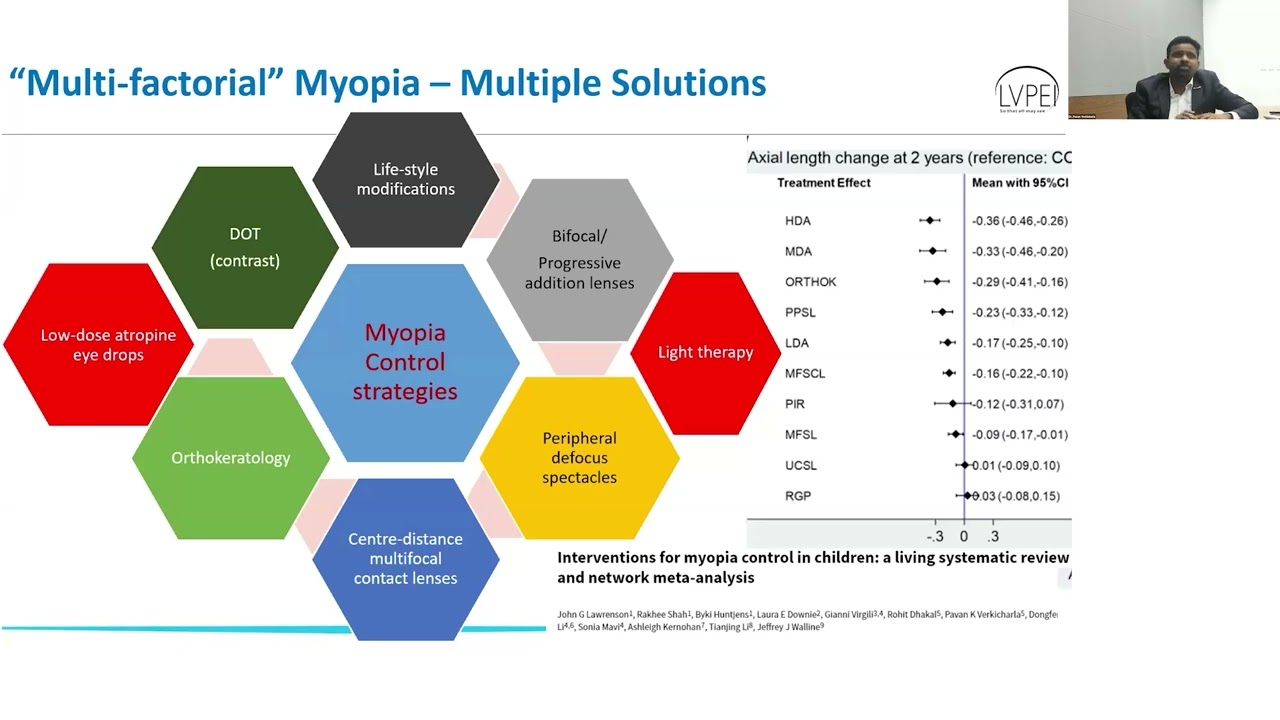
Evidence-based Myopia Control
Myopia- a public health issue!
Myopia in Children
Current Understanding of Myopia Among Pediatric Populations: Treatment Options in 2023
Myopia, Are We Short-Sighted in Our Approach?
Myopia, commonly known as nearsightedness, is a prevalent vision condition where individuals can see objects that are close to them clearly, but objects farther away appear blurry. This refractive error occurs when the eye's shape causes light rays to bend (refract) incorrectly, focusing images in front of the retina instead of directly on it.
Causes of Myopia
The exact cause of myopia is not entirely understood, but it is believed to be a combination of genetic and environmental factors. Some of the primary causes include:
- Genetics: Myopia tends to run in families. If one or both parents are nearsighted, there is a higher chance that their children will also develop the condition.
- Environmental Factors: Prolonged close-up tasks, such as reading or using digital devices, especially in poor lighting, can contribute to the development of myopia.
- Eye Structure: Myopia can occur if the eyeball is too long or the cornea is too curved, causing light to focus in front of the retina.
Symptoms of Myopia
The symptoms of myopia can vary in severity and may include:
- Blurry vision when looking at distant objects
- The need to squint or partially close the eyelids to see clearly
- Headaches caused by eyestrain
- Difficulty seeing while driving, especially at night (night myopia)
Diagnosis of Myopia
Myopia is typically diagnosed through a comprehensive eye examination, which may include:
- Visual Acuity Test: This test measures how well you see at various distances.
- Retinoscopy: The eye doctor shines a light into your eye and observes the reflection off the retina to determine the refractive error.
- Refraction Test: This test uses a phoropter to measure the exact prescription needed to correct vision.
Treatment Options for Myopia
There are several treatment options available for managing myopia, including:
- Eyeglasses: The most common and simplest way to correct myopia. Lenses are prescribed to help focus light correctly on the retina.
- Contact Lenses: These offer a wider field of vision and are a popular alternative to glasses.
- Refractive Surgery: Procedures like LASIK or PRK can reshape the cornea, providing a more permanent solution to myopia.
- Orthokeratology: Specially designed contact lenses are worn overnight to temporarily reshape the cornea.
Managing Myopia
While myopia cannot be completely prevented, certain lifestyle changes and practices can help manage its progression:
- Regular Eye Exams: Routine check-ups can help detect changes in vision early and adjust prescriptions as needed.
- Limit Screen Time: Reducing the amount of time spent on digital devices can help alleviate eye strain.
- Proper Lighting: Ensure adequate lighting when reading or working on close-up tasks.
- Outdoor Activities: Spending time outdoors has been shown to slow the progression of myopia in children.
Complications Associated with Myopia
If left untreated, myopia can lead to several complications, including:
- Retinal Detachment: The risk of retinal detachment increases with the severity of myopia.
- Glaucoma: Myopic individuals are at a higher risk of developing glaucoma.
- Cataracts: There is an increased likelihood of cataract development in those with high myopia.
Articles/Studies
Vitamin D and Its Pathway Genes in Myopia: Systematic Review and Meta-Analysis
Effective Home Remedies for Myopia
The Childhood Myopia Epidemic: Screen Time to Blame; Red Light To the Rescue
Low-level red light effectively controlled myopia progression at 0.37 mW, 0.60 mW, and 1.20 mW.
Fallopia Japonica and Prunella vulgaris inhibit myopia progression.
Ginkgo biloba extracts improve choroidal circulation leading to suppression of myopia in mice.
Repeated low-level red-light therapy was a novel and effective intervention for myopia prevention.
Repeated low-level red light therapy for the control of myopia in children.
The repeated irradiation of 650 nm LLRL may have a strong effect for myopia prevention in children.
Low-intensity red-light is an effective measure for preventing and controlling myopia.