Glycolysis
Return to Cellular Biology Menu
Videos

What Shuts Down Glycolysis? Too Much Energy
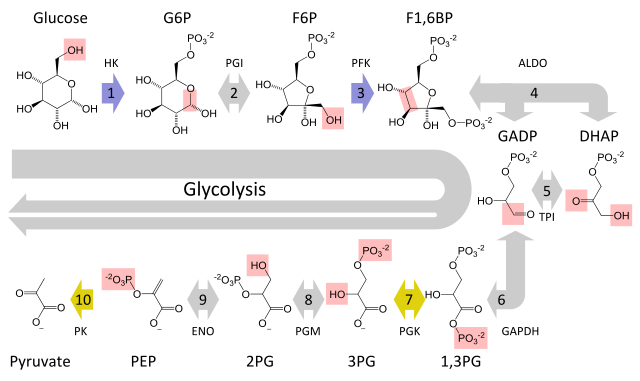
The metabolic pathway of glycolysis converts glucose to pyruvate
Use of glucose as an energy source in cells is by either aerobic respiration, anaerobic respiration, or fermentation. All of these processes follow from an earlier metabolic pathway known as glycolysis. The first step of glycolysis is the phosphorylation of glucose by a hexokinase to form glucose 6-phosphate. The main reason for the immediate phosphorylation of glucose is to prevent its diffusion out of the cell as the charged phosphate group prevents glucose 6-phosphate from easily crossing the cell membrane. Furthermore, addition of the high-energy phosphate group activates glucose for subsequent breakdown in later steps of glycolysis. At physiological conditions this initial reaction is irreversible.
In anaerobic respiration, one glucose molecule produces a net gain of two ATP molecules (four ATP molecules are produced during glycolysis but two are required by enzymes used during the process). In aerobic respiration, a molecule of glucose is much more profitable in that a maximum net production of 30 or 32 ATP molecules (depending on the organism) is generated.
Given the resources, cells can make ATP much faster using glycolysis than by using mitochondrial OxPhos.
Glycolysis produces reactive oxygen species.
Tumor cells are different from healthy cells in the sense that they are dependent on aerobic glycolysis to produce energy even if there is sufficient oxygen in the surroundings This switching of the cell from the normal respiratory pathway to aerobic glycolysis is known as the Warburg effect
Bloodroot inhibits glycolysis in saliva
Articles/Studies
- Methylglyoxal, the dark side of glycolysis
- EGCG** activated AMPK and insulin pathways, thereby promoting glycolysis, glycogen, and protein synthesis and inhibiting fatty acid and cholesterol synthesis.
- CTRP1 protects against diet-induced hyperglycemia by enhancing glycolysis and fatty acid oxidation