Th2
Return to Lymphatic System Menu
Return to Immune System Menu
Th2 (T-cell Helper type 2) induce humoral immunity and are Effector Cells
Th2 helper cells are the host immunity effectors against extracellular parasites. TH2-lymphocytes are primarily made in response to helminths (worms), allergens, and extracellular microbes and toxins. The TH2-type cytokines include interleukins 4, 5, and 13, which are associated with the promotion of IgE (severe allergies) and eosinophils response, and also interleukin-10, which has more of an anti-inflammatory response. In excess, TH2 responses will counteract the TH1 mediated microbial killing action. The optimal scenario would therefore seem to be that we should produce a well-balanced Th1 and Th2 response, suited to the immune challenge
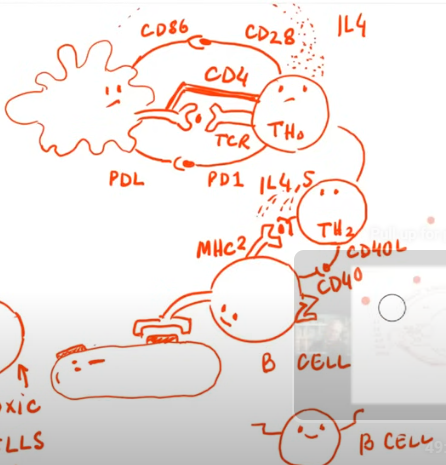
TH2 will bind with a B-cell in the lymph node where there are many B-cells. Some of the B-cells are bound to the pathogen that had floated from an infected site to a lymph node. There may be multiple B-cells bound to the same pathogen. (see below) . This B-cell will phagocytose it. B-cells are professional antigen presenting cells in addition to making antibody cells. They pick up the pathogen and eat it just like macrophages and dendritic cells, then present it on their MHC2 to bind with TH2. . They present it for their own activation. The TH2 is connected with MHC2 as well as the CD40 and CD40 Ligand (connects to both TH2 and the B-cell) ... called co-stimulation and formation of the synapse between these cells. Now the TH2 cell is ready to release various cytokines such as IL4, IL5, IL10. Especially IL4 and IL5 are responsible for that B-cell to become activated, triggering the cell to proliferate
Those with TH-1 dominance creating symptomatology usually feel better with coffee or caffeine. But feel worse with immune stimulators– Echinacea, goldenseal, immune-boosting mushrooms or probiotics. TH-2 dominance creating symptomatology are the opposite. They will feel better with immune stimulators – Echinacea, goldenseal, immune-boosting mushrooms or probiotics and feel worse with coffee or caffeine.
They are triggered by IL-4 and their effector cytokines are IL-4, IL-5, IL-9, IL-10 and IL-13. The main effector cells are eosinophils, basophils, and mast cells as well as B cells, and IL-4/IL-5 CD4 T cells. The key Th2 transcription factors are STAT6 and GATA3. IL-4 is the positive feedback cytokine for Th2 cells differentiation. Besides, IL-4 stimulates B-cells to produce IgE antibodies, which in turn stimulate mast cells to release histamine, serotonin, and leukotriene to cause broncho-constriction, intestinal peristalsis, gastric fluid acidification to expel helminths. IL-5 from CD4 T cells will activate eosinophils to attack helminths. IL-10 suppresses Th1 cells differentiation and function of dendritic cells. Th2 overactivation against autoantigen will cause Type1 IgE-mediated allergy and hypersensitivity. Allergic rhinitis, atopic dermatitis, and asthma belong to this category of autoimmunity. In addition to expressing different cytokines, Th2 cells also differ from Th1 cells in their cell surface glycans (oligosaccharides), which makes them less susceptible to some inducers of cell death
FACTORS THAT INCREASE Th2 CYTOKINES
The three most common factors that drive Th2 cytokine responses are:
- Faulty digestion leading to absorption of partially digested and unusable proteins and other food particles (increases IgG and IgE antibody responses that are directed against these foreign food particles).This is the condition called leaky gut due to increased intestinal permeability.Instead of the intestines serving as a barrier to the outside world, it allows an excessive amount of particles to be presented to the body through a non-physiologic entryway.Just as if you entered a home with a security system through a window, the alarm is triggered and you are alerted to a foreign invader.The result is a recruitment of police and other protective mechanisms, in the case of the food this represents the immune system.Proper digestion, a balance of friendly supportive bacteria, and a healthy gastrointestinal lining create a strong barrier to improper entry.Likewise, use of digestive enzymes, eating slowly mixing lots of saliva with food, avoiding over-eating or processed foods that are difficult to digest, anti-microbial therapy, etc. are necessary components to establishing immune balance.To emphasize the importance of proper digestion is the fact that the largest immune organ in the body is the gastrointestinal tract!
- White sugar and glucose and all processed foods containing these (Coke, canned soda, candy bars, cake, pie, sweet rolls etc.) - directly weakens the functioning of macrophages, natural killer cells and other white blood cells and weakens systemic resistance to all infections.This statement is not just politically correct but has been documented in several scientific studies.The effects last for up to six hours, which means if you consume this at every meal, you are basically immune -suppressed all of the time.It may also explain that in an otherwise nutritionally repleted individual, fasting extends lifespan…
- Consuming trans-fatty acids found in almost all heated and processed vegetable oils (soy, canola, safflower, corn and sunflower) and food products made with them (i.e. French fries, potato chips, almost any crunchy snack) stimulate IL-6 and depress delayed type hypersensitivity (DTH) thus weakening CD8 Killer-T cell activity. The trans-fatty acids are twisted out of their normal “cis” shape and produce cell membranes that are porous and vulnerable to viral infections.In his book Fats that Heal and Fats that Kill, Udo Erasmus states: “Besides producing atherosclerosis in the arteries of animals, fried and deep fried (vegetable) oils can also impair cell respiration and other cell functions, inhibit immune functions, and lead to cancer.”
Among the most problematic hydrogenated vegetable oils are in margarine and shortening due to their high content of trans-fatty acids.Soybean oil, safflower, corn, sunflower, canola and most other vegetable oils should also be avoided by persons with chronic illness who have a predominant TH2 cytokine profile (too much Il-6, Il-10, TNF and triglycerides). It is nearly impossible to find vegetable oils that are strictly cold processed. Except for expeller pressed oils, nearly all other vegetables are processed with solvents, hexane or gasoline, to remove the oils from the seeds. The oil and hexane/gasoline mixture is then heated to 302 degrees F. to remove the hexane or heptane (gasoline) (1). At this point, the oils are now toxic for human use as they are twisted out of their natural “cis” shape and become trans-fatty acids. Add heat, light and oxygen to oils and the lipid peroxides increase and they become rancid and develop a strong taste. The safest and freshest oils to buy are cold pressed (best choice) or expeller that are stored in a can or black bottle to keep out light.It is even better if Vitamin E or BHT is added as an antioxidant to prevent lipid peroxide formation.
Other factors that stimulate a Th2 response include a strain of bacteria, Streptococcus thermophilus, which is widely used in the making of commercial yogurt.Marin ML et al from Michigan State University found that streptococcus thermophilus significantly increased IL-6 production in macrophage lines. They also found that lactobacillus bulgaris and B. bifidum also increased IL-6, although less than S. thermophilus. (J Food Prot 1998 Jul;61(7):859-64). Most commercial yogurt have to add acidophilus and many also have S. thermophilus, which is not shown on the label.Perhaps eating yogurt may not be a good idea after all even though research shows that acidophilus inhibits tumor growth in laboratory animals (Nutr Cancer 1997;28(2):130-4).If the yogurt contains more thermophilus than acidophilus, Th2 cytokine response may dominate over the beneficial Th1 cytokines.
Toxins such as asbestos lead, mercury and other heavy metals, pesticides, air and water pollutants imbalance the immune system towards Th-2dominance.
Hormones such as progesterone (pregnancy is a state of elevated progesterone.A Th2 cytokine predominant profile is needed. A strong Th1 cytokine profile including TNF can cause an abortion because the immune system would reject the fetus…), prednisone (cortisol), possibly melatonin (conflicting research suggests that high levels induce Th2 cytokines while very small amounts induce Th1 cytokines), some anabolic steroids for muscle gain are hard on the liver and adrenals and suppress Th1 cytokines.
Medications such as morphine, tobacco, Thalidomide
Alcohol - Note: Studies on animals show that ethanol (alcohol) definitely suppresses Th1 cytokines and induces Th2. However, beer was not tested.
Infections HIV, candida albicans, HCV, E coli and many other pathogens.
Miscellaneous: Stress (continuous), UVB, sedentary life - lack of exercise - leads to a build up of toxins that weakens CMI, lack of water leads to toxic overload and depressed CMI, negative attitudes such as suppressed anger/rage, inability to forgive, resentfulness, holding grudges, etc. all stresses the adrenal glands and increases cortisol levels leading to adrenal exhaustion... Low body temperature, acid saliva pH, chronic insomnia, weight lifting - muscle tearing increases cortisol levels.Source
European Mistletoe preparations induce T-helper 2 immune response, as evidenced by significant eosinophilia during treatment in patients with chronic hepatitis C .
Vagal activities are involved in antigen-specific immune inflammation in the intestine The intestinal vagus nerve in mice expresses a high-affinity IgE receptor. An antigen-specific immune response can activate the vagus nerve in the intestine and induces the release of transmitters to modulate dendritic cell phenotypes that facilitate the development of skewed Th2 polarization in the intestine.
*Boswellia carterii* Extract Inhibits TH1 Cytokines and Promotes TH2 Cytokines In Vitro