Royal Jelly
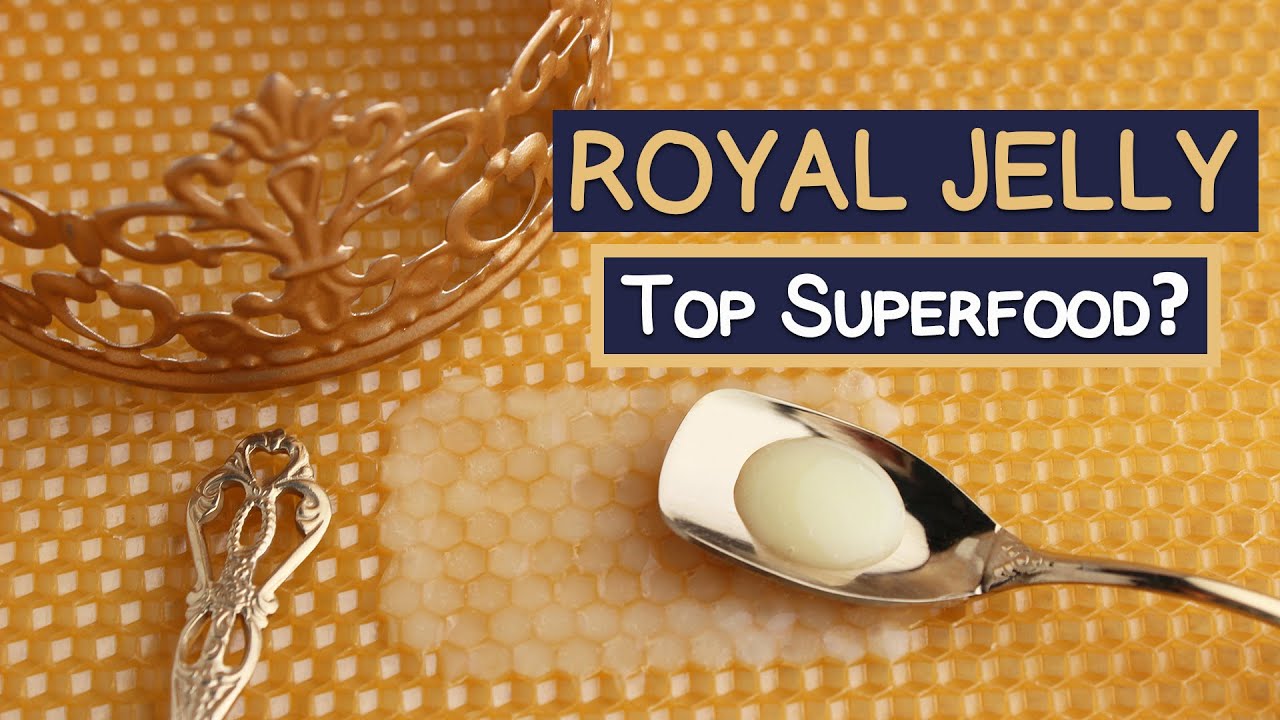
Royal jelly is a honey bee secretion that is used in the nutrition of larvae, as well as adult queens. It is secreted from the glands in the hypopharynx of worker bees, and fed to all larvae in the colony, regardless of sex or caste.
When worker bees decide to make a new queen, because the old one is either weakening or dead, they choose several small larvae and feed them with copious amounts of royal jelly in specially constructed queen cells. This type of feeding triggers the development of queen morphology, including the fully developed ovaries needed to lay eggs.
Royal jelly has long been sold as both a dietary supplement and alternative medicine. Both the European Food Safety Authority and United States Food and Drug Administration have concluded that the current evidence does not support the claim of health benefits, and have actively discouraged the sale and consumption of the jelly. In the United States, the Food and Drug Administration has taken legal action against companies that have used unfounded claims of health benefits to market royal jelly products. There have also been documented cases of allergic reactions, namely hives, asthma, and anaphylaxis, due to consumption of royal jelly.
Developing queen larvae surrounded by royal jelly: 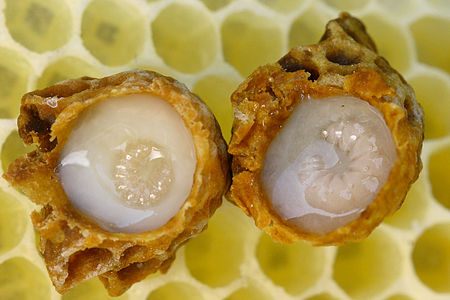
Uses
Menopausal symptoms
In one uncontrolled prospective study, royal jelly improved symptoms in postmenopausal women.
Osteoporosis
Royal jelly improved bone health in laboratory and animal studies.
Cholesterol management
Some research evidence supports its use for high cholesterol levels.
Male infertility
One study suggests its use for male infertility, but more large-scale clinical trials are needed to confirm this effect.
Diabetes
A few studies suggest it may improve some type 2 diabetes markers in both men and women. Confirmatory studies are needed.
Mucositis
In patients receiving radiotherapy and chemotherapy, royal jelly along with standard mouthwash therapy improved symptoms of oral mucositis and healing time. Confirmatory studies are needed.
Clinical Summary
Royal jelly is a viscous substance secreted by worker bees and constitutes the essential food for queen bees and their larvae. It is consumed as a health food around the world. It demonstrated vasodilatory, hypotensive, antihypercholesterolemic, antitumor, anti-inflammatory, and estrogenic effects , although its affinity for estrogen receptors is weaker compared with diethylstilbestrol . Animal studies indicate that oral administration of royal jelly may be effective against colitis and improve testosterone levels .
Clinical studies have demonstrated that royal jelly lowered total serum lipid levels and total serum cholesterol in individuals with moderately elevated cholesterol levels , and improved erythropoiesis, glucose tolerance and mental health in healthy subjects . Royal jelly also improved type 2 diabetes markers in both men and women , but was not found to be effective in healing diabetic foot ulcers.
Mid-cycle pericoital intravaginal applications of a combination of Egyptian bee honey and royal jelly improved infertility due to idiopathic asthenozoospermia . Royal jelly also improved premenstrual and menopausal symptoms . In a combination supplement, it appeared to benefit patients with mild cognitive impairment . In human glioblastoma multiforme cells, royal jelly increased the cytotoxic activity of temozolomide . It also inhibited growth-promoting effects from the environmental estrogen bisphenol A (BPA) on human breast cancer MCF-7 cells in vitro, but did not have this inhibiting effect in the absence of BPA . However, royal jelly was also shown to stimulate MCF-7 cell proliferation which was reversed by tamoxifen . In patients receiving radiotherapy and chemotherapy, royal jelly along with standard mouthwash therapy improved symptoms of oral mucositis and healing time . Another study with a very small sample size also suggests benefit with topical royal jelly in head and neck cancer patients .
Because royal jelly has estrogenic effects, women with estrogen receptor positive breast cancer should avoid this product. Prostate cancer patients should also use caution as royal jelly increased testosterone levels in animal
studies.
Mechanism of Action
Royal jelly stimulated the production of type 1 collagen and other bone formation activities through its action on osteoblasts . In animal models, antiinflammatory effects with royal jelly were likely mediated by CD3-, CD5-, CD8- and CD45-positive T-cell immune responses . Protective effects against taxol-induced testicular damage were attributed to improved antioxidant status and E2f1 transcription factor upregulation .
Various mechanisms for cholesterol-lowering effects have been posited . Royal jelly may decrease reabsorption of cholesterol in the GI tract and increase its excretion in the bile due to the presence of phytosterols, mainly B-sitosterol.
Another explanation offered is that royal jelly suppresses hepatic cholesterol synthesis.
Effects against oxidative stress are attributed to antioxidant peptides . Improved glucose tolerance and erythropoiesis occur from accelerated conversion of DHEA-S to testosterone via activation of 3β-HSD2 and/or 17β-HSD3 . In type 2 diabetic women, royal jelly supplementation reduced hemoglobin A1c and fasting blood glucose levels, increased insulin concentrations, and decreased oxidative stress via improvement of malondialdehyde levels, erythrocyte superoxide dismutase, and glutathione peroxidase activities .
Compounds identified in royal jelly exhibit weak estrogenic activity, but also inhibit binding of estradiol to estrogen receptor beta.