Wild Ginger Root
See also: Asarum (genus)
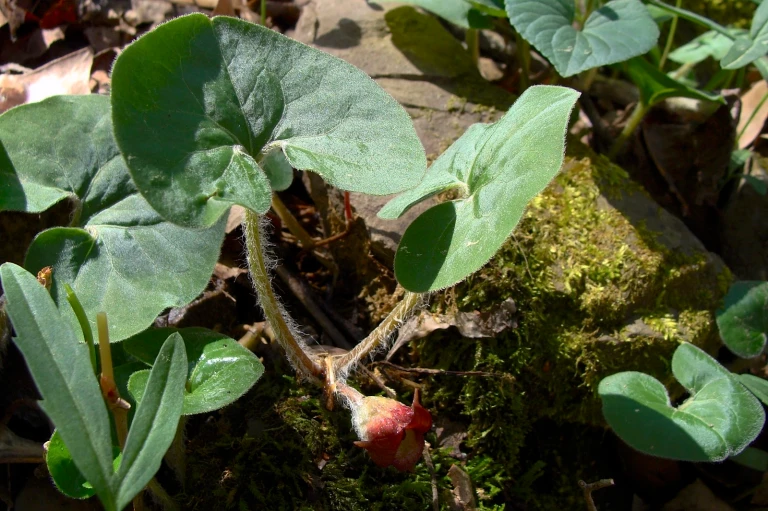


Population growth and viability analyses of the clonal woodland herb, *Asarum canadense*
Constituents
Essential oil 3-4% (incl. asarone 20-30%, eugenol, methyleugenol, asarol, awarene, ketone asaryl), resin, alkaloid, acids, glycosides, mucilage, sugar, tannin, camphoraceaus substance, B-sitosterin
- Listing in Duke's Phytochemical Database
- Constituents of the rhizome of *asarum canadense*
- Composition of the essential oil from Asarum canadense
- Antibacterial Substances from Asarum canadense. I. Isolation, Physical Properties and Antibacterial Action
- Determination of aristolochic acid I and II in North American species of Asarum and Aristolochia.
- Chalcone and flavonol glycosides from *Asarum canadense* (Aristolochiaceae)
Qualities: pungent, a bit bitter, hot, very dry, stimulating, dispersing, relaxing, restoring, decongesting
Tropism:uterus, head, arterial circulation, lungs, stomach, intestines, liver
Ground: Phlegmatic krasis
Dependent / Tai Yin Earth and Self-Reliant/Yang Ming metal biotypes
Mixed/Phosphoric/Grey-Green Iris constitution
Uses
Native American Uses:
CHEROKEE-swollen breast-The whole plants of Asarum canense and Camptosorus rhizoplzyllus, mixed with the roots and leaves of Collinsonia canadensis, are made into an infusion which is applied to the swollen breast. This infusion is also drunk as an emetic which is believed to relieve the swelling.
CHEROKEE-abdominal pain-The plant is made into an herb decoction with Hepatica acutiloba and Epigaea repens. This is boiled down to a thick syrup and is drunk to cause vomiting as a cure for a pain in the stomach.
It has an aromatic, slightly bitter taste and is said to become nauseous in large doses.
Promotes sweating, dispels wind cold, opens the sinuses and promotes eruptions; reduces allergy and relieves pain
lung wind cold; body aches, headache, suppressed discharge, sinus pain, frontal headache - SINUSITIS WITH PAIN
ALLERGIES (immediate, incl. rhinitis, atopic asthma; antibody-mediated hypersensitivities)
IMMUNE COMPLEX DISORDERS (incl. bronchial asthma, rheumatoid arthritis, food allergies)
ERUPTIVE FEVERS (incl. measles, chickenpox)
cold damp obstruction: acute muscle or joint aches, joint swelling and numbness - NEURALGIA, rheumatism, fibromyalgia, arthritis, toothache
2. Promotes Expectoration, resolves phlegm cold and relieves coughing
lung phlegm cold: productive coughing with expectoration of white sputum, tight chest, wheezing - CHRONIC BRONCHITIS
3. PROMOTES MENSTRUATION, CLEARS STAGNATION AND RELIEVES AMENORRHEA: PROMOTES LABOR AND EXPELS THE AFTERBIRTH; INCREASES ESTROGEN
uterus cold: delayed painful menstruation, stopped menses, chills
AMENORRHEA, SPASMODIC DYSMENORRHEA
ESTROGEN DEFICIENCY conditions
DIFFICULT, PAINFUL LABOR with nervous tension or depression
FAILURE TO PROGRESS during LABOR (uterine dystocia)
RETAINED PLACENTA
4. CIRCULATES THE QI, RELEASES CONSTRAINT AND RELIEVES COUGHING AND PAIN
lung Qi constraint: spasmodic coughing, tight painful chest, wheezing
ASTHMA, WHOOPING COUGH
intestines Qi constraint; abdominal pain, indigestion, appetite loss
INTESTINAL COLIC, SPASMODIC IBS
5. STIMULATES DIGESTION AND APPETITE, AND WARMS THE MIDDLE; PROMOTES URINATION, DRAINS FLUID CONGESTION AND RELIEVES EDEMA
stomach and intestines damp cold (Spleen damp): appetite loss, irregular bowel movement, cold limbs
liver cold stagnation with fluid congestion; jaundice, nausea, constipation, swelling, fatigue
BILIARY and GASTROINTESTINAL DYSPEPSIA, microbial toxicosis
The Physiomedical Dispensatory by William Cook, M.D., 1869
Indigenous to America, growing in moist woods and shady places. The root is strongly aromatic, with a warming and slightly bitter taste; pleasant to most persons, but disagreeable and nauseating to some. It yields a small quantity of a fragrant essential oil; and a resinous material that is slightly terebinthinate in smell. Alcohol eliminates all. its active powers, and water nearly all of them. Boiling injures it.
Properties and Uses: This root is one of the positive aromatics, stimulating and relaxing, rather prompt in diffusiveness, and somewhat tonic. Its influence is expended largely through the circulation and nerves, both of which it arouses and sustains. Through these channels it warms and invigorates the surface, and secures a favorable perspiration. in languid conditions; but this soon subsides, and is followed by an increased warmth of the skin and a little dryness. These facts make it objectionable in all cases where the skin is already dry and hot; and it should not be used indiscriminately as a diaphoretic. It is best for recent colds, and such functional suppressions as follow colds; for scarlet fever, small-pox, typhoid fever and pneumonia, when the languor is considerable; and for suppressed menstruation. It exerts a direct influence upon the uterus, which is of value in suppressions of an atonic and congested character; and as a promptly stimulating parturient, when the pains become feeble from nervous fatigue, it probably has few superiors. For such purposes, I frequently combine it with the more permanent caulophyllum. S.B. Dodd, M..D. of Ohio, informs me that he uses an infusion of it, in small and frequent doses, for all uterine hemorrhages of a passive character, (including menorrhagia,) with the happiest results–securing very prompt uterine contraction and a warm surface. It stimulates the pulmonary vessels, and increases expectoration; for which purposes it may be used in old or languid coughs. Also good in colic and painful menstruation. Large draughts of it will soon nauseate; and their close repetition will usually incite vomiting of the stimulating character–emptying the stomach, and leaving the skin warm and dry. It may be combined with tonics, or used alone in cold infusion, for excessive and cold perspiration. It is not suitable in cases of acute sensitiveness of the stomach, bowels, or uterus, nor in any active inflammation. The powder is a good stimulating snuff in catarrh; and it stimulates the contraction of small blood vessels in a favorable manner, when applied locally in hemorrhages. Dose, five to fifteen grains of the powder.
Pharmaceutical Preparations: I. Infusion. Although water does not obtain all its virtues, the warm infusion is the favorite mode of employing it. Two drachms of the powder to a pint of boiling water; macerated in a close vessel for half an hour; given in doses of from one to four tablespoonfuls every thirty minutes or oftener. II. Tincture. An ounce of the root to a pint of 50 percent alcohol; used in doses of half a drachm to a drachm, every hour or two. It is an ingredient in the Compound Tincture of Lobelia.. It is many times added in small portions to tonic expectorant and tonic-emmenagogue preparations. The Asarum Europaeum, or asarabacca, is similar to the above; but is much more prompt as an emetic, and not unfrequently induces catharsis. A warm infusion has been used in neuralgia and
rheumatism. A drachm will usually induce vomiting.
Physio-Medical Therapeutics, Materia Medica and Pharmacy BY T. J. LYLE, A.M.M. 1897
The root is a mild, aromatic, diffusive stimulant. It is somewhat less stimulating than zingiber, and is more soothing to the nerves, and they about equally influence the circulation when given in hot infusion. It gives very favourable results in eruptive diseases, in colds, coughs, suppressed menstruation from colds, and in dysmenorrhoea. Large doses may in the sensitive stomach create nausea and emesis, which in chronic coughs and gastric catarrh, when the mucous membrane needs to be aroused, is valuable, and it increases expectoration. In irritated or inflamed conditions of the mucous membrane, other agents are to be preferred. In parturition it is valuable when the surface is cold, and in all languid conditions of the mucous membrane. In insomnia it gives excellent results