Bernard Glazer
BERNARD “BENNY” GLAZER
(1913–1984)
A truly remarkable story of a great man who laid the foundations for an international empire
At a glance
Lithuanian‑born Jewish entrepreneur who became a central, if largely invisible, architect of mineral and real‑estate power in southern Africa, using mineral rights, property structures and offshore networks to build – and ultimately to lose control of – an empire that now sits at the heart of the Blue File investigation.
1. Origins and character
- Born 1913 in Lithuania, emigrated to South Africa in 1930 at age 17.
- Part of the wider wave of Lithuanian Jewish immigration that profoundly shaped South African commercial life.
- Worked closely with his brother Samuel Lieb Glazer, with whom he built a complex lattice of mining, mineral‑rights and property interests.
- Within family and Blue File material, remembered as visionary, intensely private, and operational rather than ideological – focused on building infrastructure and financial structures rather than on public politics.
2. African pioneer & mineral‑rights strategist
Drawing on [[thought:b04ccc8e-28f1-5ae7-9aac-fd825610b61c|A BRIEF HISTORY OF BERNARD GLAZER]]:
- Emerged as a major player through acquisitions in the 1950s, notably:
- Bechuanaland Exploration Company Ltd (BEC) – a former Cecil John Rhodes vehicle tied into the British South Africa Company (BSAC) concession system.
- Tati Company Ltd and the Tati Concessions, covering ~1.3 million acres with far‑reaching mineral rights in Bechuanaland/Botswana, Northern & Southern Rhodesia (Zambia & Zimbabwe).
- Built a portfolio across gold, diamonds and strategic metals (copper, zinc, lead), positioning himself in what contemporaries saw as some of the most important mineral fields in the British Empire.
- Understood and exploited the separation between mineral rights and mining operations:
- Typically acted as landlord / mineral‑rights holder, not the mining operator.
- Let specialized mining companies carry the capital and operational risk while he earned royalties on production.
- Leveraged these rights into urban real‑estate holdings (Johannesburg CBD and beyond), turning cash from mining into a diversified property and company portfolio.
3. Real‑estate and “invisible” assets
From [[thought:1b498d9b-0bc3-528b-89b3-fc2b5a4d3491|Glazer Property Portfolio]] and [[thought:df3ef164-9595-51ec-a676-4de3a59c6260|The Real Estate Parcel]]:
- First post‑war recorded transaction: purchase of Marston House in Johannesburg (January 1946) and the formation of Embassy Investments (Pty) Ltd.
- Expanded into a large CBD portfolio – especially around Eloff / Plein / Jeppe / Joubert Streets – and into major centres beyond.
- Key thesis of Blue File investigators:
- Many buildings were fronts for mineral‑royalty flows.
- True wealth often resided in mineral‑rights endorsements on title deeds, feeding secret (often Swiss) accounts, while tax authorities saw only visible rental income.
- Central vehicles:
- African City Properties Trust / ACP Investments and related entities.
- Later entanglement with Volkskas, Retco, Sage, major pension funds and insurers.
- These parcels later form the heart of what [[thought:df3ef164-9595-51ec-a676-4de3a59c6260|The Real Estate Parcel]] calls the “ball of assets” repeatedly passed between corporate hands and allegedly positioned for asset‑stripping ahead of political transition.
4. Relationship to the British/SA establishment
Linked thoughts – [[thought:5ce3a0e4-aea5-5fb0-ac13-1ebb50da402f|Crown Agents for Overseas Government and Administrations]], [[thought:419ff000-9e62-5b45-876d-0cf569c6c0b3|Rothschilds]], [[thought:b405297d-e840-5786-9983-1c27031339a6|Rhodes’s Wills]] – frame Glazer inside a longer imperial financial continuum:
- Crown Agents: operational arm of Britain’s "Third Empire" – an “emanation of the Crown” that moved from procurement into high‑risk finance and, in later decades, controversial own‑account trading and exchange‑control offences.
- Rhodes/BSAC legacy: Glazer’s acquisition of Rhodes‑era companies (BEC, Tati) effectively put him inside the same concession architecture that underpinned Rhodes’s empire and the BSAC charter system.
- Rothschilds and imperial mining finance: the family that backed Rhodes and took control of Rio Tinto later appears in Glazer‑era structures (Central Mining, Rand Mines, Lonrho and associated houses), suggesting a continuity of City of London control over southern African mineral flows.
- Within South Africa, his close working relationship with Volkskas/Jan Hurter, Broederbond and National Party figures positioned him as a bridge figure between British imperial finance, Afrikaner nationalism and Jewish mining capital.
5. Major corporate plays and alliances
- Central Mining & Investment Corporation / Rand Mines bid (1956–1957) – see [[thought:f7c7d16d-f751-5ec8-9f2e-b7321c834c40|Glazer's Bid for Central Mining 57]].
- High‑stakes attempt to gain leverage over one of the core houses of the Rand mining finance system.
- Lonrho bid (1957) – bid for control of London Rhodesia Mining Corporation, later the platform for Tiny Rowland and post‑colonial British influence in Africa (see parent thought [[thought:45fe827c-7dfb-5a7a-8a64-4b8198d924c3|LONRHO GLAZER RESEARCH]]).
- Botswana agreements – see [[thought:c4791aa1-ff46-5fc1-ba1b-f9fbd487ea61|AGREEMENTS - GLAZER & THE BOTSWANA GOVERNMENT]]:
- 1970–1980s memoranda of agreement with Sir Seretse Khama’s government ensured that when surface land passed to the state, mineral rights were explicitly retained by Tati/BEC.
- Statute Law (Botswana) confirms that mineral rights on transferred land remained with Tati – preserving Glazer’s core “invisible” asset even amid nationalisation and land reform.
- International banking and finance:
- Later structures (described in [[thought:1b498d9b-0bc3-528b-89b3-fc2b5a4d3491|Glazer Property Portfolio]] and the Blue File) show Glazer as a key player in offshore and international banking, including the building blocks of Volkskas International and related entities.
6. Family, risk and political pressure
From [[thought:66cf7317-dd9b-56fe-a886-56030dac4ac5|THE GLAZER KIDNAPPING – 1966]]:
- 30 March 1966 – Wife Etty and 22‑month‑old son Sammy abducted; record ransom of R140,000 demanded.
- Complex investigation led by Brig. Hendrik van den Bergh (later BOSS chief), with heavy security‑state involvement and public praise from John Vorster.
- The case reveals:
- Close, direct access between Glazer and the highest levels of the apartheid security apparatus.
- The importance of Volkskas as his primary banking node (the ransom was arranged via Volkskas; serials recorded, becoming a key investigative trail).
- A pattern of politically inflected pressure around Glazer’s person and family during a time when uranium, gold and strategic minerals – and thus the networks around them – were becoming entangled in nuclear and Cold War geopolitics.
7. Death, estate and alleged hijacking
- Died 17 July 1984.
- Shortly thereafter, the South African rand began its long, documented decline (see [[thought:eefb3ea5-f531-5be1-a0b1-906b04e895eb|Glazer Deceased Estate Investigation]] and [[thought:95306daf-19e6-500f-a8c0-464a25c2f5b1|Blue File]]).
- Glazer Deceased Estate Investigation and Blue File frame his death as the trigger for a coordinated restructuring and offshoring of assets:
- Use of nominee companies, bearer instruments, and Amarena (Panama) to move holdings beyond the reach of the estate.
- Allegations that administrators, lawyers (e.g. [[thought:a27728b4-5b48-5d1c-ad3e-f8d3ab2b7f96|Julius Feinstein]], [[thought:4a2c5bf4-d0e3-5bbd-9c2b-fae114bdd1da|Cyril Jaffe]], [[thought:23213a02-2a65-52fd-a522-a8365ce5c510|Nathan Werksman]]) and banking partners failed to disclose or diverted key assets.
- Particular focus on the Botswana mineral‑rights structures, the property parcel traced in [[thought:df3ef164-9595-51ec-a676-4de3a59c6260|The Real Estate Parcel]], and flows into/off Sage, Liberty, Investec and associated vehicles.
8. Historical significance in the Blue File
Within the structure of the Blue File and related thoughts (e.g. [[thought:eefb3ea5-f531-5be1-a0b1-906b04e895eb|Glazer Deceased Estate Investigation]], [[thought:1b498d9b-0bc3-528b-89b3-fc2b5a4d3491|Glazer Property Portfolio]], [[thought:df3ef164-9595-51ec-a676-4de3a59c6260|The Real Estate Parcel]]):
- Bernard “Benny” Glazer stands as:
- A successor‑figure to Rhodes, operating a generation later in many of the same territories and structures.
- A nodal point linking British imperial concession systems, apartheid‑era Afrikaner finance, Jewish mining capital, and later globalised banking networks.
- The central human subject of an alleged international fraud around his estate – a case where mineral‑rights, property, trust law and geopolitics meet.
Definitive summary (for quick reference):
Bernard “Benny” Glazer (1913–1984) was a Lithuanian‑born Jewish entrepreneur who became a pivotal, though deliberately obscured, owner and consolidator of mineral rights and properties across Botswana, Zimbabwe, Zambia and South Africa. Through vehicles like Bechuanaland Exploration Company, Tati Company and African City Properties, and in alliance with Volkskas, Anglo American, Rothschild‑linked financiers and state actors, he built an empire in which mineral royalties and urban real estate were tightly interwoven. The Blue File contends that, in the decade around his death, this empire was dismantled, re‑routed offshore and partially hijacked by administrators and aligned interests, leaving his heirs with only a fraction of the value he had created.
9. Map of linked themes and open questions
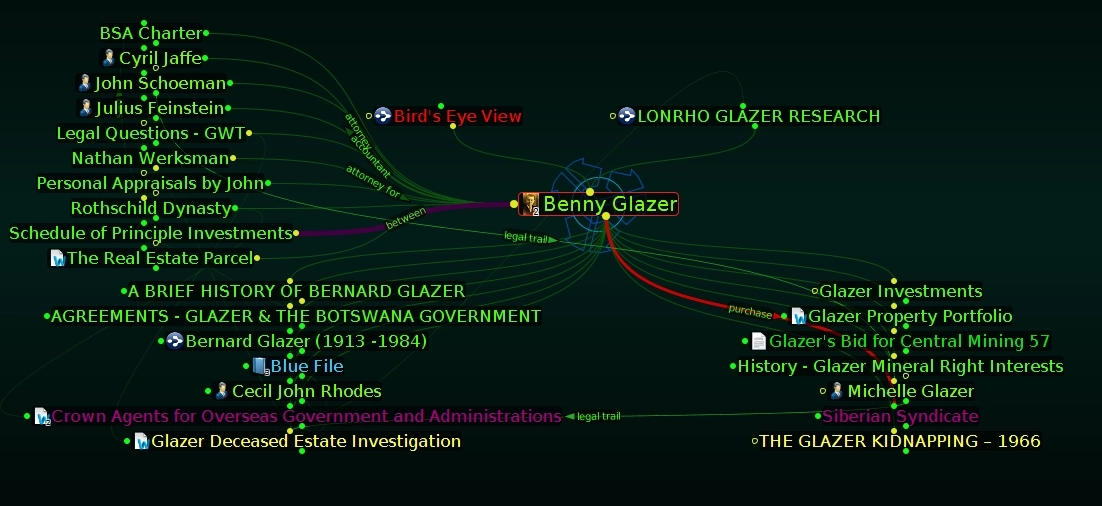
Bringing together the surrounding thoughts – [[thought:5ce3a0e4-aea5-5fb0-ac13-1ebb50da402f|Crown Agents for Overseas Government and Administrations]], [[thought:c4791aa1-ff46-5fc1-ba1b-f9fbd487ea61|AGREEMENTS - GLAZER & THE BOTSWANA GOVERNMENT]], [[thought:66cf7317-dd9b-56fe-a886-56030dac4ac5|THE GLAZER KIDNAPPING – 1966]], [[thought:df3ef164-9595-51ec-a676-4de3a59c6260|The Real Estate Parcel]], [[thought:419ff000-9e62-5b45-876d-0cf569c6c0b3|Rothschilds]], [[thought:45fe827c-7dfb-5a7a-8a64-4b8198d924c3|LONRHO GLAZER RESEARCH]], [[thought:95306daf-19e6-500f-a8c0-464a25c2f5b1|Blue File]] – a composite picture emerges:
- Imperial system: Crown Agents, BSAC and Rothschild finance form the pre‑existing lattice into which Glazer steps via BEC and Tati.
- National‑party nexus: Volkskas, Broederbond figures and apartheid‑era security (BOSS/van den Bergh, Vorster) show how Glazer’s structures mesh with Afrikaner state power.
- Corporate conduits: Property and financial vehicles (ACP, Retco, Sage, Liberty, Volkskas International, etc.) act as conduits for re‑routing value, often through London and offshore hubs.
- Personal risk: Events like the 1966 kidnapping indicate the degree to which Glazer’s personal life was entangled with these power struggles.
- Estate battle: The Blue File, estate investigation and [[thought:9a1eaa72-19e2-5084-9b7c-947abf4c4d8d|Michelle Glazer]]’s position place his heirs’ claims at the centre of a contested, trans‑national balance sheet.
Key open questions exposed by the linked thoughts:
- Where, in concrete legal and accounting terms, did the Botswana and Rhodesian mineral‑rights income flow after nationalisation, and how much was due to the estate?
- How exactly were the Johannesburg CBD properties and associated royalties tracked, revalued or written down across ACP → Urban → Retco → Sage and later structures?
- To what extent did Crown Agents‑style mechanisms and City of London finance (including Rothschild‑linked houses) remain silently embedded in these post‑colonial structures?
- Can a full reconstruction of these flows restore a documented asset trail sufficient to support legal recovery by the Glazer heirs?