The War Chest
The War Chest
The story of these bonds and their source of funding has been publicized on the internet for several years,38 but the story has never really gained much credibility, even though the bonds themselves have been at the heart of several law suits and criminal proceedings. In trying to understand the origins of what seems at first glance to be a sort of cold war internet-legend, history suggests that in September of 1991, George H.W. Bush and Alan Greenspan did indeed finance $240 billion in bonds in a buyout of the Soviet Union as part of a broader program to end the Cold War through an attack on the economy of the Soviet Union. More-over, President George H.W. Bush had initiated a number of related covert operations to takeover certain sectors of the Soviet economy, and ten years later in 2001, these programs had finally come back to haunt the U.S. policy makers. Most, if not all of these programs appear to have stepped outside of the boundaries of the law. As a result, investigative agencies from Britain, Switzerland, Russia, Kazakhstan and the Philippines were putting pressure on Congress and the U.S. Department of Justice to open up the accounts in the banks used to finance these covert activities, which were being viewed as criminal activities in foreign courts. Alan Greenspan, the Treasury Department and key banks in the U.S. and Europe were being sued for gold-price fixing or illegal gold sales which appears to have it’s origins in the covert war chest used to wage this war. 39 At the same time, the suits brought by the Holocaust survivors victims of the Marcos regime, and the US Congress under influence of pro-Israeli lobbyists were putting pressure on the Swiss banking cartel to open it’s bullion records to public scrutiny. Full disclosure by these banks during an investigation would have resulted in a major exposure of U.S. Government complicity in some of the greatest financial fraud of the 1980s and early 1990s as well as 50 years of gold bullion theft by numerous U.S. and British government agencies. Moreover, investigation into these accounts would disclose a National Security secret known as the Black Eagle fund, and virtually every covert operation since World War II. Bringing an end to these investigations and preventing this disclosure was the sole objective for the destruction of the WTC and Pentagon.
These investigative and legal pressures began to accumulate in 1997, and in February 1998, Osama Bin Laden declared his fatwa , and Atta started planning the September 11 attacks. To understand the decisions made in 1998 which brought about the attack on the World Trade Center, one must go back in history to appreciate the magnitude of exposure these bankers and government officials faced. Ten years prior to the planning that Atta was beginning, planning had begun for economic war on the Soviet Union. The source of funding for this covert war is traced to the end of World War II, but it was not until 1986 did the size of that war chest make the 1991 attack on the Soviet Union feasible. Understanding the source of that funding is absolutely critical to understanding why the World Trade Center was destroyed in 2001.
Numerous sources have documented that at the end of World War Two, the treasury of the Japanese Empire was discovered in the Philippines by a staff member of General Charles Willoughby, who was General MacArthur’s chief of Intelligence. Then known as the Golden Lily Treasure, this mass of wealth had been accumulated by the Japanese with over fifty years of its army pillaging Southeast Asia and China. It was deposited in the Philippines due to the U.S. submarine blockade of Japan. Reports vary, but documents in the public domain suggest the recovered treasure was in excess of 280,000 metric tonnes of gold, not including jewels and diamonds. 40 After the War that staff member, Edward Lansdale and Severino Garcia Diaz Santa Romana tortured Major Kojima Kashii - General Yamashita Tomoyuki’s driver –until he revealed and created a map of the gold sites.41
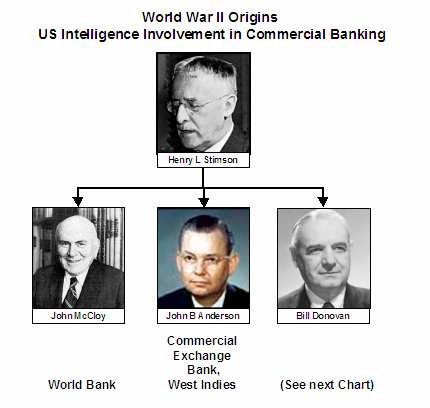
Lansdale briefed Assistant Secretary of War John J. McCloy about the findings, and a U.S. Cabinet level decision was made to confiscate the gold and cover-up its discovery. The gold would be added to the Black Eagle Trust fund. It was McCloy, along with Secretary of the Navy Robert B. Anderson and Secretary of War Henry L Stimson who created the Black Eagle Trust.42 John McCloy, who had shared a box at the 1939 Olympics with Adolph Hitler, went on to become President of the World Bank. Robert Anderson would go on to operate the Commercial Exchange Bank in the British West Indies, be convicted of running illegal banking operations and tax evasion, and be sentenced to prison. 43 A fourth member of that group – William ‘Wild Bill’ Donovan – would go on to found the CIA, distribute the gold to key banks represented by his staffers, and establish AIG as a key partner in the CIA’s covert operations.
The trust they created takes its name from the Nazi Black Eagle stamped on the gold bars of the Third Reich. Gold bullion confiscated from the Reich and not returned to its rightful owners and their heirs was the original source of funding for this trust.44 Over the years, the significance of the Nazi gold would pale in comparison to the confiscated Japanese treasure. As the fund grew, it was distributed in private accounts across the globe in over 100 banks, and administered by General Earle Cocke, financial advisor to every U.S. President from Truman to Clinton, until his death.45 Most of the individuals who controlled these accounts are long dead, and attempts by their heirs to access these accounts have been met with stonewalling, false imprisonment or death under suspicious circumstances. Santa Romano’s heirs are one example.46 Mrs. V. K. Durham is one such individual. Her husband, Colonel Russell Herman, controlled the Durham Trust. This report will return to their story in a little while.
The men responsible for initiating and executing the confiscation of Nazi and Japanese treasury gold represent the most senior Intelligence officers in the U.S. and Britain at the end of World War II, and the Cabinet of the President of the United States. From the Office of Strategic Services – the OSS - the decision-makers were:
Wild Bill Donovan, the most decorated soldier of World War I and head of the OSS and his direct staff which included:
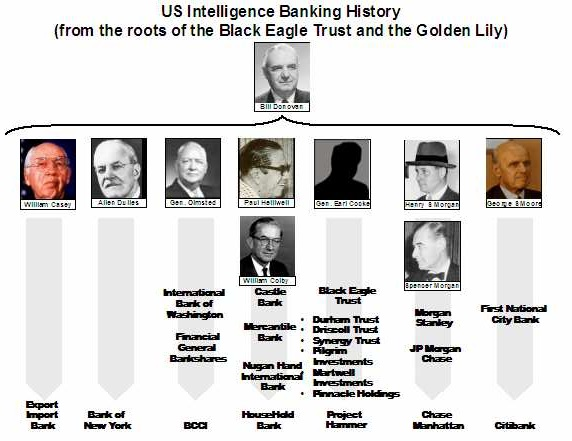
Allen Dulles, future Director of the CIA and a principal of Bank of New York, and legal representative of Brown Brothers, Harriman.47
Henry S Morgan and Spencer Morgan. Henry and Spencer were the sons of JP Morgan, and would return from their service to manage the financial empire that would evolve from JP Morgan to ‘Morgan and Chase’ to then to ‘Chase Manhattan’ to finally what in 2008 was known as Chase.
Paul Helliwell would become the primary covert operations banker for U.S. intelligence, setting up in Nassau Castle Bank and then Mercantile Bank and Trust. When Castle Bank needed to be closed, he set up Nugan Hand Bank. When the Nugan Hand Bank closed, he helped shift banking operations to Household Bank in Chicago, Illinois and to the notorious BCCI bank. His front man, and associate of Bill Donovan was General Earle (a.k.a. Erle) Cocke.48
General Earl Cocke would be the financial advisor to every President from Truman until Cocke’s death in the year 2000. Cocke was a true American hero in the classical sense: the recipient of the Silver Star, four Bronze Stars and four Purple Hearts. He was also the coordinator for the Black Eagle Fund and Project Hammer, which would be used to bring down the Soviet Union and attempt to bring Soviet oil and gas resources under the control of Western investors.
George S Moore; future President and CEO of First National City Bank of New York, which would evolve to become Citibank. Citibank would end up with over 116,000 metric tonnes of the Marcos Gold.49
General George Olmsted; was another World War II hero who subsequently was responsible for distributing
U.S. Military Assistance, later becoming President of a Washington DC based bank holding company known as International Bank, which took over the CIA’s Mercantile Bank and Trust in the Bahamas.50 Under Olmsted’s leadership, International Bank sold Financial General Bankshares (FGB) then known as First American, to BCCI.51
William Colby future CIA director and lawyer for Helliwell’s covert operation banks.
William Casey, decorated World War II veteran, future Director of the CIA. Casey took over from Paul Helliwell the “Secret Intelligence Branch” of the OSS in Europe in 1945.52
These men would form the core of the OSS that worked to create an “ apparatus belli ,”53 and virtually all of them would play a dominant role in the worlds’ most important banks. From the British Special Operations Executive (SOE) came participation and support for the OSS from John and William Keswick from the Jardine Matheson Bank.54 The Keswick family would also control the Hong Kong Shanghai Banking Corporation (HSBC).55 Fifty years later, the financial institutions represented by these individuals would become the major financial banks in the world, along with the Swiss-German banks they hid their gold in.
Lansdale and Santa Romana were made responsible for recovery of the treasure. They fabricated a “Communist Revolution” by the Hukbalahak rebels in order to confiscate the land where much of the gold was buried, and proceeded to mine it.56 Several sites sit on Clark Air Force Base.57 Over the years, Lansdale’s personal account in Zurich grew to over thirty thousand metric tonnes – greater than the national treasury of any modern nation state. Santa Romana had multiple accounts, the largest single account was valued at over 20,000 metric tonnes. While these accounts were created in their names, over time it would be shown these were actually government accounts. As a point of reference, the annual gold production of the world is estimated to be 1,200 tonnes, and in 1980 the U.S. gold repository at Fort Knox held only 8,221 tonnes. There has been no public report of the Fort Knox inventory since 1980.
According to David Guyatt and Sterling and Peggy Seagrave, the Yamashita gold would become the cornerstone of the Black Eagle Fund, from which many covert operations of the U.S. intelligence would be funded. 58 The most common interpretation international law is that the gold should have been either returned to the countries from which it was stolen (as was done with the Nazi gold59), or should have been incorporated into the U.S. Treasury. With no uncertain terms, the U.S. Government’s continued efforts to stifle news on this matter provides prima facie evidence that the confiscation of this gold is illegal.
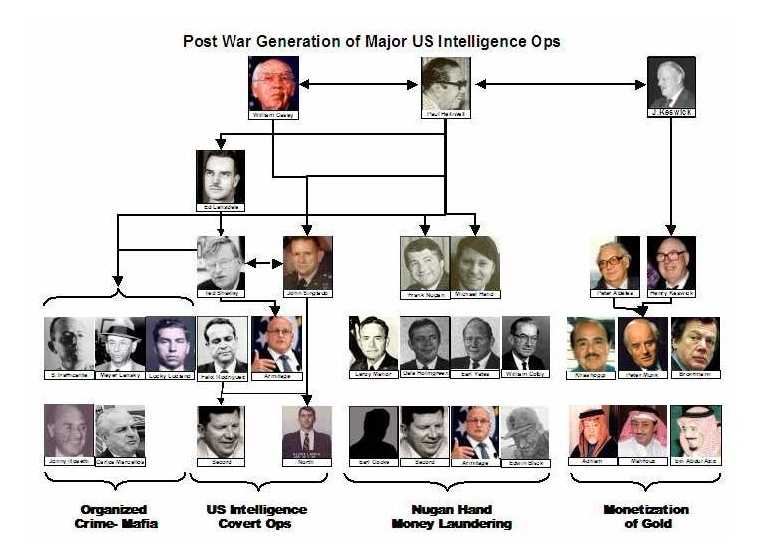
Lansdale’s operation in the Philippines gave birth to most of the common features of modern covert operations for U.S. Intelligence: bribery, theft, torture, and false flag operations. It would be Lansdale who would initiate a bond between the US intelligence organizations and the Israeli intelligence. It would be Lansdale that would set precedents for the Intelligence community to retain the services of organized crime on U.S. soil. Lansdale would hire American Mafia family heads Carlos Marcello, Santos Trafficante, Meyer Lansky, and Lucky Luciano in the U.S. war against Fidel Castro in 1961, much as he would hire the Italian Mafia families to wage an illegal operation against the Italian Communist party.
“…the gangsters in Lansdale’s employ were the very gangsters the FBN was chasing--Carlos Marcello, Santos Trafficante, Meyer Lansky, and Lucky Luciano. … The CIA’s connection, of course, began with ‘Wild Bill’ Donovan’s old OSS and its recruitment of Lucky Luciano and the Corsican mafiosi to beat and murder Communist union dockworkers in Marseilles and elsewhere along the Mediterranean Coast, and to seize Sicily from the Communists. With CIA blessing, and using drug running as a way of financing activities, the Mafia set up drug supply routes back to the U.S. Many an FBN operation would trace the drugs back to Mafia sources, in turn supplied through Lebanon, Turkey, Afghanistan, and elsewhere in the Middle East, only to be thwarted by the far more powerful CIA stepping in and terminating the investigation on national security grounds.”60
It would be Lansdale’s team that would propose and justify sacrificing innocent U.S. civilians in order to rally the American citizenry to support an invasion of foreign soil. This was done under a program run by Brigadier General William H. Craig, who reported to Lansdale for the Cuba project . 61 This project was called Operation Northwoods. Documents for this project would be accidentally released from the files of Robert McNamara into the public domain some 40 years later, exposing the degree to which Lansdale’s operatives would go to wage war. 62 In these documents, the U.S. military acknowledged it could wage a “terror” campaign against US citizens in order to justify a second invasion of Cuba. It would be the first official recognition that US intelligence operations used terrorist tactics.
It was Lansdale who oversaw the set up of assassination squads to target Fidel Castro while operating out of Florida. One of Lansdale’s proteges’ in the assassination business was Ted Shackley, would go on to set up assassination squads in Vietnam under Operation Phoenix.63 Shackley would take Felix Rodriguez with him from the Cuba Project to Laos for a secret war in support of Vietnam. Felix Rodriguez was a close confidante of former CIA Director George H.W. Bush, and maintained direct phone contact with Bush when Bush became Vice President under Ronald Reagan.64 When the U.S. intelligence funded, Iran-Contra gun running pilot was shot down in Nicaragua, it was Rodriguez that called George Bush to let him know that the pilot had been captured alive. In Vietnam, Shackley and Rodriguez would expand their circle of operatives to include Oliver North, Richard Secord and Richard Armitage. North, Secord and Armitage had proven themselves as men who could ‘get results’ against the communists by operating outside of the rules. They would provide the second generation of U.S. black ops leadership. The ‘whatever it takes’ zeal that these men developed in service of their country was ruled unacceptable in U.S. Military courts at the Mai Lai Massacre trial65, but it was still condoned by ‘ apparatus belli ’ spawned by Wild Bill Donovan.
While in Southeast Asia, North, Secord, Armitage, Rodriguez and Shackley would finance their operations through the Nugan Hand bank in Australia rather than with funds under congressional oversight.66 Nugan Hand Ltd. was founded in Sydney in 1973 by Australian lawyer Frank Nugan (who was reputedly associated with the Mafia) and former U.S. Green Beret Michael Jon Hand who operated in Northern Laos as part of the Phoenix Project. They were assisted in this by Paul Helliwell, one of the primary OSS agents in the original Yamashita gold operation.67 Frank Nugan’s family ran the primary supply shipping operation between the U.S. Navy base in the Philippines and Australia.68 It is through Frank Nugan and his business partner Peter Abeles, that insight is provided to the flow of some of this Marcos treasure. Peter Abeles was reputed to be a member of what was known in Australia as the Hungarian Mafia and a partner with Henry Keswick. Sir Henry Keswick was the son of SOE officer John Keswick. The Keswick family had controlling interest in Jardine Matheson, which owned and operated Ferdinand Marcos’ gold smelting operation, which was opened in the mid 1970s.69 The Keswick family also had controlling interest in the Hong Kong and Shanghai Banking Corporation (HSBC), which was the largest holder of Santa Romana’s known gold accounts, although Citibank would be the largest recipient of the confiscated treasure.70 When Romana died, the bank refused to hand over his accounts to his heirs, and confiscated his accounts.71
It was Peter Abeles and Sir Henry Keswick that brought Canadian businessman Peter Munk back to business prominence from a scandalous insider-trading lawsuit in Canada in 1967. Munk would partner with Adnan Kashoggi, Sheik Kamal and Edgar Bronfmann in a series of operations which ultimately would evolve into Barrick Gold.72 Barrick Gold would become an investment for nearly every gold bullion bank associated with the Marcos gold recovery. These banks would loan gold to Barrick, which would then sell the borrowed gold as derivatives, with the promise of replacing the borrowed gold with their gold mining operation. The records of many of those transactions disappeared when Enron collapsed and the trading operation and all its records were taken over by UBS, another major recipient of Marcos gold. The FBI was reportedly conducting an investigation into those transactions, and the investigation files were kept on the 23rd floor of the North Tower of the WTC. A review of the personal accounts of September 11 now suggests that office was deliberately targeted with explosives prior to the collapse of the WTC.73
The Nugan Hand Bank would be one of the many banks used for transferring the Marcos gold from the Philippines into covert operations. Brigadier General Earle Cocke was the President in charge of the Nugan Hand Washington Office, and would be the key manager of Project Hammer and the Black Eagle Trust.
Other Nugan Hand Bank employees from U.S. Intelligence operations included:
General Leroy J. Manor (manager of the Manila branch) former chief of staff of the U.S. Pacific; Command and deputy director for counterinsurgency and special activities; he shared his office with Marcos’s brother-in-law ;
General Edwin F. Black (president of Hawaii branch) former commander of U.S. forces in Thailand;
Richard Secord (all around operative with responsibilities in Iran-Contra, Vietnam assassinations, creating Mujahadeen armies in Afghanistan, and central Asia);
Dale Holmgreen (former chairman CIA's Civil Air Transport, manager of the Taiwan branch);
Richard L. Armitage (was special consultant to the Pentagon in Thailand who oversaw the transfer of heroin profits from Indonesia to Shackley's account in Tehran);
William Colby (former director of the CIA as legal counsel);
Rear-Admiral Earl P. Yates, the former Chief of Staff for Policy and Plans of the U.S. Pacific Command and a counter-insurgency specialist, became president of the company;
Walter McDonald (retired CIA deputy director, headed Annapolis branch);
Dr. Guy Parker (an expert from the RAND Corporation who came on as a bank consultant) senior Republican foreign policy adviser;
The bank was founded as a funding operation for U.S. covert operations in Australia74, and was a conduit for Marcos gold. One of the objectives of the ‘bank’ was to bring about the pre-mature closure of the Australian labor government. The Whitlam government had quietly threatened to nationalize subsidiaries of American corporations.
“The subsequent inquiries have established the Nugan-Hand bank was to be the organisation used as cover for the operations of Task Force 157. The Task Force 157 was a group set up by Henry Kissinger and it was set up in a quite strange way. It was a mini-CIA which was actually separate from the CIA and probably was set up by Kissinger so he could deny any connection between what the Task Force 157 was doing and the CIA. Nevertheless, the personnel of Task Force 157 included Ted Shackley, who was one of the head of sabotage operations against Cuba, he was Station Chief in Saigon during the Vietnam War, and he was the Chief of the CIA Western Hemisphere Division, so with an impeccable CIA record like that it would be very difficult to disassociate him from what the CIA was doing. The concept of Task Force 157 seems to have been two-fold: firstly, to set up operations against the Whitlam government. And secondly, to go ahead with using Australia as a base for certain clandestine U.S. operations such as arms dealing and smuggling of contraband goods.”75
The Nugan Hand Bank was closed in January 1980 within several days of the unsolved murder or suicide of Frank Nugan. The reasons for his murder have never been identified, but during that time, the operation was at risk of being exposed.
“Bobby Inman, former Deputy Director of the National Security Agency and Deputy Director of the CIA, said on two occasions that he expressed deep concern that investigations of Nugan-Hand would lead to disclosure of a range of dirty tricks played against the Whitlam government (Australian labor government).”76
(The U.S. Intelligence’s _modus operandi _of using murder for covering its tracks is further documented when the Iran-Contra and October Surprise affairs are reviewed later in this report.)
John Hand would disappear a few days after the death of Frank Nugan, never to be seen again. Bank operations were transferred to HouseHold Bank in Chicago, Illinois, where William Colby would be come the unofficial counsel. There, according to Herman Skolnick, Household Bank would continue the work of Nugan Hand.
Among their functions, transferring covert operations funds, assassination team funding, skimming of dope, gambling, and gun-running loot; military, civilian, international. U.S. Military, Admirals and Generals, as well as intelligence community officials, supposedly either "retired", or "on leave", operated Nugan-Hand, and aided thereafter Household and its numerous units and subsidiaries. The "tracking the money” project was conducted over-all by Household International with the assistance reportedly of Systematics, a banking computer services firm, originally a subsidiary of an Arkansas-based operation. Targeted have been the banks of both friends and enemies alike. (Vince) Foster and his crew -- Hillary (Rodham Clinton) and Webster (Hubbell) -- used as a cover that they were supposedly "attorneys" for Systematics…. Vincent and Hillary's role in this was arranged and supervised by a Chicago-based law firm Hopkins & Sutter…77.
Many units of Household Finance were shortly thereafter taken over by Harris Bank, which was then taken over by the Bank of Montreal. The Bank of Montreal would be controlled by the Bronfmann family, which became heavily invested in Barrick Gold. It would be Edgar Bronfmann that would cut a deal with the Swiss banking cartel in 1998 that would derail U.S. Congressional and Israeli pressure for an investigation into the Holocaust and Marcos gold accounts.
By the end of the 1980s, the banks that had their agents in the OSS intelligence operations at the end of World War II were the banks that would be the dominant global players by 2001.
Morgan Guaranty Trust
Chase Manhattan
Citibank
Jardine Matheson
UBS
Deutschebank
HSBC
The covert operations funded by the Black Eagle Trust in the 1960s and 1970s became visible stains on the global image of the U.S. despite all efforts to keep them under cover. In an effort to clean house, President Jimmy Carter would order the retirement of over 800 covert operatives.78 Many of these operatives would move into private consulting and security firms and be employed as subcontractors for covert operations. Thus began a loose association of private operatives that would be referred to as “the Enterprise” in the years to come. George H.W. Bush, having been CIA Director, had many acquaintances in this group, and would work with them to restore their influence and control over U.S. foreign policy and the foreign investment opportunities it created for their benefit.