The Fails
The Fails
In the aftermath of September 11th, the analysts at the Fed attributed the security settlement failures to two causes:
the initial inability to match up trades with correspondent data, and
the use of ‘strategic’ fails by brokers in the aftermath, when the special rate on securities was so low that there was no incentive to avoid the refinancing fail. This reduction in the special rate was attributed to operations to increase liquidity in response to excess balance issue discussed in the section above.
One key Federal Reserve researcher summarized it accordingly:
“Fails rose initially because of the destruction of trade records and communication facilities. They remained high because the method typically used to avert or remedy a fail—borrowing a security through a special collateral repurchase agreement—proved as costly as failing to deliver the security. The U.S. Treasury responded to the fails problem by reopening the on-the-run ten-year note. The increased supply made borrowing the note more attractive than failing.”211
The standard remedy for a fail—borrowing a security through a special collateral repurchase agreement— fell apart when the Fed dropped the special rate to nearly zero. As a result, a second, ongoing ‘wave’ of ‘fails’ was created by removing the incentive for regular traders to avoid fails. It is this structurally created second wave that masked the underlying wave of fails due to the loss of the covert funding notes.
“ The Desk “had to accept the vast majority of propositions – even those offered at rates well below the new 3 percent target level – in order to arrange RPs of sufficient size.” (Markets Group of the Federal Reserve Bank of New York 2002, p. 24) On Wednesday, the Desk accepted all propositions submitted, the lowest of which was ¾ percent: see Table 2. The effective federal funds rate sank to 1¼ percent on Tuesday and below that on Wednesday” 212
“The incentive of a seller to borrow securities to avoid or cure a fail declines with the specials rate for the security. When the specials rate is near zero, a seller has little to gain lending money (at nearly no interest) to borrow the needed securities.13 This suggests that market participants may have little incentive to break daisy chains and round robins when the specials rate for a security is near zero. This aspect of the market is important to understanding the fails problem after September 11…. the specials rate for a security will be driven to its lower limit more frequently when the fed funds rate, and hence the general collateral rate, is lower. This follows because the gross compensation earned by a lender of securities at any given specials rate is the difference between the general collateral rate and the specials rate.”213
As shown in the following chart, the specials rate dropped by 200 -300 basis points, creating a disincentive to resolve short term, repo fails and creating a statistical flurry of fails.
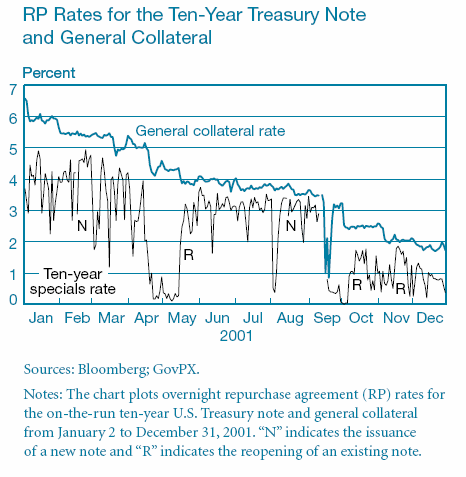
[When the Back Office Moved to the Front Burner: Settlement Fails in the Treasury Market after 9/11, Michael J. Fleming and Kenneth D. Garbade, FRBNY Economic Policy Review / November 2002, p 41.]
The response of the Fed in bringing a new issue to the market at this time seems to have inadvertently (an assumption which should be challenged) been the source of continued lower “special rates” on the ten year note, and exacerbated the fail problem through the end of the year. In the extended condition of a high level of settlement fails, it would require little effort to ‘statistically hide’ the settlement of the remaining $240 billion that may not have been cleared in the immediate aftermath. The three week lull of fails in October could easily represent the 30 day short term refinancing of the debt. As the debt came back to the market for permanent refinancing, a shortage of investors would result in more fails.
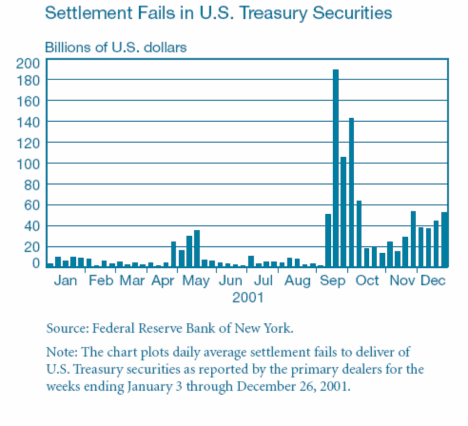
[When the Back Office Moved to the Front Burner: Settlement Fails in the Treasury Market after 9/11, Michael J. Fleming and Kenneth D. Garbade, FRBNY Economic Policy Review / November 2002, p 43.]
The critical perspective here is that in making the original paper on $240 Billion in covert notes disappear in the rubble of the World Trade Center, it would be implausible to refinance them in a few days without the financial world taking note. Notes could conceivably be refinanced for 30 days in the repo market, and the final refinancing extended for weeks, possibly months.
There is a contention that at the core of the September 11th attack, someone was planning to cover the 1991 issuance of $240 billion in covert securities used to finance the collapse the Soviet Union. The facts surrounding the financial aftermath of September 11 suggest this is not only possible, but that reports describing the aftermath have deliberately been misleading.
The US dollar money supply was significantly increased in the aftermath of 9/11;
The bank at the core of the illegal money laundering by ex-Soviet criminals was the source of the increased money supply (BoNY);
The generally disseminated rationale for BoNY’s operational problems seems to have affected no other bank in a similar manner or magnitude and is inconsistent with reports on the BoNY operations in the aftermath;
A key witness who might provide insight to these issues is a statistically aberrant death;
The source of the BoNY’s $330 billion increase in assets is cloaked under the privilege of “private banking;”
The only alleged “severe” disruption to the financial systems was the Federal Reserves account balance and the securities trading fails – both systems required to hide the laundering of $240 billion in covert securities.
This is not a ‘proof’ that $240 billion was laundered, but it provides probable cause for paying serious attention to Durham’s claim that it was indeed what happened. When one looks deep enough into the murky cloud of black ops and secret financing – the world of Durham’s husband - her claims regarding 1991 and 2001 begin to gather credibility.