SABSA Life-cycle (Four Phases)
SABSA® Life-cycle (Four Phases)
The implied process flow is that successive layers are developed in sequence, except for the operational security architecture layer. This operational security architecture is developed in parallel rather than sequentially, although this activity cannot really begin until the conceptual security architecture has been defined. Thus you will see the combination of sequential and parallel flow as shown:
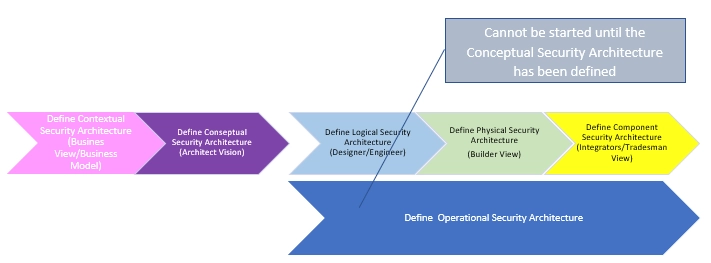
The conceptual security architecture (the architect’s vision) is the conclusion of what is called the Strategy and Concept phase, within which high-level strategy is developed and agreed on. It is essential to gain buy-in and sign-off to these strategic visions before heavily committing resources to what follows. The end of the conceptual security architecture activity is therefore a milestone at which to stop, draw breath and reach consensus. The break in the diagram shows this milestone.
Once the contextual security architecture (business model) and the conceptual security architecture (architect’s vision) have been agreed on and there is clearly broad buy-in from all interested parties, then these concepts can be realized through a more detailed Design phase of work. This encompasses the definition of the logical, physical, component and operational layers of the SABSA® Model.