Cetyl Alcohol
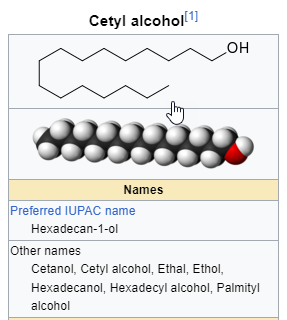
Cetyl alcohol /ˈsiːtəl/, also known as
hexadecan-1-ol and
palmityl alcohol,
is a C-16 fatty alcohol with the formula CH3(CH2)15OH.
At room temperature, cetyl alcohol takes the form of a waxy white solid or flakes.
The name cetyl derives from the whale oil (cetacea oil,
from Latin: cetus, lit.'whale',
from Ancient Greek: κῆτος, romanized: kētos, lit.'huge fish')[3]
from which it was first isolated.[4]
Preparation
Cetyl alcohol was discovered in 1817 by the French chemist Michel Chevreul when he heated spermaceti, a waxy substance obtained from sperm whale oil, with caustic potash (potassium hydroxide).
Flakes of cetyl alcohol were left behind on cooling.[5]
Modern production is based around the chemical reduction of ethyl palmitate.[6]
Uses
Cetyl alcohol is used in the cosmetic industry as an opacifier in shampoos, or as an emollient, emulsifier or thickening agent in the manufacture of skin creams and lotions.[7]
It is also employed as a lubricant for nuts and bolts, and is the active ingredient in some "liquid pool covers" (forming a non-volatile surface layer to reduce water evaporation, related latent vaporization heat loss, and thus to retain heat in the pool).
Moreover, it can also be used as a non-ionic co-surfactant in emulsion applications.[8]
Side effects
People who suffer from eczema can be sensitive to cetyl alcohol,[9][10] though this may be due to impurities rather than cetyl alcohol itself.[11]
However, cetyl alcohol is sometimes included in medications used for the treatment of eczema.[12]