Potassium Hydroxide
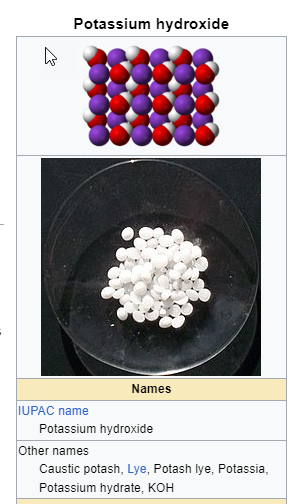
Potassium hydroxide is an inorganic compound with the formula KOH, and is commonly called caustic potash.
Along with sodium hydroxide (NaOH), KOH is a prototypical strong base.
It has many industrial and niche applications, most of which utilize its caustic nature and its reactivity toward acids.
An estimated 700,000 to 800,000 tonnes were produced in 2005. KOH is noteworthy as the precursor to most soft and liquid soaps, as well as numerous potassium-containing chemicals.
It is a white solid that is dangerously corrosive.[11]
Properties and structure
KOH exhibits high thermal stability.
Because of this high stability and relatively low melting point, it is often melt-cast as pellets or rods, forms that have low surface area and convenient handling properties.
These pellets become tacky in air because KOH is hygroscopic.
Most commercial samples are ca. 90% pure, the remainder being water and carbonates.[11]
Its dissolution in water is strongly exothermic.
Concentrated aqueous solutions are sometimes called potassium lyes.
Even at high temperatures, solid KOH does not dehydrate readily.[12]
Structure
At higher temperatures, solid KOH crystallizes in the NaCl crystal structure.
The OH^− group is either rapidly or randomly disordered so that it is effectively a spherical anion of radius 1.53 Å (between Cl− and F− in size). At room temperature, the OH− groups are ordered and the environment about the K+ centers is distorted, with K+−OH− distances ranging from 2.69 to 3.15 Å, depending on the orientation of the OH group. KOH forms a series of crystalline hydrates, namely the monohydrate KOH · H~2~O, the dihydrate KOH · 2H~2~O and the tetrahydrate KOH · 4H~2~O.[13]
Reactions[edit]
Solubility and desiccating properties[edit]
About 112 g of KOH dissolve in 100 mL water at room temperature, which contrasts with 100 g/100 mL for NaOH.[14] Thus on a molar basis, KOH is slightly more soluble than NaOH. Lower molecular-weight alcohols such as methanol, ethanol, and propanols are also excellent solvents. They participate in an acid-base equilibrium. In the case of methanol the potassium methoxide (methylate) forms: ^[15]
KOH + CH3OH → CH3OK + H2O
Because of its high affinity for water, KOH serves as a desiccant in the laboratory. It is often used to dry basic solvents, especially amines and pyridines.
As a nucleophile in organic chemistry[edit]
KOH, like NaOH, serves as a source of OH−, a highly nucleophilic anion that attacks polar bonds in both inorganic and organic materials. Aqueous KOH saponifies esters:
KOH + RCOOR' → RCOOK + R'OH
When R is a long chain, the product is called a potassium soap. This reaction is manifested by the "greasy" feel that KOH gives when touched; fats on the skin are rapidly converted to soap and glycerol.
Molten KOH is used to displace halides and other leaving groups. The reaction is especially useful for aromatic reagents to give the corresponding phenols.[16]
Reactions with inorganic compounds[edit]
Complementary to its reactivity toward acids, KOH attacks oxides. Thus, SiO2 is attacked by KOH to give soluble potassium silicates. KOH reacts with carbon dioxide to give potassium bicarbonate:
KOH + CO2 → KHCO3