Labarum
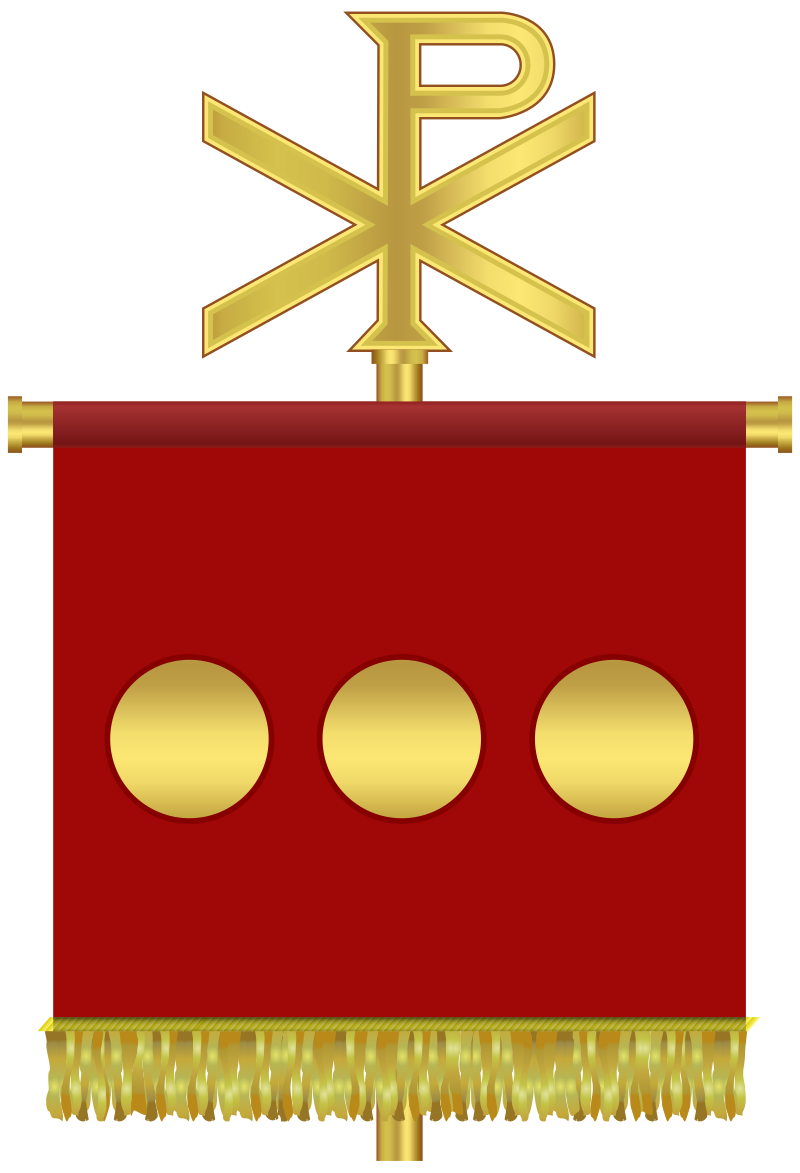
The labarum (Greek: λάβαρον) was a vexillum (military standard) that displayed the "Chi-Rho" symbol ☧, a christogram formed from the first two Greek letters of the word "Christ" (Greek: ΧΡΙΣΤΟΣ, or Χριστός) – Chi (χ) and Rho (ρ).[2] It was first used by the Roman emperor Constantine the Great.[3]
Ancient sources draw an unambiguous distinction between the two terms "labarum" and "Chi-Rho", even though later usage sometimes regards the two as synonyms. The name labarum was applied both to the original standard used by Constantine the Great and to the many standards produced in imitation of it in the Late Antique world, and subsequently.
Etymology
Beyond its derivation from Latin labarum, the etymology of the word is unclear.[4] The Oxford English Dictionary offers no further derivation from within Latin.[5] Some derive it from Latin /labāre/ 'to totter, to waver' (in the sense of the "waving" of a flag in the breeze) or laureum [vexillum] ("laurel standard").[6]
An origin as a loan into Latin from a Celtic language or Basque has also been postulated.[3] There is a traditional Basque symbol called the lauburu; though the name is only attested from the 19th century onwards[7] the motif occurs in engravings dating as early as the 2nd century AD.[8]
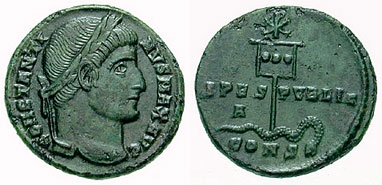
A follis of Constantine (c. 337) showing a depiction of his labarum spearing a serpent on the reverse; the inscription reads SPES PVBLICA[9]