D'Hreng'ec

Field Report — Byzanthium Expedition
Site Designation: D’Hreng’ec
Filed by: Marcus Draaken
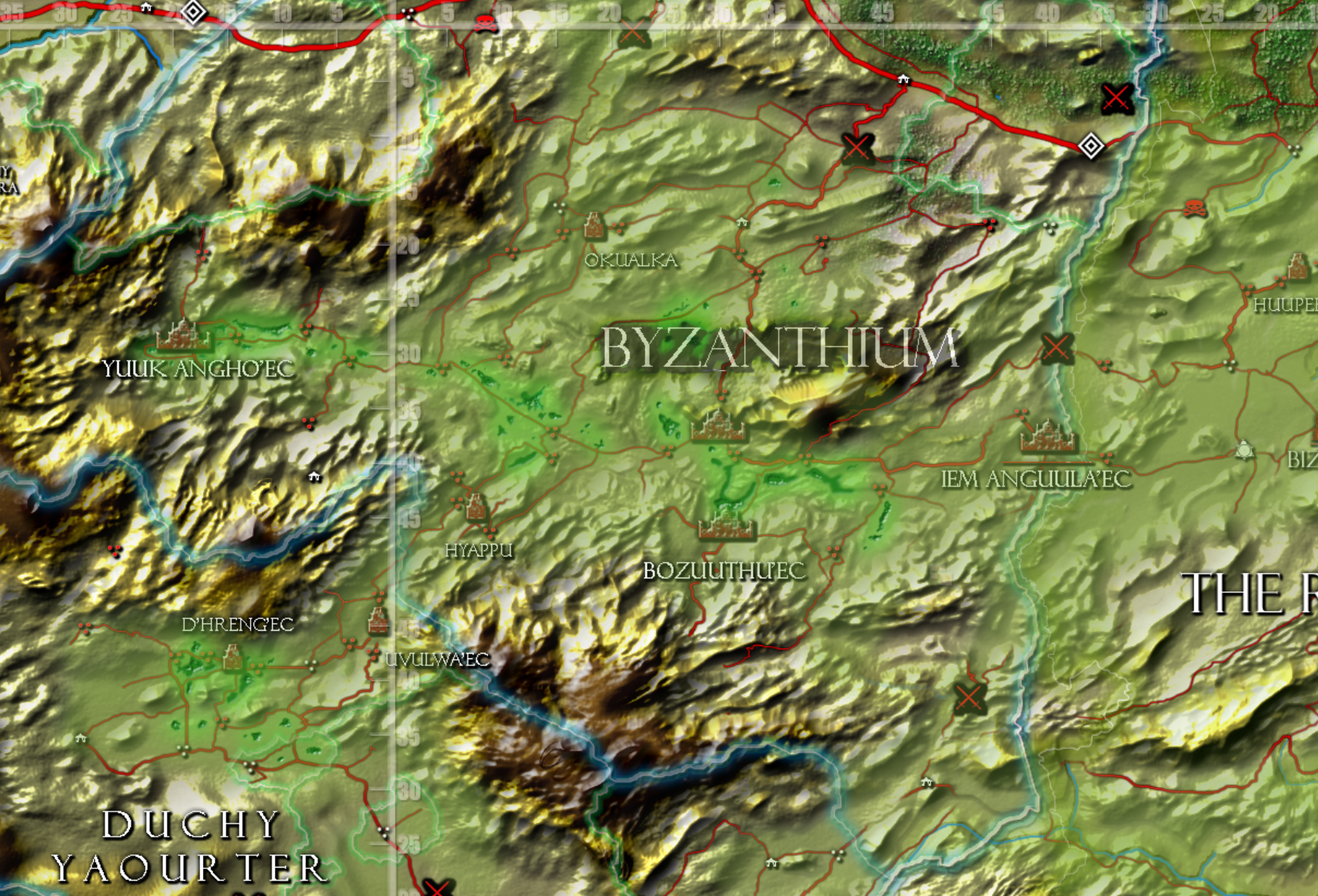
D’Hreng’ec occupies a lower basin west of the main Bozuuthu-ec cluster, though “valley” is again an approximation that flatters the terrain. It presents initially as a collapsed watershed, but no hydrological model holds for more than a few minutes under observation. What remains of the original topography has been overwritten by a structural and atmospheric system that behaves more like a continuous process than a location.
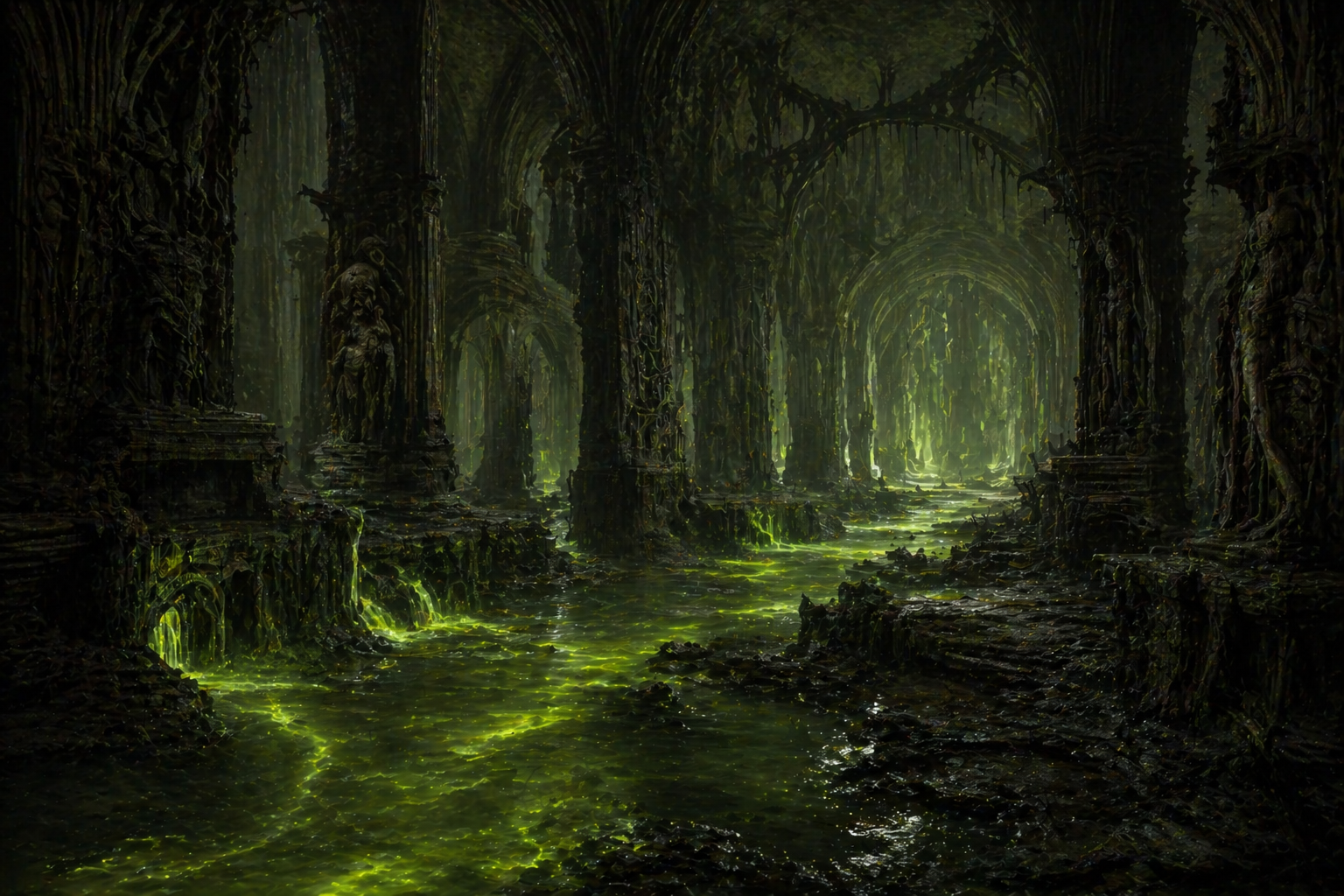
The most immediate characteristic is the light. The entire basin is suffused with a diffuse green luminescence, not projected from any single source but emerging from the ground, the air, and the surfaces of the ruins simultaneously. It is not bright enough to illuminate cleanly, but sufficient to erase shadow contrast and flatten depth. Distance becomes unreliable very quickly. What appears to be fifty yards may be twice that, or half, depending on angle and duration of observation.
The ruins themselves are markedly more gothic in profile than the higher Byzanthine structures. This is almost certainly incidental rather than intentional. The architecture exhibits repeated vertical emphasis—arches, vaults, rib-like supports—yet none of it aligns with human structural logic. Columns terminate in nothing. Arches intersect at angles that distribute no load. Entire sections appear to have sagged under gravity that is no longer present.
From a distance, the site resembles a drowned cathedral complex. At closer range, that analogy breaks down. The repetition of form suggests not design, but recursion—an idea applied repeatedly until it ceased to require meaning.
The lower floors of the ruin are submerged in a shallow but extensive flow of viscous green liquid. It moves slowly, though not always in accordance with the slope of the ground. In several places, the flow divides around obstacles and rejoins upstream. Surface disturbance produces faint luminescent turbulence, as though the fluid is reacting to presence rather than displacement.
We tested neither depth nor composition directly. A thrown probe dissolved in under ten seconds. Vapors rising from the surface produce mild cognitive interference at close range, even through filtration. Prolonged exposure is not advised.
The fog that fills the basin is not merely atmospheric. It maintains density gradients independent of temperature and wind. In certain corridors, particularly between standing arch structures, it gathers into bands that resemble processional lanes. These bands move slowly, and when intersected, they produce auditory artifacts—voices, fragments of speech, tonal patterns. These do not correspond to any known language, though several members of the expedition reported hearing familiar cadences layered within the noise.
I do not consider these communications. More likely they are residual impressions, or byproducts of whatever process sustains the valley.
Vegetation exists, but only in degraded form. Trees grow along the higher ridges, their trunks blackened and split, leaves reduced to narrow, yellow membranes that do not appear to photosynthesize in any conventional way. Root systems extend into the green flow rather than soil. Some of these structures may no longer be plants in the biological sense, but something that has adapted to the local medium.
Fauna is present, though classification is not particularly useful. Several organisms resembling wolves were observed moving along the upper edges of the ruin. Their morphology was inconsistent—additional ocular structures, asymmetrical limb growth, irregular gait patterns—but they retained enough coordination to hunt. They avoided the central channels and showed no interest in the expedition unless approached.
More concerning were the serpentine forms observed near the submerged sections. These remained partially within the green medium, exposing only segments of their bodies at irregular intervals. Contact was not attempted. One sample of shed material was collected and immediately sealed after it began to degrade the container.
None of these creatures appear dominant. They are products of the environment, not controllers of it.
Throughout the site, small pools of denser liquid collect in depressions and structural recesses. These differ from the main flow in both color and behavior, exhibiting iridescent surface patterns and intermittent bubbling without visible heat source. Instruments placed near these pools produced erratic readings before failing. One such pool emitted a localized distortion field sufficient to displace a measuring rod by several inches without physical contact.
It is tempting to interpret these as remnants of prior activity—experiments, containment failures, or similar events. I am not convinced that interpretation holds. They may instead be nodes within the same larger system that governs the basin.
Subsurface structures are present. Multiple entry points to lower levels were identified, though none were entered during this survey. Airflow from these openings is warm and carries particulate matter consistent with long-term decay, though not strictly organic. Acoustic probing suggests extensive chamber networks below, some of significant size.
At irregular intervals, low-frequency tremors pass through the ground. These are not seismic in character. The movement is too uniform, too evenly distributed. It feels less like the shifting of earth and more like the adjustment of something beneath it.
No central authority, structure, or focal entity was identified. There is no throne, no command center, no observable locus of control. As with other regions of Byzanthium, D’Hreng’ec appears to operate as a condition rather than a governed space.
Previous accounts attribute the state of the valley to failed experimentation by local scholars. There may be some truth in that, but it is likely incomplete. The scale of the transformation exceeds what any human or even organized arcane effort could sustain without external framework.
More likely, the site represents an intersection between local activity and a larger, pre-existing system. The “experiments,” if they occurred, may have been an attempt to interact with that system rather than create it.
I conducted a limited descent along one of the primary ruin corridors. Wards held. Cognitive interference increased steadily but remained manageable within controlled exposure time. No direct confrontation occurred. The environment itself constitutes the primary hazard.
At approximately three hundred paces from the entry point, structural coherence degraded to the point where further progress would have required anchoring lines and a larger support team. At that stage, I withdrew.
There was no clear threshold where the valley became more dangerous. It simply became less interpretable.
Final assessment:
D’Hreng’ec is not a site of active hostility, but it is not passive either. It does not seek, pursue, or defend. It alters. It degrades. It absorbs.
If Bozuuthu-ec is a system that continues to function, D’Hreng’ec is what happens when such a system leaks into its surroundings and is allowed to remain.
It is not spreading in any rapid sense, but it is not stable.
Given sufficient time, it is reasonable to assume the condition will expand.
I recommend continued observation from elevated positions, with no attempt at deep penetration until a more reliable model of the underlying process can be established.
There is nothing to fight here.
Only something to understand, or avoid.
Preferably both.