Bozuuthu'ec
Field Report — Byzanthium Expedition
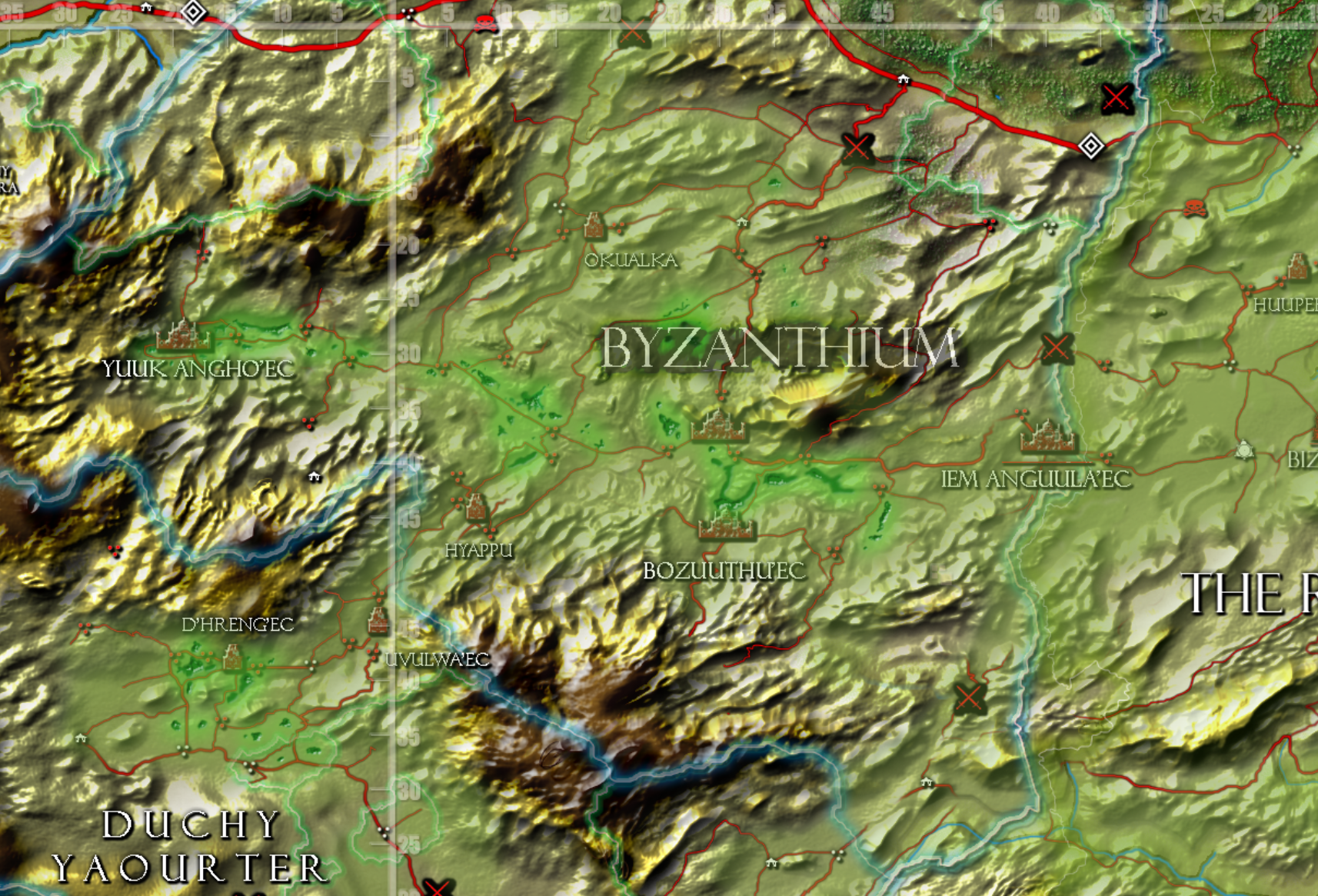
Site Designation: Bozuuthu-ec
Filed by: Marcus Draaken
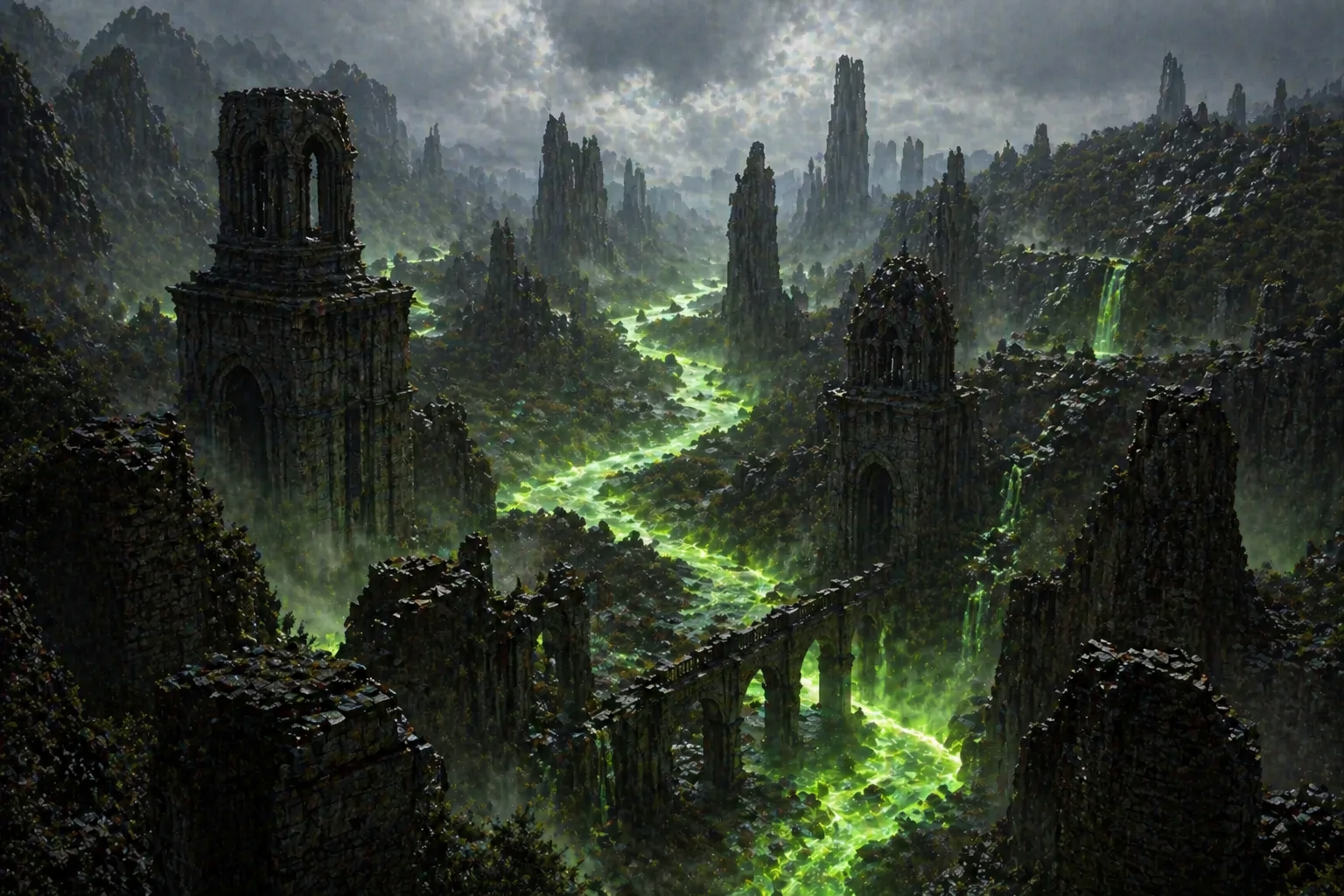
Bozuuthu-ec lies deeper within the basin than most surface-visible structures, partially embedded in the surrounding slopes and descending well below the observable strata. It presents at a distance as a clustered emergence of towers and recesses, but this impression simplifies the reality. It is not a city, nor even a ruin in any conventional sense. The structure does not appear to have been built upon the land so much as coexistent with it, as though the surrounding geology accreted around an older, more durable framework.
The upper sections consist of spiraling vertical masses and recessed vault systems, many of which show no signs of collapse despite clear evidence of extreme age. Surface materials behave inconsistently. In several locations, the stone exhibits low-level luminescence and intermittent pulsing, not in any rhythmic pattern I could identify, but with the suggestion of internal process. Attempts at thaumic probing returned unstable readings, and I discontinued further testing after the instruments began to align in ways I could not account for. There is no evidence of quarrying, cutting, or assembly in the conventional sense. The working assumption is that the structure predates Atlantean methods, and may not be terrestrial in origin at all.
Beneath the upper complex lies a large substructure, accessible only through collapsed sections and partial exposure along the lower slopes. Within this space is a fluid mass of considerable volume, which I will provisionally refer to as the Sea of the Lost. It is neither water nor oil. The substance is thick, cohesive, and slow-moving, with a density that resists easy classification. Suspended within it are vast numbers of humanoid forms.
I will note that these are not corpses in the usual sense. They do not decay, nor do they appear recently deposited. Their arrangement suggests fixation rather than burial. Faces remain intact. Limbs are contorted, but not randomly so. The impression is less of death than of interruption. At irregular intervals the surface of the medium shifts, producing slow, rolling displacements that carry the forms with it. No external cause for these movements was observed. Nothing surfaced. Nothing emerged. The disturbance originates from depth.
It is difficult to avoid the conclusion that this is not a repository of the dead, but some form of retention system. What is being retained, and in what state, remains unclear.
The structure is not uninhabited. Entities are present throughout the accessible periphery and within the exposed sublevels. They resemble humanoid forms at a distance, but closer observation shows extensive degradation. Their bodies are attenuated, skin drawn tight and grey as if mineralized. Movement is slow, repetitive, and without visible purpose. They do not respond to observation in any meaningful way, nor do they coordinate with one another. Their behavior is best described as procedural.
A particular subtype was observed in chambers that resemble libraries or archival spaces. These entities possess elongated skulls and distorted upper limbs, often fused or extended into claw-like structures. They engage continuously with objects that appear to be books or tablets, though the condition of these materials makes verification difficult. Despite clear evidence that their sensory apparatus is no longer functional, they persist in turning pages, tracing surfaces, and repeating the same gestures. There is no sign of comprehension. The activity appears to be maintained rather than performed.
Bozuuthu-ec exhibits significant spatial instability. Gravity cannot be relied upon to remain consistent within confined areas. In several observed zones, directional orientation shifted without warning, producing the sensation of falling sideways or upward. Structural pathways do not behave predictably. Corridors loop, reconnect, or terminate in configurations that do not correspond to their external geometry. Personnel exposed to these conditions for extended periods reported disorientation and minor temporal discontinuities, including brief gaps in memory and difficulty sequencing events.
At the center of the complex there is strong evidence for a vertical shaft extending beyond measurable depth. I did not approach this feature directly. Structural alignment throughout the site trends inward toward a central axis, and acoustic resonance suggests a large open volume below. Limited scrying attempts produced non-conclusive results, though all observers reported increasing discomfort and distortion of perceived depth. The impression was not of emptiness, but of extension beyond usable spatial understanding. I will refrain from naming it anything more specific until direct observation is possible.
There are indications of periodic large-scale activity within the structure. Variations in heat distribution, shifts in entity density, and movement within the substructure appear to occur in loose cycles. It would be tempting to describe this as ritual behavior, but that implies intention and agency. I am not convinced either applies. It is more accurate to say that Bozuuthu-ec continues to execute processes that no longer have relevance to the current world, if they ever did.
The primary hazards of the site are not immediate in the conventional sense. The entities present are not actively aggressive, and the structure does not defend itself in a recognizable way. The danger lies in cumulative exposure. Perceptual drift, spatial misalignment, and gradual degradation of cognitive coherence were observed in all personnel after prolonged proximity. Physical risks exist, particularly in unstable zones, but they are secondary.
Bozuuthu-ec is not a necropolis, nor a temple, nor a failed city. It is a system, degraded but still functioning, with no regard for human presence. It does not react to intrusion in the way a living thing would. It does not resist. It does not acknowledge.