Seeile (Matured Vocation)

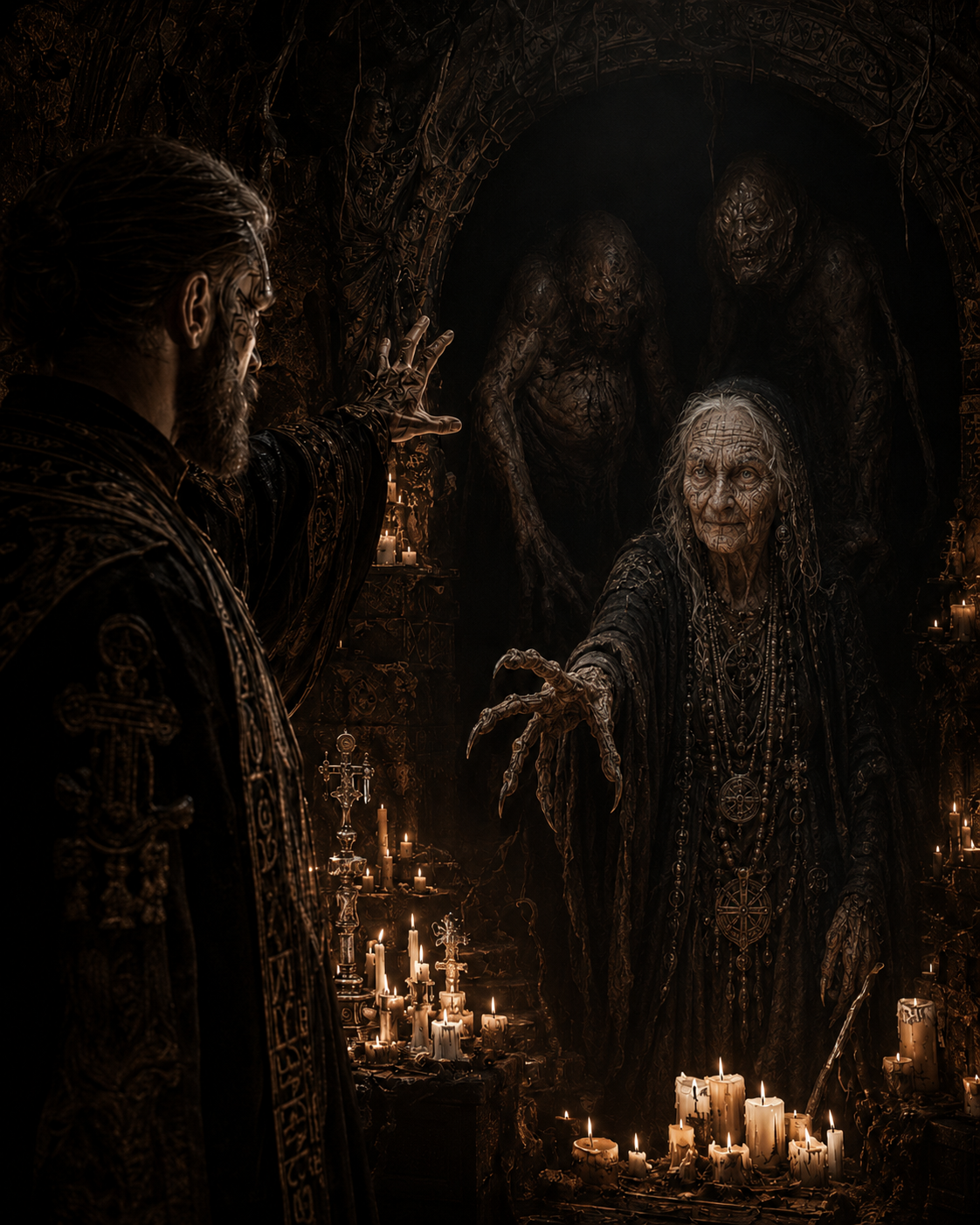
The Temple of Shinthai did not look like a place where secrets went to die. That was the first mistake strangers made.
It stood on a terrace above the spice quarter, all red stone, white colonnades, gilt capitals, painted lintels, hanging flower ropes, bronze braziers, silk curtains, perfumed water, and bright mosaics of women dancing with blades, wine bowls, lions, storms, lovers, kings, and flowers that could never have grown in the same season. There was music from before sunrise until after midnight, drums in the court, flutes in the bathing galleries, women’s voices rising and falling through open screens, laughter behind curtains, quarrels under awnings, dancers practicing ankle-bell patterns beneath pillars while rich men pretended not to stare, and poor men stared because they had less practice pretending. Flowers were everywhere. Coins were everywhere. Red, saffron, lapis, copper, ivory, peacock green, pomegranate, gold. The place was loud with life and louder with money.
Anyone foolish enough to call it a brothel in public usually left with either a broken nose, a new debt, or a marriage contract unexpectedly improved in favor of his wife.
The priestesses of Shinthai were beautiful, yes, often spectacularly so, but only an idiot stopped there. They were brokers, fixers, rumor-keepers, blackmailers, witnesses, musicians, dancers, couriers, seducers, accountants, poison-readers, letter-forgers, marriage-arrangers, guild whisperers, and the most cheerful extortionists in the southern city. They knew who entered whose house by the kitchen door, who paid which magistrate, who fathered which child, who had a scar where no wife had seen it, which noble boy liked to be slapped by laundresses, which Daevonite cleric had a poet’s weakness for red wine and being told he was serious, which Alalvarite factor had bought saffron through an intermediary, and which Shinthai novice had stolen earrings from the wrong patron and needed to be screamed at before she became a corpse.
They were a flower garden where every blossom had teeth.
Shukwyrvatha ruled one of the inner reception courts with the exhausted fury of a woman who had once been gorgeous, knew exactly how much of that remained, and had turned the rest into weaponry. She was broad-hipped, heavy in the middle, splendid in red silk and old gold, her red hair streaked with white and pinned up badly because she had slapped away three attendants that morning for being useless. Her mouth was painted too dark. Her eyes were rimmed in too much kohl. Her wrists were loaded with bangles that clattered when she pointed, and she pointed often. She smelled of rose oil, musk, smoke, wine, bitter orange, and the fatigue of being necessary to people she despised.
Three temple acolytes fled past her in a cloud of giggles, bright scarves whipping behind them.
“Fuck off,” Shukwyrvatha, Administress Priestress barked without turning.
They scattered harder, which only made them laugh more.
“Bitches,” she snarled, settling herself against a heap of cushions as if lowering an empire onto a couch. “Always gossiping. Always watching. Always thinking they invented secrets because some fishmonger’s son looked at their ankles and forgot his mother’s name. It is one giant vipers’ nest here, phah. Sit down, fool. No, not there. That cushion is for people I like.”
The Daevonite Minstrel lowered himself carefully onto a bronze-legged stool, which was uncomfortable enough to feel deliberate. He wore yellow, black, and old gold, excellent boots, a sword with a tasteful hilt, and the expensive composure of a man accustomed to being welcomed, watched, and mildly underestimated. His hair was fair, his smile easy, his eyes not easy at all.
“You asked for coin,” he said. “I brought coin.”
“Yes,” said Shukwyrvatha.
“I asked of the Seeile.”
“Yes.”
“I am not merely a songster.”
“No?”
“I am an ordained Minstrel of Daevon.”
“Yes,” said Shukwyrvatha again, with such perfect indifference that the title wilted in the air.
He gave her the coin purse. She weighed it, judged it respectable, and made it disappear into the folds of her clothing with a speed that suggested either training or witchcraft, though with Shinthai’s women the distinction was academic.
“The Seeile,” he said. “The old women of Alalvar. The quiet ones.”
At that, the noise of the temple seemed to retreat by half a pace. Not stop. Shinthai’s house never stopped. But the drums beyond the colonnade became softer, the flute more distant, the acolytes’ laughter less sharp. Shukwyrvatha’s eyes moved once toward the curtain, then toward the open court, then toward the little bronze image of Shinthai burning with red powder and oil at the far end of the room.
“Witches,” she said.
The Minstrel leaned in slightly.
“Witches they be,” she said, “and do be cautious. That we are in this sacred place means they cannot easily sense us speaking of them. Not here. Not under Shinthai’s flowers. Not with drums in the stones and perfume in the lamps and seven women gossiping within earshot about things filthier than fear. The Temple Of Shinthai ★★★ makes a noise the old claws dislike. But if I were in a field, under wet cloud, with my shoes full of earth and no song between my tongue and the ground, and I spoke of them? Maybe they would sense it. Maybe not. I am old enough not to test such maybes for sport.”
The Minstrel said nothing.
“They have their claws in the Earth,” Shukwyrvatha continued. “Do not make the stupid face. Not metaphor. Not only metaphor. The oldest Seeile, the ones who have ceased being women in the ordinary civic sense, they listen downward. Through wells. Through roots. Through house posts. Through sleeping mothers. Through birth-blood buried where it should not be buried. Through those ugly oak pillars the black hats carry like portable fathers. They hear whispers if the whispers matter. Gossip, conspiracy, vows against Name-Father, plans to harm The Faith Of Alalvar ★★★★, plans to steal a girl, plans to burn a birth-house, plans to count their children from outside the wall. They may know. Not always. But enough.”
The Minstrel’s hand rested lightly on his knee. “You have seen one?”
“Everyone has seen one if they have looked at an Alalvarite woman long enough. Most do not know what they saw. A bent old midwife by the cart. A veiled aunt at the rear of a procession. A little dried thing with black marks on her hands sitting near a covered wagon while four patriarchs talk too loudly to draw attention away from her. Men look at hats. Men look at books. Men look at pillars. Men are idiots. The Seeile look back.”
She shifted, winced, poured herself wine, and ignored the cup set aside for him.
“They begin as women of the inner houses. Not pretty temple peacocks like mine, no. They are not trained to smile unless smiling is useful to frighten someone. They attend births. They count blood. They wash infants. They bind bellies. They whisper the first household law into the ears of children before those poor little worms know there are words other than hunger. They mark girls. They measure them. They decide who is sturdy, who is promising, who is troublesome, who has too much dream in her, who must be watched, who may be used, who may be trained. Men think they choose wives. Adorable. The Seeile have usually chosen three seasons earlier.”
“You said they gain power from children,” said the Minstrel.
“Power, status, permission, danger. Their god likes a full cradle. So do their men. But the old women, ah, they know the arithmetic below the hymns. A woman who has borne many children carries proof. A Seeile who has begotten, delivered, preserved, or overseen many children accumulates standing. Forty children in her blood or under her hand, they say, and a village stops contradicting her. More than that, and even elders step aside. Clown-car old women, yes? Little dried hags who look as if a cough should kill them, and yet half a district moves because she clicked her tongue.”
She leaned forward. “But that is the pretty truth. The temple truth. The thing one may say over bread.”
“And the ugly truth?”
“The malformed count too.”
The Minstrel’s face did not change, but his eyes sharpened.
Shukwyrvatha smiled without mirth. “There. Now your Daevonite songster brain wakes up. Yes. The children who come wrong. The bent. The swollen. The too-large. The too-small. The blind. The double-jointed. The ones with teeth early. The ones with skin like wet clay. The ones who do not cry but watch. The ones whose limbs do not hang as limbs should hang. Such children are not always exposed. Not always killed. Not always recorded. The Seeile keep some. They hide them first in rooms. Then cellars. Then underhouses. Then the digging begins.”
“Digging.”
“Under the birth-houses, under the old women’s courts, under the granaries, under the prayer rooms. First a warren, nothing more. A warm crawlspace, a place to keep shame out of daylight. Then tunnels, because one hidden creature becomes two, and two become labor, and labor digs better than guilt. They dig down. The old women feed them, train them, bless them, bind them. The elders know. Of course the elders know. Do not imagine these black-hatted thunder-goats know nothing under their own floors. It is an arrangement. The men rule the surface. The women keep what serves below.”
The Minstrel’s mouth had gone very still. “Serves.”
“Yes. Serves. Carries. Guards. Listens. Digs. Fetches. Frightens. Pulls a man into a hole when a man has offended something deeper than law. You have heard stories of Annis in the woods? Scrags by the marsh? Hags beneath ruined mills? Old women who never die, with claws like roots and sons like ogres in the dark? Where do you think stories come from? From poets? Phah. Poets steal what grandmothers saw.”
The music outside rose suddenly, a wild red swirl of drums and handbells. Shukwyrvatha waited until it passed.
“Most Seeile die,” she said. “Let us not make them grander than rot. They die like others. They cough. They bleed. Their hearts stop. Their daughters wash them, if daughters are permitted to touch so much authority. But some do not die properly. The powerful ones. The ones with too many births behind them, too much blood, too many buried mistakes, too many malformed servants kept in the warm dark, too many blessings contracted with Name-Father and whatever squats underneath his name. They grow old, then older, then old beyond usefulness to men. They retire from public life. That is the phrase. Retire. Like a merchant with gout. In truth they go inward, downward, behind the walls, under the cradle rooms.”
“They become hags.”
“They become themselves without witnesses.”
That was the first thing Shukwyrvatha said that sounded almost respectful.
“Do not think of them as mad old crones gnawing bones in mud. That is tavern comfort. The oldest Seeile are wise. Terribly wise. Not broad-wise, not kindly-wise, not the kind of wisdom that teaches princes humility. Narrow-wise. Womb-wise. Bloodline-wise. House-wise. Earth-wise. Pain-wise. They know how fear sits in a girl before first bleeding. They know how a husband lies by how he asks for sons. They know which dreams come before a malformed birth. They know which herbs make obedience and which make fever look like judgment. They know how to curse a household by blessing it incorrectly. They know how to make a woman believe her own body betrayed her, which is a sharper chain than iron.”
The Minstrel swallowed once. “How much of this have you seen?”
Shukwyrvatha laughed, but only once. “I have seen enough not to enter an Alalvarite cellar. I have seen a Seeile cross a market and make three men stop talking without knowing why. I have seen a girl from one of their houses, escaped, poor sweet rabbit, who could not sleep unless her feet touched a wall because she had been told the floor listened. I have seen a black-hatted elder refuse to speak over the head of an old woman half his height. I have seen a roach-boy, starving, filthy, eyes like cracked glass, kiss the ground because he smelled one of them on a road after rain. I have seen a nobleman’s wife recover from three miscarriages after an Alalvarite old woman touched her belly through a sheet and asked for no coin, only future silence. I have seen enough.”
“What do they smell like?” asked the Minstrel.
She gave him a look of deep contempt. “That is what you ask?”
“Smell carries in songs.”
“Of course it does.” She sighed. “Old milk. Bitter roots. Iron. Damp wool. Lamp smoke. Fenugreek sometimes. Rot if they are very old, but clean rot. Not corpse rot. Cellar rot. Mushroom rot. Earth that has not seen sun. And something else. Sweet, faint, unpleasant. Like flowers left too long in a birthing room.”
The Minstrel nodded as if cataloguing an instrument.
“They tattoo themselves?” he asked.
“Not themselves. Not at first. Marks are given. A line for first blood witnessed. A line for first birth attended. A knot for a mother preserved. A hook for a child pulled back from death. A small black tooth-mark for a malformed one kept. A ring under the eye for a household bound. A root-line at the jaw for earth-service. Later, when they are old enough and terrible enough, perhaps they mark themselves. The face becomes a ledger. A pretty Daevonite priest wears chains to show office. A Seeile wears memory in her skin.”
“And the malformed ones?”
She looked toward the colonnade. Beyond it, a dancer spun, laughing, red scarf flashing like a wound in sunlight.
“Do not put them in a song too clearly,” Shukwyrvatha said. “Not unless you want farmers burning every strange child born within fifty miles, and Daevon’s clerics sorting ashes while your pretty Minstrel friends explain intent. Say shadows. Say under-sons. Say cellar-servants. Say the old women are attended by things that should have been mourned but were instead made useful. Let fear do the rest.”
“You think the stories are exaggerated.”
“All stories are exaggerated. That is how truth survives being ignored.”
“Then what is true?”
She drank again, and for a moment she looked very tired indeed. Not theatrical, not angry, not perfumed, just old enough to have survived too much information.
“The Alalvarite men fear their old women,” she said. “That is true. The old women know more of the faith than the men admit. That is true. Some of the old women are older than they should be. That is true. Some malformed children are hidden and not killed. That is true. There are tunnels beneath certain houses, and not all of them are for grain. That is true. People who conspire against them in the wrong place sometimes suffer coincidences too elegant to be weather. That is true. Beyond that? Who knows? Perhaps every duchy has a hag-queen under it, nursing ogres on sour milk and prophecy. Perhaps only three do. Perhaps one story crawled out of one village a hundred years ago and every frightened mouth since has fed it a new limb.”
The Minstrel smiled faintly. “You do not sound unconvinced.”
“I am a priestess of Shinthai. I believe in gossip the way fishermen believe in water. You cannot drink all of it, and some of it will drown you, but only fools deny the sea.”
“And why tell me?”
“Because you paid. Because Daevon’s singers are useful when aimed away from me. Because Alalvar’s women offend me. Because their men offend me more. Because every closed house is a locked instrument and I dislike music I cannot hear. Because one day some yellow-clad little rooster like you will sing a song that makes a farmer notice the cellar door, or makes a girl run before her first mark, or makes an old woman under the hill lift her head and wonder who is speaking.”
He stood.
Shukwyrvatha’s hand shot out and seized his sleeve with surprising strength.
“Do not speak their names in fields,” she said. “Do not mock their claws near wells. Do not call them barren, no matter how old they look. Do not pity them where they can feel pity. Pity has a taste. They dislike it. And if you ever meet one who smiles kindly, run from the kindness. Their cruelty is ordinary. Their kindness has roots.”
The Minstrel bowed, properly this time.
Outside, the temple of Shinthai erupted into song. Drums, bells, women’s voices, laughter, money changing hands, flower petals crushed under sandals, the city roaring bright and alive beneath the afternoon sun. Shukwyrvatha watched him go, then shouted at another cluster of acolytes for standing where patrons could see them being stupid.
“Bitches,” she muttered again, but softer.
Then she turned her face toward the little bronze goddess and, for once, said nothing at all.