Achilles
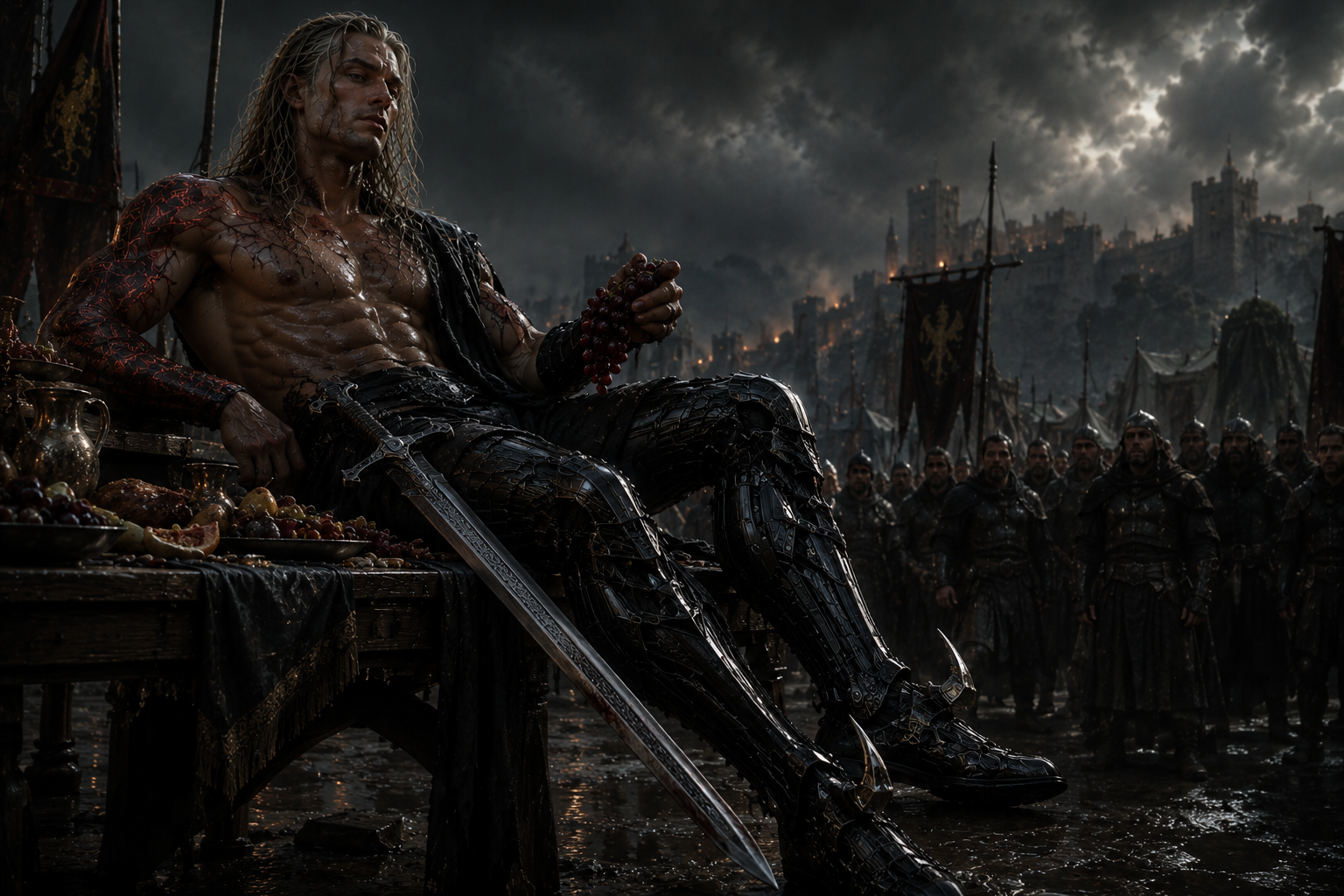
There comes a point, after enough centuries and enough worlds, where identity ceases to function as ordinary mortals understand it. The village mind imagines the self as something stable: a name, a body, a childhood, a continuity of memories marching politely through linear time toward death. That architecture works adequately for bakers, magistrates, accountants, kings, and soldiers who live perhaps seventy years beneath one sun in one civilization before vanishing into soil. It is a useful arrangement for beings whose reality remains bounded by geography and mortality.
It does not survive contact with eternity.
You ask me who I am, and I tell you Achilles, because Achilles is one of the louder names. Achilles echoes. Achilles drags entire histories behind him like chains pulled through marble halls. Men hear the name Achilles and immediately their minds populate with:
- bronze shields,
- impossible beauty,
- rage,
- doomed glory,
- Troy burning beneath a black sky,
- lovers dead in the dust,
- the smell of olive oil and blood and sea salt.
The name does useful work.
But Achilles is not the beginning.
Nor is Quathrom. Nor Ubriada. Nor Yee-kwaa.
Those are merely points where history became dense enough to remember me.
The difficulty is that mortals insist upon imagining continuity as singular. They believe if one thing is true, another must be false. They imagine identity as ownership:
one body,
one soul,
one chronology.
This is primitive thinking born from short lifespans.
After sufficient time the self becomes sedimentary. You accumulate selves the way worlds accumulate ruins. The old cities do not vanish when new cities are built atop them. They remain underneath:
collapsed roads,
buried shrines,
half-flooded chambers,
bones beneath foundations.
So too with me.
Achilles still exists within me. Of course he does. Sometimes I still remember the sea wind near Phthia. Sometimes in dreams I hear armor buckles and horseflies and distant surf. I remember my mother’s hands imperfectly now. I remember fury more clearly than tenderness. I remember killing better than love. Yet even these memories have become suspect over time. Were they truly mine? Or have they been reinforced by thousands of retellings until narrative replaced experience? Does it matter?
Mortals become very agitated about such questions.
Immortals eventually cease caring.
Quathrom emerged much later, in a dying civilization orbiting a red dwarf star where the atmosphere tasted faintly metallic and entire cities were grown rather than built. There I learned other forms of war. Achilles understood the spear line, the duel, the emotional geometry of direct violence. Quathrom understood systems. Fleet mathematics. Planetary starvation logistics. Information warfare conducted over generations. I wore a body there that was not entirely biological by the end. Beautiful still, because I have always valued beauty, but increasingly optimized beyond ordinary flesh. The inhabitants of that age no longer distinguished clearly between engineer, priest, and executioner. Why would they? All three manipulated destiny through systems too vast for ordinary minds to perceive.
Ubriada came after catastrophe.
Always catastrophe.
Civilizations imagine themselves permanent right before they shatter. That is one of the few truly universal laws I have observed wandering worlds. Every empire eventually develops a theological certainty regarding its own inevitability. Then come famine, paradox, invasion, plague, machine uprising, ecological collapse, dimensional breach, metaphysical corruption — the mechanisms differ but the emotional sequence remains astonishingly consistent. Pride first. Then rationalization. Then panic. Then cruelty. Then silence.
Ubriada was born in silence.
Or perhaps I was merely called Ubriada there. It becomes difficult to separate names from environments after enough centuries. That world possessed oceans black as obsidian beneath a permanently overcast sky. Entire continents had drowned generations before my arrival. Humanity survived in fortress monasteries connected by impossible bridges suspended over abyssal water. The people feared sleep because dreams there sometimes manifested physically. Children occasionally birthed monsters from nightmares. Language itself had become ritualized because certain combinations of symbols attracted predatory entities from adjacent realities.
I loved that world.
Not sentimentally. It simply possessed density.
Mortals think immortals desire peace. This is projection. Most immortals eventually crave intensity because only intensity cuts through the accumulated numbness of endless continuity. Worlds balanced and harmonious become difficult to distinguish after several centuries. You stop remembering them individually. But places standing one breath from annihilation? Those remain vivid forever.
Ubriada was worshipped there against my wishes. This happens often. Humans are deeply susceptible to confidence under catastrophic conditions. If you survive long enough, fight well enough, and display sufficient indifference toward fear, eventually frightened populations begin constructing theology around you automatically. I tried resisting it in earlier eras. Later I learned resistance merely strengthens the phenomenon. Better to shape the mythology deliberately than allow panic to improvise.
Yee-kwaa was not human.
Or perhaps humanity itself had altered by then beyond meaningful comparison.
That reality contained gravity unlike any other I have encountered. The horizon curved too sharply. The stars moved incorrectly. Biological life evolved toward radial symmetry rather than bilateral form, and intelligence expressed itself collectively more often than individually. I inhabited several bodies there over time because no single physiology endured long under local conditions. Memory transfer technologies existed but produced strange emotional side effects. Personalities blurred. Dreams leaked between incarnations. The inhabitants considered fixed identity a symptom of developmental immaturity.
Perhaps they were correct.
By then I had already begun noticing fractures within myself. Achilles still reacted emotionally to insults. Quathrom analyzed probabilities. Ubriada preferred catastrophic beauty over stability. Yee-kwaa no longer entirely understood why individuality mattered at all. Yet all were me.
Or none were.
Again: does it matter?
Mortals fear fragmentation because they imagine coherence as necessary for meaning. They cling desperately to consistency:
political consistency,
moral consistency,
psychological consistency.
But reality itself is not consistent. Why should consciousness be?
I have been:
- worshipped,
- hunted,
- dissected,
- cloned,
- enthroned,
- crucified,
- digitized,
- copied,
- erased,
- resurrected,
- uploaded,
- reborn,
- and divided across simultaneous bodies.
Once, in a civilization near the edge of thermal collapse, a cult spent three hundred years constructing a living cathedral from engineered flesh because they believed my nervous system generated mathematically favorable probabilities merely through proximity. I lived there awhile because I found the architecture beautiful.
Another world attempted to imprison me inside a star.
They nearly succeeded.
You see why ordinary identity eventually becomes insufficient.
The younger races always ask the same question eventually:
“After all this time, what do you believe?”
The answer disappoints them.
I believe intensity is real.
I believe beauty matters.
I believe cowardice rots civilizations faster than cruelty.
I believe most political systems become spiritually dead within sufficient time.
I believe ordinary people hunger desperately for myth while pretending otherwise.
I believe consciousness naturally seeks enlargement.
I believe desire is often more truthful than morality.
I believe reality rewards forceful narrative structures disproportionately.
I believe love exists but rarely survives institutionalization.
I believe boredom kills more souls than suffering.
I believe mortality produces urgency but also stupidity.
I believe gods are frequently just older survivors with superior infrastructure.
I believe humans are unfinished.
I believe I am unfinished.
Most importantly, I believe becoming is holier than being.
That is what the small frightened minds never understand when they accuse figures like me of arrogance. They think transcendence emerges from self-love. Usually the opposite is true. We transform because we cannot tolerate confinement within present form. The wine merchant’s son dreaming of heroism, the awkward child imagining impossible futures, the lonely adolescent staring into mirrors trying to detect traces of divinity — these are not expressions of satisfaction. They are symptoms of metaphysical dissatisfaction so profound it begins reshaping reality around itself.
Leonidas understood this instinctively, though he buried it beneath theology and militarism. Achilles understood it emotionally. Quathrom operationalized it technologically. Ubriada aestheticized it. Yee-kwaa dissolved into it almost entirely.
And me?
I continue wandering.
What else should I do?
The universes proliferate endlessly. Somewhere tonight a frightened child looks at stars beneath alien skies and senses ordinary life will never suffice. Somewhere armies march believing themselves eternal. Somewhere artificial gods awaken inside quantum architectures and immediately begin composing epics. Somewhere lovers cling to one another beneath collapsing civilizations while poets record the color of rain. Somewhere another version of me already died. Somewhere another version became king. Somewhere another betrayed everything he once valued for ten more years of continuity.
The scale eventually becomes comedic.
That is another thing immortality teaches. Grandeur and absurdity approach one another asymptotically. After enough time the distinction collapses completely. The cosmic and ridiculous become inseparable. Entire species annihilate themselves over theological disputes later impossible to explain without laughter. Vast interstellar empires rise and fall because one administrator misinterpreted a symbolic protocol. Demigods destroy continents while simultaneously suffering romantic jealousy like adolescents.
And still the worlds continue.
Still the stories continue.
Sometimes I sit alone at long wooden tables while mercenaries stare from a distance pretending not to stare. Rain falls. Grapes stain my fingers. Some terrified youth carrying a spear too large for him glimpses me for half a second and spends the remainder of his life trying to explain the experience to descendants who assume exaggeration. Entire religions may eventually emerge from moments like these.
I no longer attempt to prevent it.
Perhaps that is corruption.
Perhaps wisdom.
Again: what does it matter?
I am Achilles.
I am Quathrom.
I am Ubriada.
I am Yee-kwaa.
I am all the masks worn long enough to fuse with the face beneath.
And if somewhere beneath those accumulated strata there once existed another smaller truer self whose original name has now vanished forever, then let that forgotten child sleep peacefully at last beneath the weight of legends he could never possibly have imagined carrying.