The Arena
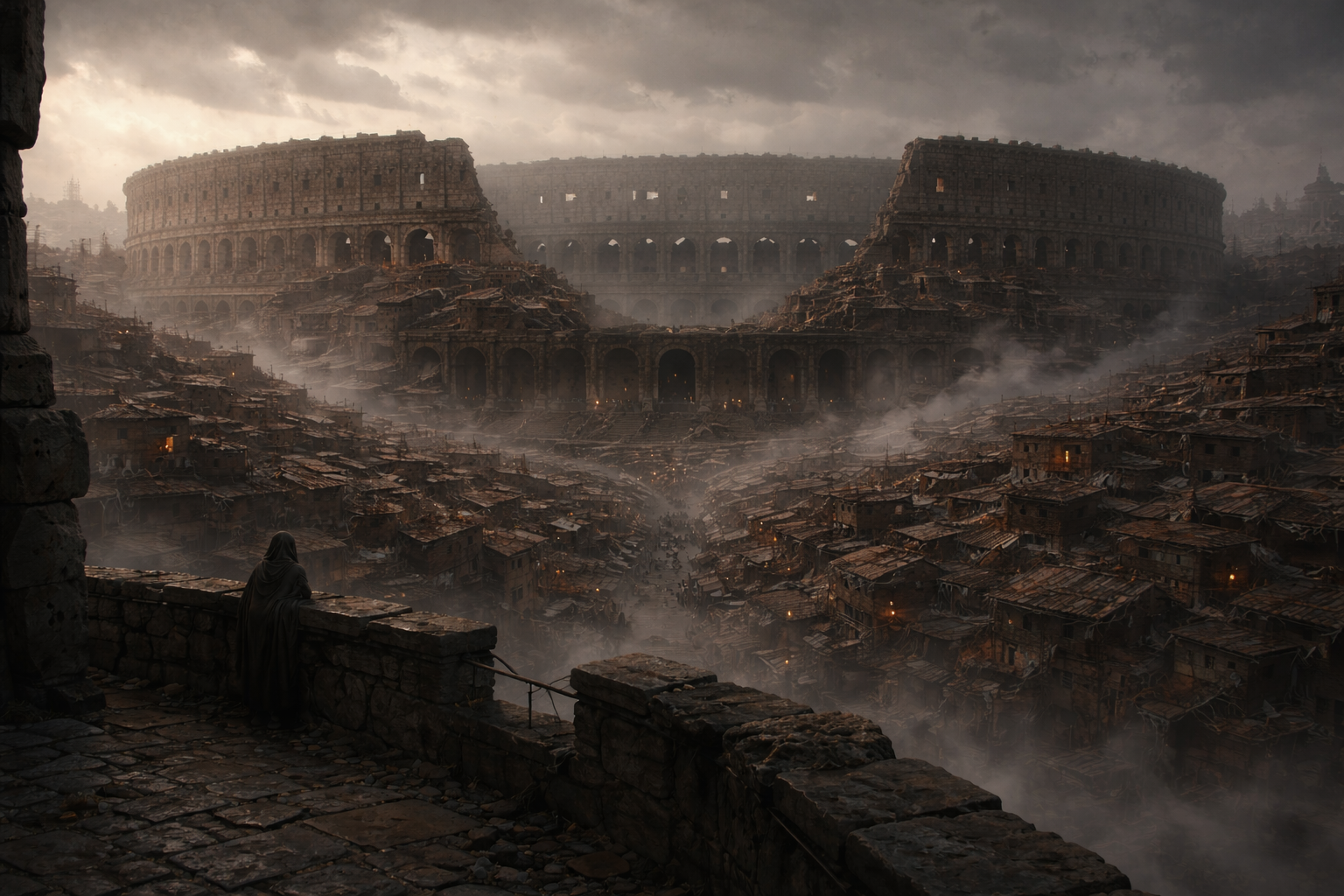
Circus Hades: A History of the Arena of Rinyldissen
Seven hundred years ago, before the Great War reduced the Kingdom to a stitched-together relic of itself, before roads vanished and travel became an act of intent rather than habit, Rinyldissen was chosen for a lesson. It was not chosen because it was disloyal, nor because it was uniquely sinful, but because it was visible, old, and symbolically dense. Rinyldissen had once mattered. That alone made it suitable for punishment and reuse.
The age preceding this choice was one of prolonged failure disguised as reform. The Sidhe Integrations had already collapsed under the weight of their own arrogance. The project had begun as an act of enlightened coercion: to make the Sidhe human, to sand them down into administratively legible subjects. Some endured the process. Those survivors and their descendants still exist, altered slowly over decades, reshaping bone and bearing to pass as human enough to rule quietly—names like Silvershield and Dindae still carry that history in their blood. Others refused, resisted, or simply could not survive the transformation. For them there was an Inquisition, justified first as correction, then as containment, and finally as necessity. The Kingdom learned, as polities always do, that once a category of people is declared a problem, the methods used against them need never improve.
The failure of Integration did not restore stability. It fractured it. Republican movements arose in the gaps left by retreating authority, arguing that a King without an Empire was an obscenity, and that an Empire without a chosen Emperor was a fantasy already disproven by history. The Kingdom became a map of negations: not imperial, not republican, not unified. Roads fell into disrepair not through catastrophe but neglect; no one could justify their maintenance. Caravans ceased to exist because no one could guarantee arrival. Taverns closed because travelers stopped coming. The outer regions were not governed so much as visited, occasionally, by armed expeditions that returned with reports and excuses.
It was into this exhausted landscape that Yoric I asserted himself. He did not inherit an Empire; he attempted to resurrect one. His tools were old and theatrical: Sky-Galleons lifted from forgotten arsenals, harpies driven into the skies as terror-assets rather than creatures, and omens made material. When Rinyldissen was taken, it did not burn. It froze. Black snow fell from the sky—not ash, not corruption, but snow whose nature was black, as if the weather itself had been recruited. People remembered that detail because it taught them something essential: this was not punishment for rebellion. It was demonstration.
Yoric understood that conquest alone would not hold the city. Rinyldissen had been conquered before. It had survived by becoming dull, difficult, and expensive to manage. To remake it into an imperial heart, something more was required. He required hunger—not for food, but for blood. For this he turned to Leonidas, a rising Champion of Heiegos, the War God. Leonidas was an unusual choice, not because he lacked skill, but because he lacked reverence. He had read foreign books, Greek texts from the waking Earth, and had decided that Heiegos was merely Ares under another name. This was not heresy in the modern sense; it was worse. It was instrumental reinterpretation. Leonidas did not worship the god he served. He curated him.
The Arena was Leonidas’ solution. Or rather, two Arenas fused into one impossible structure. First, a Colosseum, modeled obsessively on historical records, scaled slightly larger in an act of competitive nostalgia. Second, grafted onto it, a Circus Maximus of absurd proportion, widened until it became an architectural joke, elevated until the audience tiers nearly matched the Colosseum’s height for their entire length. The combined structure was named Circus Hades. It was meant to seat millions. It was meant to be seen from miles away. It was meant to make violence communal again.
The labor was gnomish. Slave labor, in the old sense: purchased, owned, consumed. The irony of using a people renowned for precision and craft to build something so brutally wasteful was not lost on Leonidas, who considered it appropriate. Stone rose quickly. Blood soaked the foundations before the first games were ever imagined. Yoric elevated Leonidas to demigodhood to ensure continuity, binding him to the project not just as architect and champion, but as immortal custodian. The plan was simple in its cruelty: make Rinyldissen bloodthirsty, grow it rapidly, pack it with bodies until it could no longer remember how small it once was.
The plan failed.
Spectacle did not produce infrastructure. Blood did not summon trade. Crowds did not become citizens. The Arena could draw people for events, but it could not keep them. Without roads, without markets that extended beyond the city, without trust in governance, Rinyldissen could not sustain growth. The Empire had attempted to skip the unglamorous stages of civilization—maintenance, negotiation, patience—and had paid for it with silence. Within a generation, the project stalled. Circus Hades stood mostly finished and entirely unused, an immense stone husk casting shadows over empty ground.
For nearly a century, the Arena was grazed by goats. This fact is often recorded as a footnote, but it deserves emphasis. Goats are not symbolic animals. They go where there is nothing else. Their presence marked the Arena as abandoned, not cursed. Farmers followed. Then came small markets, informal exchanges that clung to the structure’s edges because stone walls break wind and offer shelter. People built against it, then into it, then within it. The Arena did not attract life because it was grand, but because it was already ruined.
By the time of the Great War, Circus Hades was no longer a single place. It was a geography. Refugees poured into Rinyldissen not because it was safe, but because it was already broken enough to absorb them. The war finished what neglect had begun. Afterward, no authority possessed the resources or will to reclaim the structure. It filled instead. Tier by tier, corridor by corridor, vomitoria repurposed as streets, seating collapsed into housing. The Arena became a city grown inward, parasitic and unavoidable.
In the present age, half a million people live inside the Arena’s bones. Conditions are unrelentingly bad. This is not poverty as an abstract statistic, but as daily abrasion: water hauled, light stolen, violence normalized because it cannot be eradicated. The Arena no longer produces spectacle in the way Leonidas intended, but it still produces bodies—workers, fighters, criminals, the Damned. It feeds the Kingdom cheaply, absorbs its refuse, and provides a visible location onto which everything unspeakable can be projected.
Circus Hades was never redeemed. It was never corrected. It simply persisted. The Kingdom learned to live with it the way organisms live with scar tissue: not useful, not gone, but unavoidable. The tragedy of the Arena is not that it failed as an imperial engine, but that it succeeded as a habitat. What was built to manufacture bloodlust instead manufactures endurance. And that endurance, raw and unaesthetic, has become intolerable to those who require continuity without witness.
This is why the Arena is feared. Not because it is violent, but because it remembers why it was built. And because it proves, in stone and flesh, that some mistakes do not end. They merely fill up.