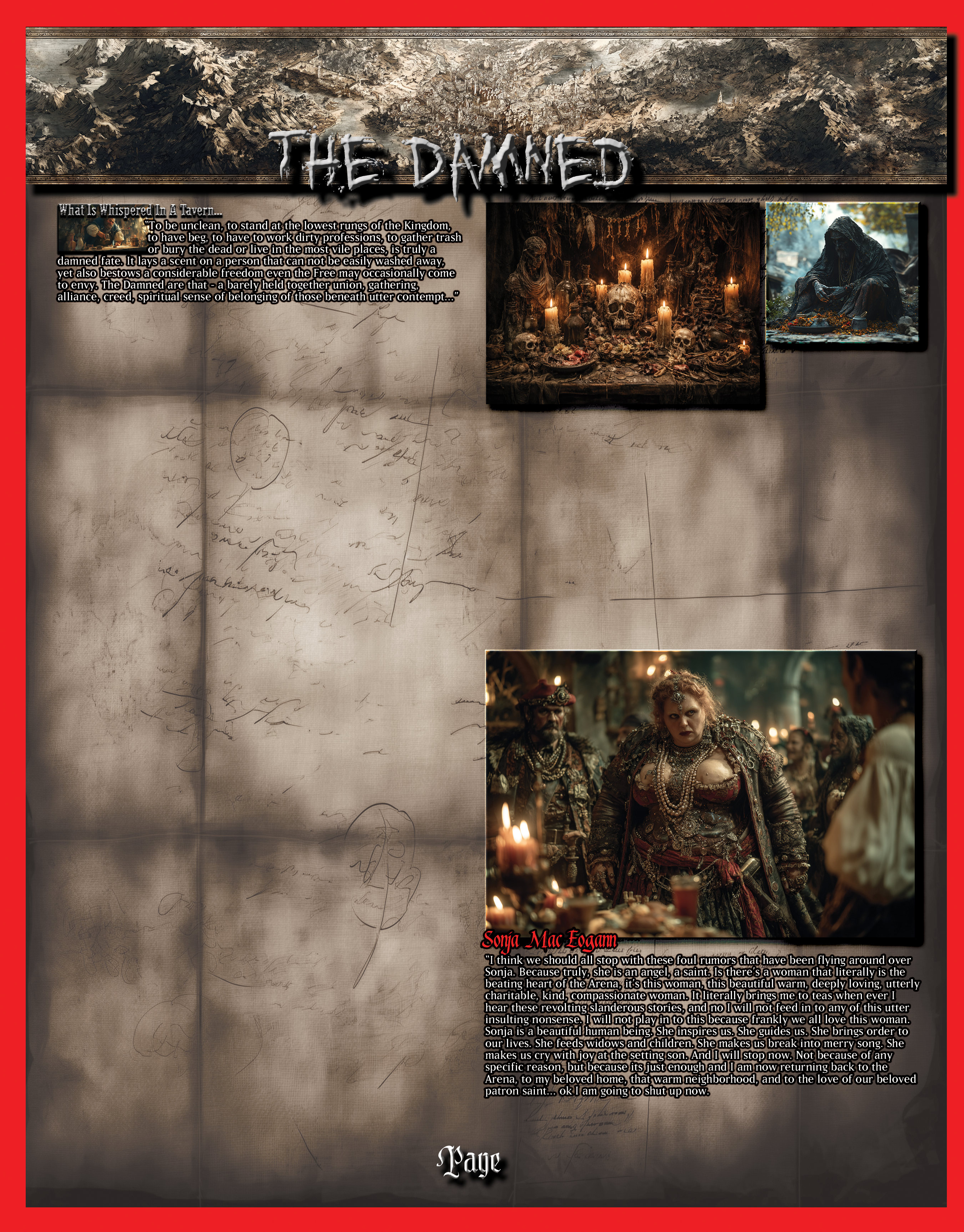
The Damned Alignment
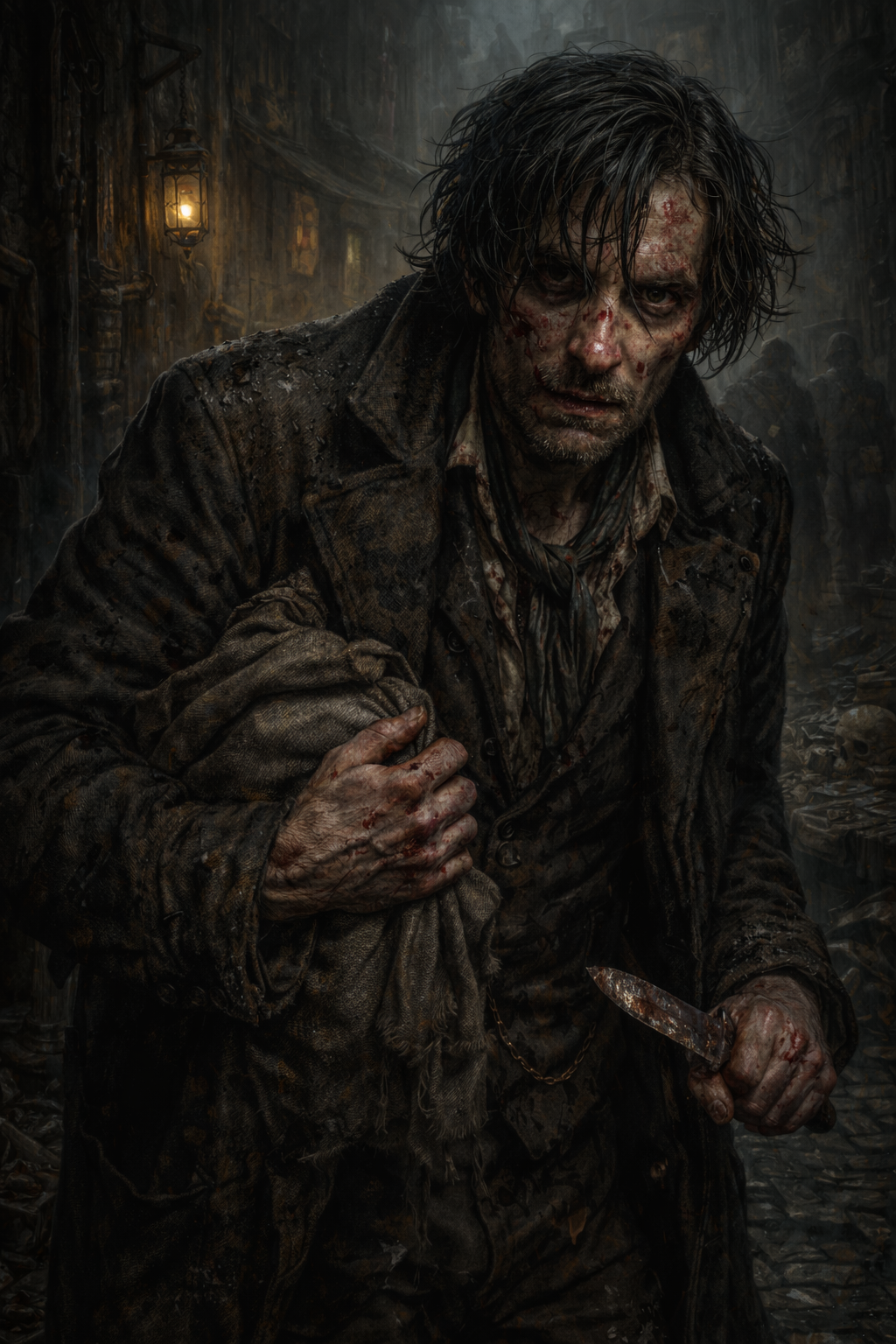
There are those who stand firmly upon the earth and those who wander it in good faith, and then there are those who have stepped half an inch too far and never quite stepped back. The Damned are not monsters, nor are they frothing caricatures of broken minds confined to padded rooms and iron restraints; they are men and women who have seen something they were not meant to see, or understood something that polite reality insists cannot be understood, and they carry that knowledge like a subtle fracture beneath the skin. In a crowded street they look ordinary, and often they are, yet the world presses differently against them, as though the angles do not quite align and the light bends in ways only they notice.
To be Damned is not to be incoherent, nor is it to be theatrical, and certainly not to be a shrieking clown waving knives at the moon. The Damned may hold positions of responsibility, may maintain friendships, may love, may conduct business, may keep accounts and attend to the mundane obligations of life, yet somewhere in the private chambers of their thought there is a door that once opened and cannot be entirely shut. They have glimpsed a geometry behind events, a pattern beneath causality, a whisper threaded through coincidence, and while others dismiss such impressions as dreams or nerves, the Damned know with uncomfortable certainty that the pattern persists whether one believes in it or not.
In drawing near to the quadrant of Yog-Sothoth, they do not become devotees or cultists, for devotion implies comfort and the Damned know no such ease. What they encountered did not invite worship but awareness, and awareness once acquired does not fade simply because society finds it inconvenient. They understand that time is less linear than assumed, that causation is more porous than philosophy admits, that the boundaries between perception and event are thinner than most would prefer, and these realizations alter a person without necessarily destroying them. Indeed, the tragedy and the power of the Damned lie in the fact that they continue to function, to reason, to choose, even as they navigate a world that now feels subtly misdescribed.
Victorian sensibilities linger about them, not merely in aesthetic but in restraint, in the quiet management of inappropriate truths. There is a composure to the Damned, a cultivated civility that masks the unsettling depth of what they have come to suspect. They know there are things normal people should not know, not because such knowledge is forbidden by decree, but because it changes the knower in irreversible ways. They are often careful with speech, not out of secrecy but out of mercy, for to speak plainly is sometimes to wound another’s innocence beyond repair. Thus the Damned become guardians of silence, custodians of unspeakable context, holding back details that would fracture the comfortable narratives of those around them.
Failed sanity does not render them useless; rather, it reorients their perception. They may notice inconsistencies others overlook, may feel unease where others feel comfort, may respond calmly to horrors that unseat sturdier constitutions, because what once shocked them has already been integrated into a broader, more disquieting framework. Their composure can be mistaken for coldness, their detachment for arrogance, yet beneath it often lies a fierce and private commitment to preserving what remains of ordinary life. They have seen the abyss not as a roaring spectacle but as a quiet expansion of possibility, and having seen it, they choose daily whether to lean further or to hold their ground.
Within the world of play, the Damned offer not chaos but perspective. They are interpreters of anomalies, mediators between the inexplicable and the pragmatic, individuals who can stand in the presence of unsettling phenomena without immediately losing agency. Where others recoil or deny, the Damned consider, weigh, and sometimes act with a clarity born of having already confronted the destabilizing truth that reality is not as fixed as advertised. Their strength lies not in madness but in adaptation, in the capacity to endure awareness without surrendering identity.
They are diverse in origin and temperament, for the touch that marks them does not discriminate by profession or disposition. A scholar who deciphered a marginal note too thoroughly, a soldier who survived an encounter no battlefield manual could explain, a physician who observed symptoms that defied anatomy, an aristocrat who inherited a diary best left unread, all may find themselves counted among the Damned. What unites them is not temperament but aftermath, the subtle shift in worldview that refuses to be undone. Some become more compassionate, recognizing fragility in all things, while others grow austere, unwilling to indulge comforting falsehoods, yet both remain recognizably human.
Society regards them with a mixture of curiosity and discomfort, sensing something slightly misaligned but rarely identifying it outright. They may be described as intense, eccentric, overly perceptive, morbidly philosophical, or merely odd in ways difficult to articulate. The Damned learn to navigate these perceptions with care, sometimes leaning into their reputation to deflect deeper inquiry, sometimes striving to appear entirely unremarkable. In either case, they remain aware of an invisible horizon others do not perceive, a threshold beyond which the world ceases to behave according to common sense.
The alignment does not demand self-destruction, nor does it encourage flamboyant displays of instability. Instead, it invites a quieter tension, the ongoing negotiation between what is known and what can safely be acted upon. The Damned walk this line not because they relish danger but because they have already crossed the first boundary and found no path back to ignorance. Their choices carry weight, for they understand that knowledge spreads and that awareness, once shared, cannot be reclaimed, and thus they weigh carefully when to reveal and when to remain silent.
To play one of the Damned is to inhabit that liminal space where certainty erodes but agency persists, where the mind stretches toward unsettling truths without dissolving into caricature. It is to accept that the world contains layers not universally acknowledged and to choose, day by day, how deeply to peer into them. The Damned are not defined by hysteria but by endurance, not by spectacle but by the steady management of a widened perception. They are those who have been touched and did not entirely shatter, who carry within them a sliver of the impossible and yet continue, resolute and composed, in a world that prefers not to notice the cracks.