Multi Level Perspectives
Overview
This guide is designed to help you understand and apply the Multi-Level Perspectives (MLP) framework as a facilitated systems thinking activity. It is critical to note that this is NOT a comprehensive overview of the academic theory and conceptual approach of the MLP . It's structured to provide:
- An overview of the framework within the context of using as a social learning activity to support systemic understanding
- Step-by-step activity instructions
- Tips for analysis and follow-up
- Frequently asked questions
Whether you're new to systems thinking or an experienced practitioner, you can use this guide to plan and facilitate MLP activities, and consider results.
Description
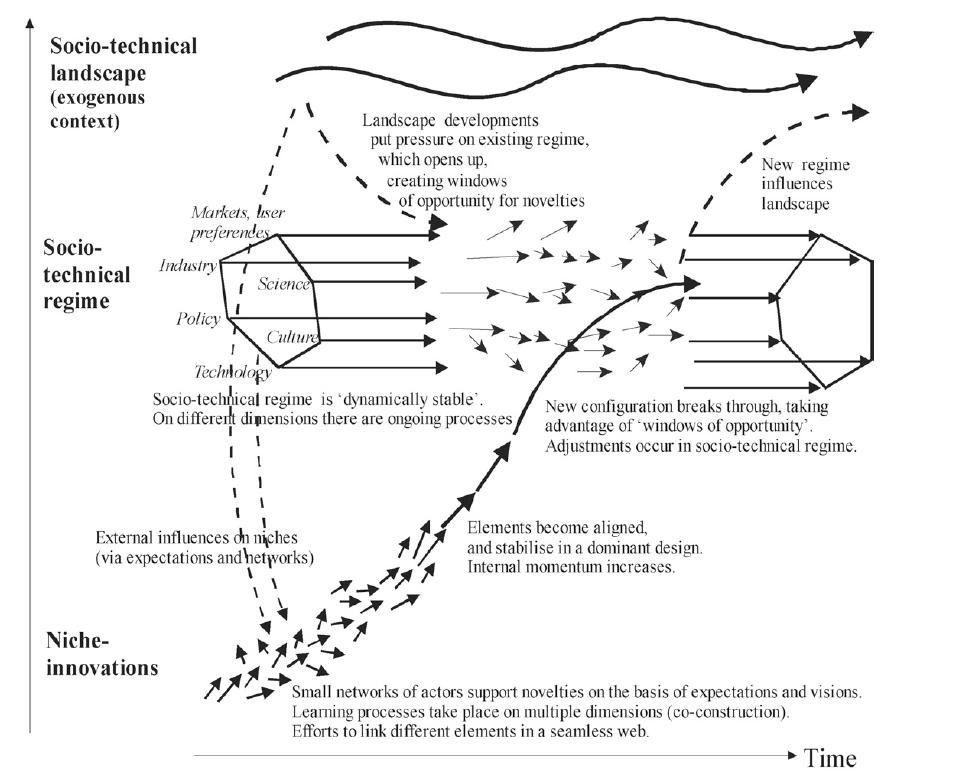
The MLP framework is a valuable tool that offers a systems level perspective on how a system changes, by exploring what is happening at multiple levels in a system and the interactions across these levels. Of particular value is the opportunity to explore how an innovation or intervention will be ‘met’ by current system characteristics. It also helps to indicate how immediate activities can cumulate into longer-term changes.
While originally introduced to explore how innovations are introduced and interact across a system, systems thinking and design facilitation has adopted its use beyond this initial and conceptual intention. It has been utilized as a social learning activity to create a systemic map of a particular situation or intervention, to forecast and backcast innovations. Adaptations, include the offering of additional layers such as ‘mentalite’ and ‘ecology’ that offer more holistic systemic perspectives on innovation transitions.
Output: A large-scale map of the MLP framework, showing interactions between niche, regime, and landscape levels over time.
Process: A medium-sized activity involving several steps, usually involving multiple participants, and is used to achieve a specific output often in 1-2 sessions.
Investment: Low cost, low resources, medium skill, medium time
Visualization of the MLP
Outcomes
- Shared understanding of system dynamics across multiple levels
- Ability to connect immediate activities with longer-term changes
- Identification of how innovations interact throughout the system
- Recognition of factors that help or hinder scaling of innovations
- Understanding of how activities are suited to unique levels in the system
- Anticipation of how new innovations might interact with the current system
When and Why to Use This
- When beginning to gain familiarity in a system
- When there's a large shift in one level of the system
- When planning an activity and trying to see how it will interact throughout the system
- To stay connected to larger system dynamics
- To track how an innovation has interacted with larger system dynamics over time
- To anticipate how a new innovation might interact with the current system
- To diagnose why certain innovations have or haven't scaled up in the past