Perkins, Jacob
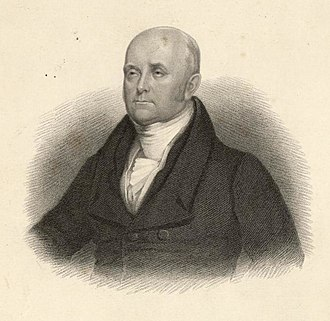
Name: Jacob Perkins
Achievements: Printed first postage stamps
Born: July 9, 1766; Newburyport, Massachusetts
Died: July 30, 1849; London, England (Aged 83)
Field & Discipline: Art; Industry; Printing; Goldsmith
Language: English.
Father: Matthew Perkins
Mother: Jane Noyes Dole
Siblings: Abraham; Sarah; Capt. Benjamin (half brother)
Spouse: Hannah Greenleaf (married 1790)
Children: Angier March; Ebenezer Greenleaf; Elizabeth; Hannah Greenleaf; Henrietta; Jane; Louisa Jane; Mary; Sarah Ann.
Education: Minimal
Major Work:
Printing of the first British postage stamps.
Life & Times:
Around 1798, counterfeiting banknotes was simple for anyone with engraving skills, and the banks were losing money. Perkins became involved in the development of check-plate protectors or stereotype steel plates. He came up with the idea of using a number of separate dies, each engraved with a complex series of elaborate designs, letters and figures.
Any single plate might have up to sixty-four different dies, clamped together in a strong frame to form one complete die, or matrix. Using the Perkins system, the name of the bank, town or denomination could be changed and the information on the die could then be transferred, under pressure, to the printing plate.
At first, the printing plates were made from copper, soft iron or steel but, after repeated use, they soon wore out and the transferred design started to lose quality. Around 1804 Perkins treated the delicate surfaces of his engraved plates, using a process known as annealing, in which steel is softened and then hardened by cementation.
The process of annealing was already in use by engineers, but this was the first time it was used in another industry. By 1805, sixteen banks were using notes printed by Perkins’ plates and, in 1809, the state of Massachusetts passed a law mandating all banks to adopt the Perkins printing method.
Sometime around 1810, Perkins began working with a bank-note engraver, Gideon Fairman and, in 1817, they decided to pitch for the contract to print notes for the Bank of England. After a year of preparation, they sailed to Britain with cases packed full of machinery.
This ‘American method’ of siderographic (“steel-writing”) printing was discussed in the British parliament but, even though it was endorsed by engineers like [idea endorsed by] Marc Brunel* and [idea endorsed by] Maudslay*, the idea was rejected. The Governor of the Bank of England, [opposed by] Sir William Congreve*, wanted to keep production of banknotes under his own supervision and he was already experimenting with new methods.
In 1819, Perkins set a company up in Britain named Perkins, Fairman & Heath. The aim of the company was to produce engravings for book illustrations and reproductions of pictures for albums, bookplates and portraits, but their most profitable work came from printing banknotes.
The Bank of England had turned them down but, since anyone could open up a bank at that time, there were hundreds of city and country banks in Britain. After two years of trading, they were given a valuable contract by the Bank of Ireland.
Another great success came in March 1840, when they were given the contract for the engraving and printing of the first penny postage stamps for [printed stamp for] Rowland Hill*. The engraved die for the stamps was multiplied and transferred onto eleven steel plates that had undergone Perkins’ annealing process.
Two presses were installed at the factory, with a third added soon after, each capable of printing 120,000 stamps a day onto watermarked paper provided by the government. The company made the plates, and printed and gummed the stamps.
Perkins then began to experiment on high-pressure steam boilers and engines and by 1827 he managed to achieve a working steam pressure of between 800 to 1400 pounds per square inch. At the same time, he developed a special alloy which allowed the pistons to be so highly polished that they didn’t need lubrication.
He also came up with an improved paddle wheel, patented in 1829 and then in 1831 invented a method for free circulation of water in boilers (the precursor of the water-tube boiler). In about 1836 he patented a very successful high-pressure boiler and steamship engine using steam at a pressure of two thousand pounds psi.
Perkins’ other inventions included a plenometer, for measuring the speed of ships, a ship’s pump, for which he was awarded the Vulcan medal, and a method of ventilating the holds of ships, for which the Society for the Encouragment of Arts awarded him its medal.
Extra Connections: His work related to that of [work related to] Nixon*.
His quality printing of American bank notes attracted the attention of the Royal Society who were busy addressing the problem of the widespread forging of English notes. In 1819, with his printing business partner, Gideon Fairman, they employed Asa Spencer and went to England at Charles Heath's urging in an attempt to win the £20,000 reward for "unforgable notes". Sample notes were shown to the Royal Society president Sir Joseph Banks. They set up shop in England, and spent months on example banknotes, but unfortunately for them, Banks thought that the inventor should be English by birth.
In 1816, Jacob Perkins had worked on steam power with Oliver Evans in Philadelphia. In 1822 he made an experimental high pressure steam engine working at pressures up to 2,000 psi (14 MPa).[8] This was not practical for the manufacturing technology of the time, though his concepts were revived a century later....
Perkins' high-pressure steam technology was also used in another invention, the steam gun. This was an early fully automatic machine gun, powered by steam rather than by gunpowder. Although not the first automatic firearm, it was the first to also have a high magazine capacity of more than a handful of rounds. It operated with musket balls at a cyclic firing rate of 1,000 rounds per minute. It is reported to have been rejected by the Duke of Wellington as 'too destructive'.[8]
Perkins is credited with the first patent for the vapor-compression refrigeration cycle, assigned on August 14, 1834[11] and titled, "Apparatus and means for producing ice, and in cooling fluids". The idea had come from another American inventor, Oliver Evans, who conceived of the idea in 1805 but never built a refrigerator. The same patent was granted in both Scotland[12] and England separately.[13]
Assessment: He is chiefly remembered as the first to have introduced steel engraving for the prevention of banknote forgery.
Oneliner: Jacob Perkins, first stamp printer
Bibliography:
- Bathe, Greville and Dorothy, Jacob Perkins: His Inventions, His Times, & His Contemporaries, Historical Society of Pennsylvania, Philadelphia, 1943.