Bennett, J Gordon
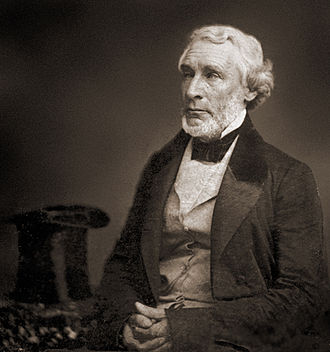
Achievements: Founded the New York Herald newspaper.
Born: September 1, 1795; Banffshire, Scotland
Died: June 1, 1872; New York City (Aged 77)
Field & Discipline: Journalism; News Publishing
Language: English
Father: Unknown
Mother: Unknown
Siblings: Unknown
Spouse: Henrietta Bennett.
Children: James Jr.; Jeanette
Education: Blair College, Aberdeen, Scotland.
Life & Times:
Bennett’s parents were Roman Catholics of French descent and wanted him to become a priest. At age fourteen he was sent to study at a seminary in Aberdeen. Bennett had doubts about religion and decided the priesthood was not for him.
He emigrated to Nova Scotia at age twenty-four, eventually making his way to Boston, where he found employment as a proofreader and book salesman. In 1822 he went to New York and worked as a freelance journalist, then moved on to Charleston, S.C. to work in the offices of the Courier as a translator. He returned to New York in 1824 and continued working as a reporter after an unsuccessful attempt at founding a commercial school.
Three years later he joined the staff of the New York Enquirer and became their Washington correspondent. Bennett boasted that he changed the tone of Washington correspondence from dull accounts of congressional hearings to lively stories of political intrigue and society. His columns were quite popular, and when the Enquirer merged with the Courier, Bennett was appointed associate editor.
Independent and opinionated, Bennett often found himself at odds with editor James Watson Webb and decided to start his own newspaper. He rented a basement office on Wall Street and worked at a desk made from a plank laid atop two barrels. On May 6, 1835, the first issue of the New York Herald hit the streets.
Bennett wrote the entire four-page paper himself and charged one cent per issue. The more established papers sold for six cents and the Herald was derisively referred to as a “penny-paper.” The Herald was competing with fifteen other daily newspapers, but it stood apart due to Bennett’s innovative style.
Newspapers in those days were written more for their editors than for the reading public. A personal feud between rival editors would typically command more print than the events of the day. Bennett was determined to give the people what they wanted to read, and in doing so, he broke many of the journalistic taboos then in existence.
The Herald was the first paper to feature a regular financial column and the first to list bankruptcies, which had previously been considered an act of slander. Criminal cases, usually given only a few lines, were widely covered in the Herald.
The beginnings of investigative journalism can be seen in the paper’s detailed accounts of the Helen Jewett murder case, in which the accused party was absolved largely thanks to the Herald. Bennett single-handedly covered the great fire of 1835 in New York City and his graphic account set a new standard for disaster reporting.
He was the first to use the telegraph for reporting news and established a network of correspondents in key cities across America and Europe. In 1846, a political speech was transmitted via telegraph for the first time. The speech, by [telegraph-reported speech by] Clay*, was received and printed by the Herald.
The paper quickly became one of the most successful in the United States. Even as the staff grew, Bennett continued to maintain close control over the paper’s content. He was an avid collector of news and would spend several hours each morning reading the press exchanges, making notes on the stories that he knew would appeal most to his readers. His sensationalist writing style and controversial practices made him the frequent target of attacks, both verbal and physical.
Assault was an occupational hazard for editors in those days but did provide good copy. Bennett twice came to blows with his former employer, James Watson Webb, and reported the incidents in full.
Despite his financial success, Bennett was excluded from New York’s high society because he ignored the implicit ban on covering social events in newspapers. The loudest uproar came in response to Bennett’s attack on Victorian prudery. When he dared to print the word “petticoat,” a term considered highly offensive, committees were organized to boycott the Herald, and rival editors prematurely announced the end of his career.
The campaign had the opposite effect and the paper’s circulation continued its steady rise. Still, the strain proved to be too much for Bennett’s wife, Henrietta. After witnessing a gang of men attack her husband on Broadway as two policemen looked on, she moved to France, taking their two children with her.
In the years leading up to the Civil War, the Herald was sympathetic to the Confederate cause. Bennett was opposed to reform movements and viewed the abolitionists as a threat to the Union. When war broke out, angry mobs surrounded the Herald building until Bennett raised the American flag. [lobbied by] Lincoln* lobbied Bennett for his support and eventually won him over to the Unionist cause.
The Herald’s coverage of the Civil War was unparalleled in depth and detail. Bennett employed 63 war correspondents and spent over half a million dollars covering the war. The Herald was more objective than most other papers in its coverage and was one of the few that Lincoln read regularly. Bennett supported Lincoln for re-election in 1864, for which Lincoln gratefully offered him a post as minister to France, which he respectfully declined.
At the age of seventy-two Bennett gave up managing the Herald and gave sole proprietorship of the paper to his son, James Jr. When Bennett died in 1872, [coffin carried by] Greeley* of the Tribune and Charles Dana of the Sun were among his pallbearers. Greeley, who had a high-minded opinion of journalism, was less than flattering in his farewell editorial to Bennett.
Bennett believed that newspapers should appeal to the tastes of the general public, and that included their bad tastes. Many found his sensationalist style offensive, but no one could argue that he redefined what was news, for better or worse. James Jr. carried on his father’s revolutionary tradition by inventing the news exclusive.
In 1869-71 he financed [funded Livingstone search by] Stanley*’s expedition into Africa to find [funded search for] Livingstone*, and from 1879-1881 he supported the ill-fated “Jeanette” expedition of G.W. Long to the Arctic.
Assessment: Bennett is considered the father of modern journalism and has been called the first real reporter.
Oneliner: James Gordon Bennett, father of the popular press.
Bibliography:
- O’Connor, Richard, The Scandalous Mr. Bennett, Doubleday, New York, 1962.
- Encyclopedia Americana, v.3, Grolier, Danbury, Connecticut, 2001, p.554.