Nasser
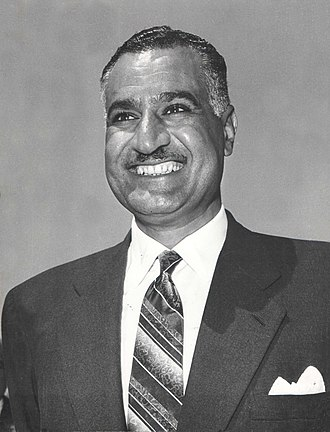
NAME: Nasser, Gamal Abdel
ACHIEVEMENTS: Egyptian independence
NICKNAME/ALIAS: None
DATE AND PLACE OF BIRTH: January 15, 1918, Alexandria, Egypt
DATE/PLACE OF DEATH/AGE AT DEATH: September 29, 1970, Cairo, Egypt. Aged 52
DISCIPLINE: Soldier/Politician
FIELD: Military/Politics
LANGUAGE: Egyptian
PARENTS: Abdel-Nasser Hussein; Fahima Hammad
SIBLINGS: Brothers: Az el Arab; Shawky
SPOUSE: Tahia Khazem
CHILDREN: Sons: Khaled Abdul; Abdel Hakim. Daughters: Hoda; Mona
EDUCATION: Primary schools, Alexandria and Cairo; El-Nahda Secondary school, Cairo; Royal Military Academy, Cairo
MAJOR WORK: "Philosophy of Religion"
LIFE AND TIMES:
As a young soldier, Nasser served briefly in Upper Egypt, then was posted to the Sudan in 1939, where he became close friends with Anwar el Sadat. The two agreed to form a secret organization, the Free Officers, whose members would be known only to Nasser.
Anti-British feeling grew in Egypt during the Second World War (1939-45). The British, who in effect controlled Egypt, imposed neutrality on it, then used it as a supply depot for their Middle Eastern war operations.
In 1943, Nasser was appointed an instructor at the Royal Military Academy in Cairo, where he began to recruit men dedicated to revolution and enrolled them in his secret Free Officers movement.
After the War, he kept the military section of the movement under his control and put the civilian section under the control of Sadat. Besides army officers, members of the movement included senior officers in the Air Force, the Tank battalions and the Royal Guards. Nasser, who gave no public sign of his affiliation, had a hard time keeping the Free Officers from initiating overt action.
In 1948, after the state of Israel was officially proclaimed in Palestine and the Britain terminated its mandate there, Nasser, now a major, was part of the Egyptian force that invaded the region. His unit was encircled by Israeli forces in the Gaza strip for four months, but it held out.
On July 23, 1952 the Free Officers staged a bloodless coup. Nasser was among those who supported exile for King Farouk rather than execution. The Revolutionary Command Council took over the government and Nasser became deputy prime minister and minister of the interior. He concealed his true role as de facto leader of the Free Officers until 1954, when he became prime minister.
Nasser introduced agricultural reforms, limited the size of farms and reducing the holding of land-owners. He brought in new social and labor legislation. He survived an attempt to assassinate him by the Muslim Brotherhood. He was suspicious of the West, particularly after Britain encouraged the independence of Sudan without discussing it with Egypt.
In 1954-55, he refused the West's invitation to join the Baghdad Pact (an association of countries bordering the Soviet Union,) seeing no good reason to do so and disapproving of the inclusion of non-Arab states in the pact. He conferred with Indian prime minister <worked with> Nehru* and Yugoslavia's <worked with> Tito*, both of whom advised him to pursue a policy of non-alignment.
In 1956, Nasser declared Egypt a socialist Arab state, with a one-party system, and with Islam as state religion. He was now supreme commander, controller of the security services, and President, with the power to appoint ministers, all of whom were responsible to him, not Parliament. He was the chief policy maker and head of the only permitted political movement, the Liberation Rally.
Nasser's policies antagonized the Western powers and in July, 1956, U.S. Secretary of State <antagonized> Dulles*, canceled the American aid he had promised for the Aswan Dam on the Nile. Britain also withdrew its support. Within days, Nasser nationalized the Suez Canal and announced Egypt would use the profits from a toll on the canal to build the dam.
In October, the Israelis invaded the Sinai Peninsula and then French and British planes attacked Egyptian airfields. The Egyptian Air force was almost destroyed, but Nasser's prestige as an Arab leader was heightened. In 1958, he formed the United Arab Republic with Syria, but Syria withdrew three years later. The most serious consequence of the war with Israel was the drain on Egypt's economy.
Although Nasser had introduced an aggressive program of modernization and industrialization, made attempts to curb corruption, and improved the status of women, the lives of the poor did not noticeably change. In time, a new educated professional class emerged, which took over the administrative jobs that foreigners had held, but competence was slow to rise.
Fearful of the consequences of another conflict with Israel, Nasser advocated a policy of restraint towards Israel, but the Palestine Liberation Organization and Syria were not buying it, and Nasser began to lose his credibility as a champion of the Palestinian cause. In addition, the pro-Western Saudis were challenging his leadership in the Arab world. To show his clout, Nasser ordered the closing of the Gulf of Aqaba to Israeli shipping, and put his troops into Sinai.
Israel responded with devastating efficiency. The Egyptian air force was virtually destroyed again, and Egypt's troops were decisively crushed. Nasser took full responsibility and attempted to resign, but there were huge street demonstrations begging him to stay, and the National Assembly would not accept his resignation. With the U.S. as mediator, Nasser opened peace talks with Israel, but died of a heart attack while negotiations were in process.
ASSESSMENT: Exhibited a forceful charisma and was recognized as the major Arab leader, but failed to unify the Arab world.
EXTRA CONNECTIONS: None
ONELINER: Gamal Abdel Nasser, who led Egypt to independence
BIBLIOGRAPHY:
Woodward, Peter, Nasser, Longman, London, 1992