Tito
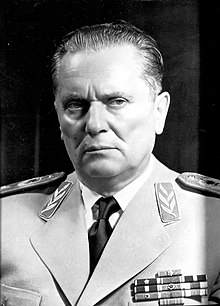
ACHIEVEMENTS: First President of Federal People’s Republic of Yugoslavia
NAME: Broz, Josip
DATE AND PLACE OF BIRTH: May 7, 1892, Kumrovec, (Zagreb), Croatia
DATE/PLACE OF DEATH/AGE AT DEATH: May 4, 1980, Ljubljana, Yugoslavia. Aged 87
DISCIPLINE: Partisan Activist/Statesman
FIELD: Communist Underground/Politics
LANGUAGE: Croat
PARENTS: Franjo Broz; Marija Javersek
SIBLINGS: Six
SPOUSE: 1) Pelagea Belousoa; 2)Jovanka Budisavljevic
CHILDREN: 1) by Pelagea Belousoa: Zarko; 2) by Herta Has: a son
EDUCATION: Village school, Kumrovec
MAJOR WORK: None
LIFE AND TIMES:
Tito was a metalworker before being conscripted into the Austro-Hungarian army at 21. Two years later, he was taken prisoner by the Russians. Impressed by Bolshevik ideology, he joined the party and married a Russian.
In 1920, after the First World War, Tito returned to Croatia, now part of the new state of Yugoslavia, and became part of the underground Communist movement. A trade union organizer in Croatia and Serbia, he joined the Zagreb party in 1927, becoming the organizing secretary and, within the year, political secretary. After the assassination of Croat politicians in the Belgrade parliament in June, 1928, Tito led street demonstrations, was arrested two months later, and when bombs were found in his apartment, was sentenced to five years' imprisonment.
Released in 1934, Tito was summoned to Vienna by Milan Gorkic, the exiled leader of the Yugoslav Communist party, who appointed him to the Politburo, the policy-making arm of the party.
In 1935, Tito went to the Soviet Union and worked for over a year in the Comintern (the International Communist party), where he established close ties with young militants inside Yugoslavia. In 1937, when Stalin* ordered a purge of international Communists, most of the leading members of the Yugoslav Communist party, including Gorkic, were murdered.
In 1939, Tito was made secretary general of the Yugoslav party, and at a party conference, outlined his plan for armed rebellion against the royalist government in Yugoslavia and the division of the country into national federal states.
When Germany and Italy invaded Yugoslavia in April, 1941, Tito's Communists were already a political force and had the organization and will to mount an opposition. When the Yugoslav king fled, the country was split between Tito's Communist Partisans and Mihailovic's pro-royalist Serbian Cetniks. Eventually the Cetniks allied with the Germans.
In 1943, the Allies recognized Tito as the leader of the Yugoslav resistance and the royal government in exile agreed to co-operate. In 1944, Serbia was liberated by the Soviet army, and by May, 1945, the Communists were in control throughout Yugoslavia. Tito purged the government of non-Communists and rigged elections to get rid of the monarchy.
In November, 1945, the Federal People's Republic of Yugoslavia, with Tito at its head, came into being. Tito conducted a series of brutal purges against Catholic priests, opposition politicians, and even fellow party-members. Unhappy with Tito's independent spirit, Stalin tried unsuccessfully to have him removed, then expelled the Yugoslavs from the Cominform (the alliance of European Communist ruling parties) and imposed economic boycotts. That made Tito move closer to the West.
During the Cold War, Tito became expert in obtaining Western aid without compromising his agenda. When Stalin died in 1953 and the more liberal Krushchev* came to power, Tito began to move closer to the Soviet Union. A visit by Krushchev in 1955 resulted in the Belgrade Declaration, which stated that the Soviet Union and other Communist-ruled countries were equals.
Tito gradually developed his own form of independent Communism, aligned to neither the Eastern Communist bloc nor the Western powers. In 1956 he met Egypt's Nasser* and India's Nehru*, both of whom wanted to keep their countries independent. In 1961, Tito held a meeting in Belgrade of Non-Aligned States.
In domestic affairs, Tito moved away from the Soviet style of authoritarian centralism, supporting the management of production by workers' councils. As power diffused outwards, the centralists became hostile to Tito.
During the mid-1960s and early 1970s, Tito initiated purges against Serbian and Croatian centralists and liberals. He introduced "symmetrical federalism", which called for a number of measures to ensure equality among the six republics and the two autonomous Serbian provinces (Kosovo and the Vojvodina,) such as a rotating presidency. In his last years, Tito remained supreme commander of the Yugoslav People's Army, President of the Yugoslav Communist Party, and President of the country.
The unity of the country was embodied in him, and on his death in 1980, Yugoslavia began to fall apart.
ASSESSMENT: Successfully followed a policy of non-alignment which kept Yugoslavia from becoming a vassal of either the West or the Soviet bloc, but he failed to make provision for the bitter rivalries within the Yugoslav federation
EXTRA CONNECTIONS: None
ONELINER: Tito, President of Yugoslavia
BIBLIOGRAPHY:
Auty, Phyllis,Tito, a biography, Penguin Books ltd., Middlesex, England, 1974
Pantheon rank 225