Powers, James
Powers, James.
ACHIEVEMENT(S): Brought automation to the operation of the Census Machine.
DATE/PLACE OF BIRTH: 12th February 1871, Odessa, Russia.
DATE/PLACE/AGE AT DEATH: ?
DISCIPLINE: Inventor
FIELD: Engineering
LANGUAGE: Russian/English.
EDUCATION: Technical School of Odessa.
MAJOR WORK:
LIFE AND TIMES:
After discovering his talent for mechanics at the Technical School of Odessa in Russia, Powers emigrated to America and, aged eighteen, he settled in Brooklyn, New York. He worked at various companies, including the Carrin Machine Company, Western Electric and Bergman’s Electrical Works, before going into partnership in a small workshop for new inventions, in Los Angeles.
There, he made improvements to a letter-registering machine, cash registers, typewriters and adding machines. He also took out a number of patents for many of his designs, including an automatic toothpick-cutting machine, a glass breadbox and a coin-operated photographic machine.
In 1907, Powers went to work for the Census Bureau in the machine shop, mainly staffed by assistants who had previously worked with Hollerith*. As an engineer, Powers’ style of work was completely different to that of Hollerith because, where Hollerith used sophisticated electric technology to solve a problem, Powers employed simpler mechanical methods.
His job was to work on a card-sorter, but his first innovation was for improvement to the punched card instead. He developed a huge, electrically powered keyboard with 240 keys laid out in a similar way to a typewriter. Information on where to punch the holes in a card was fed into the machine by pressing the appropriate keys then, when all the information had been input, the space bar was pressed and all the holes were perforated at once.
This new method saved a lot of effort and reduced the number of mistakes, so it was far superior to Hollerith’s earlier punch. The two men were immediately in competition with each other, and this stimulated huge development in the area of business machinery.
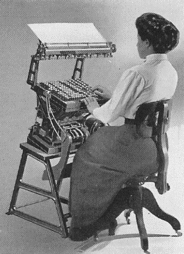
The results of the thirteenth US census were processed more cheaply using this method. Sloan & Chace built three hundred new machines, at a cost of $250 each. However, the new machines were slow and the keys had a tendency to jam.
Much to Powers’ embarrassment, the original Hollerith keyboard punch was used for a third of the Census work. Powers worked on the problem and, in 1909 delivered a hundred semi-automatic tabulators, as well as power-operated presses and printing counters.
In 1911, he set up the Powers Accounting and Tabulating Machine Company to build and rent tabulating equipment. Then, in 1912, he set up a factory in Newark, NJ with the inventor W W Lasker, who developed the Powers Tabulator Printer for tabulating and printing processed information.
Lasker made more modifications to Powers’ machinery and the company became the second largest US vendor of tabulating equipment after Hollerith. In 1914, the reincorporated Powers Company moved to Brooklyn, NY and in 1915 opened a European subsidiary: Powers-Samas Accounting Machine Limited which, after the First World War, was keenly competitive with Hollerith in the European market.
In an effort to close the gap, Powers upgraded his machines to electro-mechanical operation. In 1926 the company introduced a listing multiplier and calculator, which could list numbers and their products.
During this period both the Powers Company and IBM* flourished, and the competition between them helped to keep prices down.
The success of the Powers company made it an attractive takeover proposition and in 1927 Powers merged with the Remington-Rand* Corporation. The takeover gave Remington-Rand a strong position in the office equipment marketplace and they became IBM’s main office equipment rival.
At first, the management of the new tabulating machines division allowed Powers to work alone, but later a more integrated approach was taken.
ASSESSMENT: Powers’ machines put pressure on his rivals and forced the development of office machinery and, ultimately, today’s information technology.
EXTRA CONNECTIONS: His work related to that of Sholes*.
ONELINER: James Powers, inventor of the tabulating machine
BIBLIOGRAPHY:
Austrian, Geoffrey D., Herman Hollerith: Forgotten Giant of Information Processing, Columbia University Press, New York, 1982.
Cortoda, James W., Before the Computer, Princeton University Press, Princeton, New Jersey, 1993.
Sandbox (Census)