Hollerith
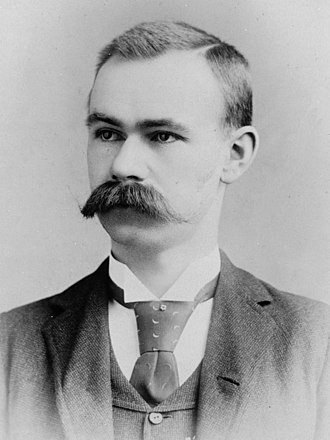
ACHIEVEMENT(S): Developed the punch card. His company became IBM
NICKNAME/ALIAS:
DATE/PLACE OF BIRTH: 29th^ February 1860, in Buffalo, NY
DATE/PLACE/AGE AT DEATH: 17th November 1929, Washington DC. Aged 67.
DISCIPLINE: Inventor.
FIELD: Statistics.
LANGUAGE: English.
PARENTS: Johann George Hollerith and Franciska Brunn.
SIBLINGS: 1 brother, George.
SPOUSE: Lucia Beverley Talcott, married 1890.
CHILDREN: 3 sons, Charles, Herman Jr. and Richard, 3 daughters, Lucia, Nan and Virginia.
EDUCATION: Columbia University School of Mines.
MAJOR WORK: The Census Machine.
LIFE AND TIMES:
In 1879, Hollerith graduated from the Columbia University School of Mines with a distinction for his studies in physics, chemistry and engineering. He took a job as a statistician in the U S Census Office and worked on the 1880 census. In his spare time, he was able to compute numerous life tables for Dr. John Shaw Billings, head of the Census Vital Statistics division.
On a social visit to Billings’ home, the two talked about the possibility of designing a calculating machine that could tabulating large quantities of data. In 1882 and 1883, Hollerith worked as an instructor in mechanical engineering at MIT, but the job wasn’t very rewarding so in his spare time he began work on his census machine.
His first idea involved using holes, punched in reels of paper tape, to store information, a concept similar to that used in the repeating telegraph. (The paper was rolled into a counting machine where a set of electrified pins were pressed against the rotating paper-roll drum. Where the pins were able to pass through perforations in the paper, they made an electric connection with the drum and, as connections were made, they were counted by an electromagnet).
The idea of using punched holes for counting was simple enough. Hollerith’s innovation was that the absence or presence of a hole could represent a numerical quantity or a defined piece of information. This original concept would turn out to be the basis for the development of computers.
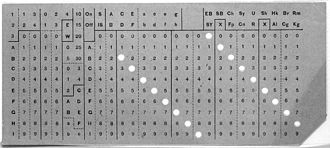
At the time, some railroads were using a ticket called a ‘punch photograph’. The train conductor made coded punch marks in the ticket that represented the characteristics, such as eye and hair colour, of the ticket holder. Hollerith decided that processing information using individual cards Punch Cards*would give greater versatility and the idea turned out to be highly effectively.
Another important influence probably came from the programmed punch cards used to control Jacquard* silk-weaving looms (Hollerith was living at the house of Albert Meyer, an importer of textile machines, who later married Hollerith’s sister).
In 1883 Hollerith took a job in the Patent Office. Aware of the pitfalls facing an inventor in patenting his work, he wanted to be able to protect his invention properly, so that he could exploit it commercially later on.
Hollerith managed to get the Census Office to agree to conduct trials using their labor if he provided the necessary equipment. After a further two years of trials and tests, Hollerith demonstrated his idea when he tabulated unprocessed information on death statistics taken during the 1880 census. These trials were a complete success and Billings recommending the machine to his employers. This prompted the New Jersey and New York health departments to use the machine to compile their statistics.
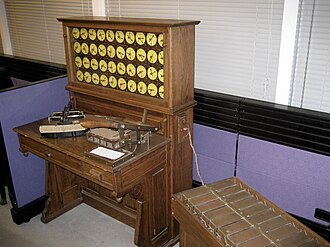
The Census Machine was then used in the 1890 US Census and data on 62,622,250 people were collated within three months. The machine was estimated to have reduced the labor needed by 67%, and saved the Bureau five million dollars. The success of the venture prompted The Franklin Institute of Philadelphia to award Hollerith the Elliott Cression Medal for the best invention of the year, at the World’s Columbian Exposition in 1893.
The Census Machine was soon in use all over the world. It tabulated the census returns for Canada, Norway and Austria in 1891 and shortly after, Hollerith supervised the processing of the Puerto Rican and Cuban census returns. Even more important, the machine was used for the first census in Russia since 1854, processing information from a hundred million cards. The French census gathered data on sixteen million returns and, in 1915, the machine was again used for the British National Registration Act.
During the course of the 1890’s, Hollerith’s modified the machine to enable it to add as well as count. He also designed a desktop punch to replace the hand punch for programming cards and an automatic feeding device cut down on manual labour even further.
In 1886, Hollerith set up his own company to manufacture and sell the machine. As general manager and majority shareholder, he employed a marketing and financial team who used the machine for data entry as well as sorting and tabulating functions. The machine was a great asset to modern business and was bought by large manufacturers, business corporations and major retailers for accounting and management purposes, as well as for sales analysis.
In 1896, Hollerith developed a new, compact, vertical machine, which included brushes to assist the feeding system, and increased the processing speed from 180 to 200 cards per minute. Five years later, the machine took only nineteen months to tabulate information (in the categories of sex, birthplace and occupation) that would have taken a hundred clerks eight years to calculate by conventional methods.
To build his machines more efficiently, Hollerith bought the Taft-Peirce Manufacturing Company in Woonsocket, Rhode Island, then added two subsidiaries, the British Tabulation Machine Limited in 1904, and Deutsche Hollerith Maschinen Gesellschaft in 1910.
A year later, Charles Flint bought Hollerith out. Flint merged the Tabulating Machine Company with the Computing Scale Company of America, the International Time Recording Company of New York and the Bundy Manufacturing Company to form the Computing-Tabulating-Recording Company. Hollerith stayed on as manager of his division and as a member of the board of directors until 1921, when he resigned to concentrate on new inventions.
In 1924, CTR Co. was renamed the International Business Machine Corporation, ( IBM*).
One of Hollerith’s last patents was for automatic control for the machine, which was quickly recognised by IBM as an important development. This proved to be a major factor in the company’s growth after the Second World War, when the machine came into its element.
ASSESSMENT: Hollerith’s punch card tabulating machine allowed governments, then businesses, to process information more efficiently than ever before. It was the idea that gave birth to today’s computer technology, allowing vast amounts of information to be processed in split seconds.
EXTRA CONNECTIONS: His work related to that of Powers*.
ONELINER: Herman Hollerith, who invented punch cards and whose company became IBM
BIBLIOGRAPHY:
Austrian, Geoffrey D.,Herman Hollerith: Forgotten Giant of Information Processing, Columbia University Press, New York, 1982.