Haviland J
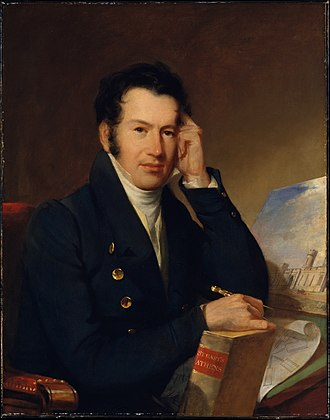
NAME: Haviland, John
ACHIEVEMENT(S): Prison design.
NICKNAME/ALIAS: None
DATE/PLACE OF BIRTH: 15 December 1792, near Taunton, Somerset, England
DATE/PLACE/AGE AT DEATH: 28 March 1852, at Philadelphia, PA. Aged 59
DISCIPLINE: Architect
FIELD: Architecture
EDUCATION: Local schooling
MAJOR WORK: Eastern State Penitentiary, 1821-29
LIFE AND TIMES:
Towards the end of his apprenticeship Haviland worked briefly for the English architect John Nash, who was planning the layout of London’s new Regent's Park. Early in 1815 Haviland decided to go to St. Petersburg, Russia, where he had a maternal aunt married to a Russian naval minister, Mordinov, who found him a job in the Russian Imperial Corps of Engineers, and commissioned him to design a monument to his close friend, the English prison reformer John Howard.
Through Mordinov, Haviland was exposed to firsthand recollections of the prison reform ideas of Howard, who had died in 1790 in Mordinov’s company in the Ukraine.
Haviland did not settle well in Russia, and became increasingly attentive to the many positive descriptions of the United States that he received from two friends - the Philadelphia-born George von Sonntag, a general in the Russian army and admiral in the Russian navy, and the future U.S. president <a pal was> John Quincy Adams*, then American minister to Russia.
In the summer of 1816 Haviland decided to try his fortunes in America, and in September 1816, arrived in Philadelphia. In 1817 he married Mary von Sonntag Wells, the widowed sister of the Russian general.
Haviland won his first major commission in 1819 for his classical design for the First Presbyterian Church. The same year his designs for a castellated Gothic Eastern State Penitentiary were accepted by the government, and constructed (1821-29) on Cherry Hill in Philadelphia.
It was the design of this prison that made Haviland's name internationally, as it incorporated ideas that became known as the "Pennsylvania System", a penal method based on the principle that solitary confinement fostered penitence.
Influenced by Howard's ideas and by those of earlier reformers like <influenced by> Beccaria* and <influenced by> Jeremy Bentham*, Haviland designed a new kind of prison in which prisoners were kept in perpetual solitary confinement in cells 16 feet high, nearly 12 feet long, and 7.5 feet wide (4.9 by 3.7 by 2.3 m). An exercise yard, completely enclosed to prevent contact among prisoners, was attached to each cell.
As the first example of this system (considered progressive and humanitarian), Haviland's Eastern State Penitentiary attracted worldwide notice and a steady stream of visitors, and during the 1830s and 1840s the Pennsylvania system spread until it predominated in European prisons.
During the 1820s Haviland established a successful practice with many commissions, including St. Andrew's P.E. Church (1822-24), the Pennsylvania Institution for the Deaf and Dumb (1824-26), the Franklin Institute (1825-26), and the House of Refuge (1828).
During this period Haviland also taught architectural drawing at the Franklin Institute, and was responsible for a number of important commercial commissions, including theatres, banks, hotels and the landmark arcades - a line of small shops arrayed along the sides of a roofed, top-lit promenade - that he designed for downtown sites in Philadelphia (1825-28, demolished) and New York City (1826-27, demolished).
Haviland suffered a major setback in the early 1830s, when the financial failure of both his Labyrinth Garden and the arcades - in which he had invested heavily - threatened to bankrupt him and his company.
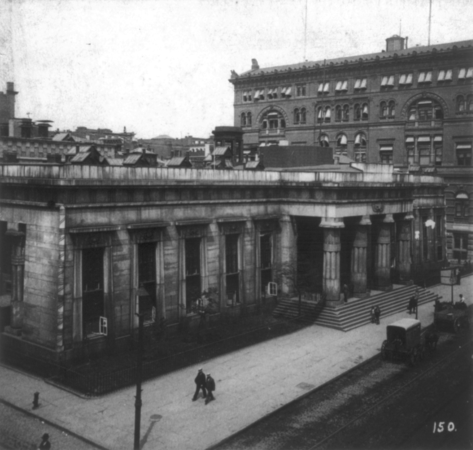
The Tombs in New York, built 1835–38 (demolished 1902).
In order to cover his debts, Haviland illegally used funds allocated for the construction of the U.S. Naval Hospital at Norfolk, Virginia (1826-33), and a public scandal erupted when his activities were discovered. For a while this effectively closed the door to any more public commissions but, through his innovation and expertise in penal design,
Haviland managed to revive his practice and public reputation, in particular through his design for the rebuilding of Pennsylvania's Western State Penitentiary (1833) and for the new penitentiary built at Trenton for the state of New Jersey (1833-36).
Through this expertise, Haviland also provided designs for new penitentiaries in Missouri (1833-36), Rhode Island (1834-37), and Arkansas (1838), as well as for Pennsylvania county prisons at Pittsburgh (1834), Harrisburg (1840), Reading (1846-48), and Lancaster (1848-51).
He also won commissions for courthouse and jail complexes in New York City ("The Tombs", 1835-38, demolished) and in Newark, New Jersey (1836, demolished), and for the Pennsylvania Fire Insurance Company (1838),and he designed and constructed Pennsylvania's State Insane Asylum at Harrisburg (1848-51).
In 1836 he was a founder of the short-lived national American Institution of Architects, the forerunner of the American Institute of Architects which was founded two decades later.
ASSESSMENT: Haviland became internationally famous as a pioneer and expert in prison design, and was responsible for the design of many state and county prisons in the United States.
EXTRA CONNECTIONS: None
ONELINER: John Haviland, expert in prison design
BIBLIOGRAPHY:
Cohen, Jeffrey A., "Haviland, John", Dictionary of American National Biography, Oxford & New York: OUP, 1999.
LANGUAGE: English
PARENTS: James Haviland and Ann Cobley
SIBLINGS: ?
SPOUSE: Mary von Sonntag Wells, married 1817
CHILDREN: Two sons, two stepsons