Bentham J
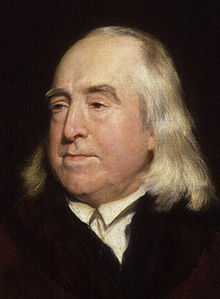
Achievements: Writings on Utilitarian philosophy, jurisprudence and economics
Born: February 15, 1748; London, England
Died: June 6, 1832; London, England (Aged 84)
Field & Discipline: Philosophy; Economy; Economist
Language: English
Father: Jeremiah Bentham
Mother: Alicia Grove
Siblings: 1 brother: Samuel
Spouse: None
Children: None
Education: Westminster School, London; Queen's College, Oxford; Lincoln's Inn law school, London
Major Work:
"An Introduction to the Principles of Morals and Legislation" (1789)
Life & Times:
Bentham’s first book: "A Fragment on Government", was written in 1776 and published anonymously. Bentham criticised the current views of the legal establishment on natural rights, and called for reform in politics and jurisprudence. This was controversial treatise, and is seen as the beginning of philosophic radicalism. The book brought him to the attention of [a pal of] Shelburne*, a leading radical politician, who became a friend and admirer.
In 1785 he left England for Russia, to visit his brother, [brother of] Samuel Bentham* who was working for the Russian government at Prince Potmekin's estate in Kritchev, where he wrote: "Defence of Usury" defending the laissez-faire doctrine of the economist [supported views of] Adam Smith*. Bentham also became a fan of his brother's design for a panopticon, an open-plan building with a central observation point. Bentham was convinced it would be an ideal arrangement for prison buildings.
On his return to England in 1788 he began work on developing his philosophy, which became known as utilitarianism, based on two concepts: the ‘association’ principle and the ‘greatest-happiness’ principle. Through association (of ideas and language, and of ideas on other ideas), he took a deterministic view of mental concepts. This was an important psychological stance because Bentham wanted to establish a social system which would automatically result in making human society virtuous.
The term ‘greatest-happiness’ was derived from its use by [borrowed idea from] Priestley* in his “Essay of Government" (1768) where he referred to "the greatest happiness of the greatest number". The principle of the greatest-happiness was needed to provide the basis of Bentham's definition of virtuous. Bentham defined what is good as pleasure, or happiness; and what is bad, or evil, as pain. The best scenario was one in which the proportion of happiness for the greatest number of people was greater than the proportion of pain.
Through his interest in law (where the greatest influence on him was that of [influenced by] Beccaria*), Bentham moved on to an interest in ethics, an area where he was influenced by the works of the rationalist philosopher [influenced by] Hume*. Bentham maintained that each individual always pursued their own happiness and that the function of legislation was to mediate between public and private interest. Punishment followed crime because the crime resulted in pain, not because the criminal was hated. He believed that punishments should be appropriate and effective rather than excessively harsh. This was a radical attitude in an era where many minor offences were punished by death. He urged the abolition of the death penalty for all except the most serious crimes, and he lived to see this reform carried out.
Many of Bentham's ideas on the reform of criminal justice and prison conditions were later mirrored in the novels of [influenced] Dickens*. Although Bentham persevered for many years in promoting his panopticon scheme for prisons, he did not succeed in making this a popular cause, and in the mid-19th century the idea of model prisons was savagely mocked by [was satirized by] Carlyle*.
In 1789 Bentham published his most famous work, "An Introduction to the Principles of Morals and Legislation," immediately hailed by liberals and radicals. He was made a French citizen in 1792 and was consulted by governments in Europe and America. He was strongly opposed to imperialism, and earned a reputation among liberals abroad, influencing constitutional reformers like [influenced] Cavour* in Italy. At home he had many friends who concerned with reforming economics, politics and social legislation.
Among them were [a pal of] Ricardo*, the economist, the statistician [a pal of] Malthus*, and the radical [a pal of] James Mill*. [a pal of] Robert Owen*, the manufacturer, was a friend, and Bentham gave money to Owen's experimental manufacturing base in New Lanark. Bentham, had no sympathy with Owen's more extreme socialist ideas and he scoffed at the utopian commune Owen and his son [criticized] Robert Dale Owen* attempted to set up in America. But the development of socialism was influenced by Benthamite philosophy, as was the development of the social Darwinism which rose out of [distant influence on] Charles Darwin's* theory of evolution.
After considering moving to Mexico for his health, in 1814 Bentham settled in Dorset where he then wrote a series of papers on education, entitled "Chrestomathia", and was a supporter of the Hazelwood system of education introduced by [supported the work of] Rowland Hill*. Bentham's writings on education stressed the importance of science.
In 1826 he supported the parliamentary candidacy of [supporter of] CEP Thomson*, who introduced a bill for the repeal of usury laws.
[Edited by] John Stuart Mill* edited Bentham's five-volume work: "Rationale of Judicial Evidence" which was published in 1827. Bentham was a revered figure by the end of his life and was surrounded by many devoted friends. Late in life he was cared for by [cared for by] Chadwick* social reformer and physician who was living with him at the time.
Bentham - in accordance with his principle of utility - famously bequeathed his body for public dissection, a deliberate act not only to utilize his body but to counter fears about dissection. In 1832, three days after his death, his doctor and fellow Utilitarian [funeral speech by] Southwood Smith* delivered an oration in the anatomy theatre before dissecting the body of his old friend in the presence of many of Bentham's friends.
Bentham's skeleton dressed and given a wax head - is preserved in a glass case at University College, London University.
Extra Connections: Influenced: [influenced] Lamb* and [influenced] Monkton Milnes*
Assessment: Bentham's most valuable contribution was as a critic of law and of the institutions of law and the prison system.
Oneliner: Jeremy Bentham, libertarian
Bibliography:
- Harrison, Ross, Bentham, Routledge & Kegan Paul, London, 1983.
- Stephen, Leslie, The English Utilitarians, vol. 1, Thoemmes, Bristol, 1991.
After his death, the skeleton and head were preserved and stored in a wooden cabinet called the "Auto-icon", with the skeleton padded out with hay and dressed in Bentham's clothes.
https://www.atlasobscura.com/articles/philosopher-auto-icon-college-commute