Fawkes, Guy
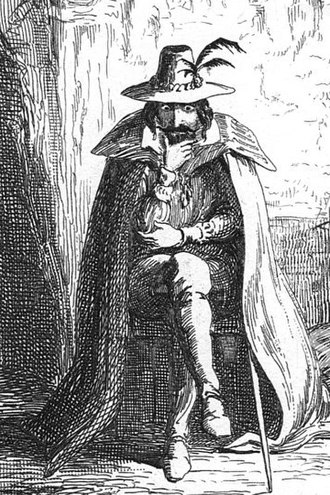
Name: Guy Fawkes
Nickname/Alias: Guye Fawkes; Guido Fawkes
Achievements: Best-known member of the Gunpowder Plot to blow up the English Parliament
Born: April 13, 1570; York, England
Died: January 31, 1606; London, England (Aged 35)
Field & Discipline: Politics; Conspirator
Language: English
Father: Edward Fawkes
Mother: Edith Blake
Siblings: Anne; Elizabeth
Spouse: Maria Pulleyn (possibily married 1590 in Scotton, England)
Children: Thomas (possibly)
Education: St. Peter's School, York (1575-85)
Life & Times:
Fawkes was raised as a Catholic in York, England. Within ten years of leaving school, he had joined the army and, in 1595, he took part in the capture of Calais, France. By 1596, he was an expert in military warfare and, in particular, the technique of destroying fortifications with gunpowder. This was achieved by means of a fuze steeped in saltpeter and limewater.
By 1599, Fawkes had been promoted to Lieutenant Officer and went into battle at Nieuport. He excelled himself so in 1603 Sir William Stanley, Hugh Owen and Father William Baldwin gave him the job of informing the new Spanish King, Philip III, of the difficulties that the Roman Catholics were facing in Protestant England.
He went to Madrid in March 1603 (just before the death of Queen Elizabeth) where he met Christopher Wright, another fervent Catholic who had attended the same school as Fawkes. Wright had been sent to Spain by [co-plotter with] Catesby* to gain support for a Catholic invasion of England on the death of Elizabeth. Neither man was successful in their mission.
With Elizabeth dead Catholics hoped that their position would improve under the new King but, within a year of his coronation, James I upheld Elizabeth’s anti-Catholic legislation.
In February 1604, Catesby began to scheme against the laws, bringing together a group of men: Thomas Wintour, Thomas Percy and John and Christopher Wright. Wintour visited the Netherlands to find another Catholic for their group, and enlisted Fawkes. The two went to Bergen, to meet Juan de Velasco, the Constable of Castile, who was on his way to see King James I to discuss a peace treaty between Spain and England. Unable to persuade Velasco to demand improved treatment for English Catholics to be included in the treaty, they returned to England.
Wintour and Fawkes arrived in London in May 1604 and met Catesby, Thomas Percy and John Wright at an inn called the “The Duck and Drake,” in the fashionable Strand district of London. Catesby explained his conspiracy to blow up the Houses of Parliament while the King was in the House of Lords. Each man pledged an oath.
On May 24, Fawkes adopted the identity of John Johnson, a servant of Thomas Percy, to rent a tenement in the block adjoining the Houses of Parliament. The two went about normal daily life for quite some time, to avoid rousing suspicions. In autumn 1605, James I authorized the enforcement of anti-Catholic legislation so, in early November, Fawkes began construction of a mine in the cellars of the apartment block connected to the cellars under Parliament.
The five original conspirators brought in tools and provisions on December 11, and operations began. It proved to be hard work, so Christopher Wright and Robert Keyes were brought in to assist. The group grew bigger with the addition of Wintour's brother, Robert, as well as John Grant and Catesby's old servant, Bates.
In March 1605, the group rented a vacant cellar which ran under the House of Lords. This was a much better location, so they stopped work and began filling the new cellar with barrels of gunpowder. Parliament was delayed until November 5 so, on October 18, Fawkes Catesby, Wintour and Francis Tresham met to discuss the finer details of the explosion.
It was agreed that Fawkes would light a slow match, giving him fifteen minutes to escape, then he would immediately leave for Flanders and spread the news of the explosion. Everyone was sure that the plan was foolproof.
Eight days later, William Parker, 4th Baron Monteagle received an anonymous letter, now known as the “Monteagle Letter,” alerting the Government to the plot. Catesby, who knew of the letter, kept the news to himself, determined to go forward with the original plan, because of the vagueness of the letter.
On Wednesday October 30, Fawkes inspected the cellar, unaware of danger. However by this time full details of the plot had been uncovered by the government who began setting a trap for the plotters.
On November 4, the Lord Chamberlain, Thomas Howard, Earl of Suffolk, searched the Parliament buildings and found a large pile of wood in one of the cellars. They approached Fawkes who, in his guise as John Johnson, said that the pile belonged to his employer, Thomas Percy. They left to report the details to the King and Fawkes ran to notify Percy, who fled London with Catesby.
During Fawkes’ absence from the cellar, Sir Thomas Knyvett, a Westminster magistrate, searched the pile and discovered the gunpowder. Fawkes was arrested and taken that same night to the Tower of London where he was interrogated then tortured on the rack. By November 7 he had confessed his real name and the names of his fellow conspirators.
Catesby and Percy were trapped and killed at Holbeach, on the Staffordshire border. The remaining offenders, Fawkes, Thomas Wintour, Ambrose Rookwood and Robert Keyes were hanged, drawn and quartered in Old Palace Yard, Westminster, on 31st January 1606.
Extra Connections: [his trial reported by] Camden* wrote an account of his trial.
He was spied on by [spied on by] Jonson*
Assessment: Fawkes’ plot prompted the establishment of November 5th as a day of thanksgiving (Guy Fawkes’ Day), still celebrated in England by the lighting of bonfires and fireworks.
Oneliner: Guy Fawkes, conspirator in the Gunpowder Plot to blow up England’s Parliament buildings
Bibliography:
- Simons, Eric N., The Devil of the Vault: A Life of Guy Fawkes, London: Frederick Muller Ltd., 1963.