Assassination
Assassination is the murder of a prominent or important person,[1] such as a head of state, head of government, politician, world leader, member of a royal family or CEO. An assassination may be prompted by political and military motives, or done for financial gain, to avenge a grievance, from a desire to acquire fame or notoriety, or because of a military, security, insurgent or secret police group's command to carry out the assassination. Acts of assassination have been performed since ancient times. A person who carries out an assassination is called an assassin or hitman.
Contents
- Etymology
- Use in historyToggle Use in history subsection
- Further motivationsToggle Further motivations subsection
- Psychology
- TechniquesToggle Techniques subsection
- Targeted killing
- CountermeasuresToggle Countermeasures subsection
Etymology[]
Main article: Hashshashin

Nikolay Bobrikov, the Russian Governor-General of Finland, assassinated by Eugen Schauman on June 16, 1904, in Helsinki.[2] A drawing of the assassination by an unknown author.

Mugshot of Lee Harvey Oswald, the individual responsible for the assassination of United States President John F. Kennedy on November 22, 1963. Oswald himself was murdered two days later by Jack Ruby, the first such event to receive wide television coverage.
The word assassin may be derived from asasiyyin (Arabic: أَسَاسِيِّين, ʾasāsiyyīn) from أَسَاس (ʾasās, "foundation, basis") + ـِيّ (-iyy), meaning "people who are faithful to the foundation [of the faith]."[3][4]
Assassin is often believed to derive from the word hashshashin (Arabic: حشّاشين, ħashshāshīyīn),[5] and shares its etymological roots with hashish (/hæˈʃiːʃ/ or /ˈhæʃiːʃ/; from Arabic: حشيش ḥashīsh).[6] It referred to a group of Nizari Ismailis known as the Order of Assassins who worked against various political targets.
Founded by Hassan-i Sabbah, the Assassins were active in the fortress of Alamut in Persia from the 8th to the 14th centuries, and later expanded into a de facto state by acquiring or building many scattered strongholds. The group killed members of the Abbasid, Seljuk, Fatimid, and Christian Crusader elite for political and religious reasons.[7]
Although it is commonly believed that Assassins were under the influence of hashish during their killings or during their indoctrination, there is debate as to whether these claims have merit, with many Eastern writers and an increasing number of Western academics coming to believe that drug-taking was not the key feature behind the name.[8]
The earliest known use of the verb "to assassinate" in printed English was by Matthew Sutcliffe in A Briefe Replie to a Certaine Odious and Slanderous Libel, Lately Published by a Seditious Jesuite, a pamphlet printed in 1600, five years before it was used in Macbeth by William Shakespeare (1605).[9][10]
Use in history[]
Main article: History of assassination
Ancient to medieval times[]
Assassination is one of the oldest tools of power politics. It dates back at least as far as recorded history.
The Egyptian pharaoh Teti is thought to be the earliest known victim of assassination. Between 550 BC and 330 BC, seven Persian kings of Achaemenid Dynasty were murdered. The Art of War, a 5th century BC Chinese military treatise mentions tactics of Assassination and its merits.[11]
In the Old Testament, King Joash of Judah was assassinated by his own servants;[12] Joab assassinated Absalom, King David's son;[13] and King Sennacherib of Assyria was assassinated by his own sons.[14]
Chanakya (c. 350–283 BC) wrote about assassinations in detail in his political treatise Arthashastra. His student Chandragupta Maurya, the founder of the Maurya Empire, later made use of assassinations against some of his enemies.[15]
Some famous assassination victims are Philip II of Macedon (336 BC), the father of Alexander the Great, and Roman dictator Julius Caesar (44 BC).[16] Emperors of Rome often met their end in this way, as did many of the Muslim Shia Imams hundreds of years later. Three successive Rashidun caliphs (Umar, Uthman Ibn Affan, and Ali ibn Abi Talib) were assassinated in early civil conflicts between Muslims. The practice was also well known in ancient China, as in Jing Ke's failed assassination of Qin king Ying Zheng in 227 BC. Whilst many assassinations were performed by individuals or small groups, there were also specialized units who used a collective group of people to perform more than one assassination. The earliest were the sicarii in 6 AD, who predated the Middle Eastern Assassins and Japanese shinobis by centuries.[17][18]
In the Middle Ages, regicide was rare in Western Europe, but it was a recurring theme in the Eastern Roman Empire. Strangling in the bathtub was the most commonly used method. With the Renaissance, tyrannicide—or assassination for personal or political reasons—became more common again in Western Europe.[citation needed]
Modern history[]
[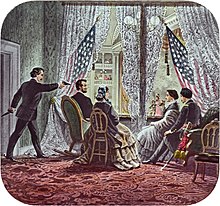
Shown in the presidential booth of Ford's Theatre, from left to right, are assassin John Wilkes Booth, Abraham Lincoln, Mary Todd Lincoln, Clara Harris and Henry Rathbone.
During the 16th and 17th centuries, international lawyers began to voice condemnation of assassinations of leaders. Balthazar Ayala has been described as "the first prominent jurist to condemn the use of assassination in foreign policy".[19] Alberico Gentili condemned assassinations in a 1598 publication where he appealed to the self-interest of leaders: (i) assassinations had adverse short-term consequences by arousing the ire of the assassinated leader's successor, and (ii) assassinations had the adverse long-term consequences of causing disorder and chaos.[19]
Hugo Grotius's works on the law of war strictly forbade assassinations, arguing that killing was only permissible on the battlefield.[19] In the modern world, the killing of important people began to become more than a tool in power struggles between rulers themselves and was also used for political symbolism, such as in the propaganda of the deed.[20]
In Japan, a group of assassins called the Four Hitokiri of the Bakumatsu killed a number of people, including Ii Naosuke who was the head of administration for the Tokugawa shogunate, during the Boshin War.[21] Most of the assassinations in Japan were committed with bladed weaponry, a trait that was carried on into modern history. A video-record exists of the assassination of Inejiro Asanuma, using a sword.[22]
In the United States, within 100 years, four presidents—Abraham Lincoln, James A. Garfield, William McKinley and John F. Kennedy—died at the hands of assassins. There have been at least 20 known attempts on U.S. presidents' lives.
In Austria, the assassination of Archduke Franz Ferdinand and his wife Sophie, Duchess of Hohenberg in Sarajevo on June 28, 1914, carried out by Gavrilo Princip, a Serbian nationalist, is blamed for igniting World War I. Reinhard Heydrich died after an attack by British-trained Czechoslovak soldiers on behalf of the Czechoslovak government in exile in Operation Anthropoid,[23] and knowledge from decoded transmissions allowed the United States to carry out a targeted attack, killing Japanese Admiral Isoroku Yamamoto while he was travelling by plane.
During the 1930s and 1940s, Joseph Stalin's NKVD carried out numerous assassinations outside of the Soviet Union, such as the killings of Organization of Ukrainian Nationalists leader Yevhen Konovalets, Ignace Poretsky, Fourth International secretary Rudolf Klement, Leon Trotsky, and the Workers' Party of Marxist Unification (POUM) leadership in Catalonia.[24] India's "Father of the Nation", Mahatma Gandhi, was shot to death on January 30, 1948, by Nathuram Godse.[25]
The African-American civil rights activist, Martin Luther King Jr., was assassinated on April 4, 1968, at the Lorraine Motel (now the National Civil Rights Museum) in Memphis, Tennessee. Three years prior, another African-American civil rights activist, Malcolm X, was assassinated at the Audubon Ballroom on February 21, 1965.[26]
Cold War and beyond[]
See also: Cold War and war on terror
Most major powers repudiated Cold War assassination tactics, but many allege that was merely a smokescreen for political benefit and that covert and illegal training of assassins continues today, with Russia, Israel, the U.S., Argentina, Paraguay, Chile, and other nations accused of engaging in such operations.[27]
After the Iranian Revolution of 1979, the new Islamic government of Iran began an international campaign of assassination that lasted into the 1990s. At least 162 killings in 19 countries have been linked to the senior leadership of the Islamic Republic of Iran.[28] The campaign came to an end after the Mykonos restaurant assassinations because a German court publicly implicated senior members of the government and issued arrest warrants for Ali Fallahian, the head of Iranian intelligence.[29] Evidence indicates that Fallahian's personal involvement and individual responsibility for the murders were far more pervasive than his current indictment record represents.[30]
In India, Prime Ministers Indira Gandhi and her son Rajiv Gandhi (neither of whom was related to Mahatma Gandhi, who had himself been assassinated in 1948), were assassinated in 1984 and 1991 in what were linked to separatist movements in Punjab and northern Sri Lanka, respectively.[citation needed]
In 1994, the assassination of Juvénal Habyarimana and Cyprien Ntaryamira during the Rwandan Civil War sparked the Rwandan genocide.[citation needed]
In Israel, Prime Minister Yitzhak Rabin was assassinated on November 4, 1995, by Yigal Amir, who opposed the Oslo Accords.[citation needed] In Lebanon, the assassination of former Prime Minister Rafik Hariri on February 14, 2005, prompted an investigation by the United Nations. The suggestion in the resulting Mehlis report that there was involvement by Syria prompted the Cedar Revolution, which drove Syrian troops out of Lebanon.
Further motivations[]
As a military and foreign policy doctrine[]
See also: Manhunt (military) and Decapitation (military strategy)
[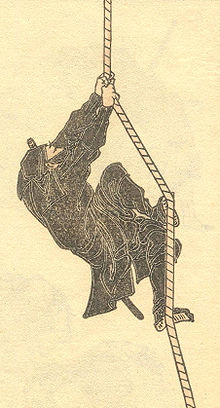
The functions of the ninja included espionage, sabotage and assassination.
Assassination for military purposes has long been espoused: Sun Tzu, writing around 500 BC, argued in favor of using assassination in his book The Art of War. Nearly 2000 years later, in his book The Prince, Machiavelli also advises rulers to assassinate enemies whenever possible to prevent them from posing a threat.[31] An army and even a nation might be based upon and around a particularly strong, canny, or charismatic leader, whose loss could paralyze the ability of both to make war.
...
See also[]
- Assassinations in fiction
- Contract killing
- History of assassination
- Hitman
- List of assassinated and executed heads of state and government
- List of assassinations
- List of assassinations by firearm
- List of people who survived assassination attempts
- List of United States presidential assassination attempts and plots
- Special Activities Center of the Central Intelligence Agency