Geodesic Dome
Science World in Vancouver, built for**Expo 86**, and inspired by[Buckminster Fuller's Geodesic dome.
A geodesic dome is a hemispherical thin-shell structure (lattice-shell) based on a geodesic polyhedron. The triangular elements of the dome are structurally rigid and distribute the structural stress throughout the structure, making geodesic domes able to withstand very heavy loads for their size.
The first geodesic dome was designed after World War Iby Walther Bauersfeld,***[***^[1]chief engineer of theCarl Zeiss optical company, for a***[***planetariumto house his planetarium projector. A first, small dome was patented, constructed by the firm of Dykerhoff and Wydmann on the roof of the Zeiss plant inJena,Germany. A larger dome, called "The Wonder of Jena", opened to the public in July 1926.
Twenty years later,**Buckminster Fuller**coined the term "geodesic" from field experiments with artist**Kenneth Snelson at**[**Black Mountain College**in 1948 and 1949. Although Fuller was not the original inventor, he is credited with the U.S. popularization of the idea for which he received**U.S. Patent 2682235A**on 29 June 1954.**^[3]^**The oldest surviving dome built by Fuller himself is located in**Woods Hole, Massachusetts**, and was built by students under his tutelage over three weeks in 1953.**^[4]^**
The geodesic dome appealed to Fuller because it was extremely strong for its weight, its "omnitriangulated" surface provided an inherently stable structure, and because a sphere encloses the greatest volume for the least surface area.
The dome was successfully adopted for specialized uses, such as the 21[Distant Early Warning Line (DEWline)] domes built in Canada in 1956,**^[5]^**the 1958**Union Tank Car Company**dome near**Baton Rouge, Louisiana**, designed by Thomas C. Howard of Synergetics, Inc. and specialty buildings such as the**Kaiser Aluminum**domes (constructed in numerous locations across the US, e.g.,[Virginia Beach, Virginia, auditoriums, weather observatories, and storage facilities. The dome was soon breaking records for covered surface, enclosed volume, and construction speed.
Beginning in 1954, the U.S. Marines experimented with **helicopter**-deliverable geodesic domes. A 30-foot wood and plastic geodesic dome was lifted and carried by helicopter at 50 knots without damage, leading to the manufacture of a standard magnesium dome by Magnesium Products of Milwaukee. Tests included assembly practices in which previously untrained Marines were able to assemble a 30-foot magnesium dome in 135 minutes, helicopter lifts off aircraft carriers, and a durability test in which an anchored dome successfully withstood without damage, a day-long 120 mph (190 km/h) propeller blast from the twin 3,000 horsepower engines of an anchored airplane.**^[6]^**...
The concept of the geodesic dome seemed feasible for the DEWline, so the Engineering Group at Lincoln Laboratory procured a series of prototype rigid radomes. The first one (31-foot equatorial diameter) was erected on the roof of Building C. It was unexpectedly pummeled by Hurricane Carol in August 1954, with winds estimated up to 110 miles per hour, and no damage was inflicted. The radome was then disassembled and erected on Mount Washington in New Hampshire, and it successfully survived that mountain's fierce environment, where the highest wind speeds on the face of the earth have been recorded....DEWline Personnel in the newly formed Engineering Group approached Buckminster Fuller, inventor of the geodesic dome, and asked him for assistance in designing a rigid radome. Fuller suggested a three-quarter-sphere design and recommended polyester-bonded fiberglass, which offered a high strength-to-weight ratio, excellent weather resistance, and reasonable cost. 50 and 150 foot versions were deployed}
The dome was introduced to a wider audience as a pavilion for the 1964 World's Fair in New York City designed by Thomas C. Howard of Synergetics, Inc. This dome is now used as an aviary by the Queens Zoo in Flushing Meadows Corona Park after it was redesigned by TC Howard of Synergetics, Inc.
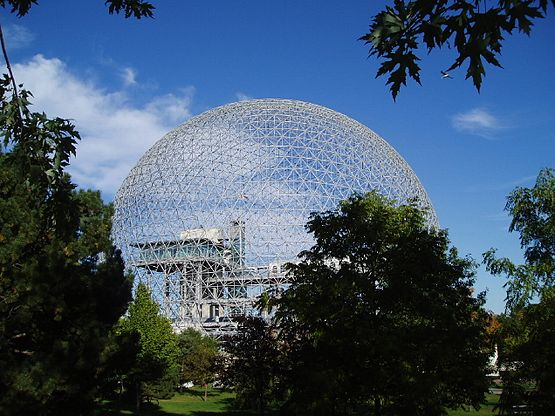
Another dome is from Expo 67 at the Montreal World's Fair, where it was part of the American Pavilion. The structure's covering later burned, but the structure itself still stands and, under the name Biosphère, currently houses an interpretive museum about the Saint Lawrence River.
In the 1970s, Zomeworks licensed plans for structures based on other geometric solids, such as the Johnson solids, Archimedean solids, and Catalan solids.[8] These structures may have some faces that are not triangular, being squares or other polygons.
In 1975, a dome was constructed at the South Pole, where its resistance to snow and wind loads is important.
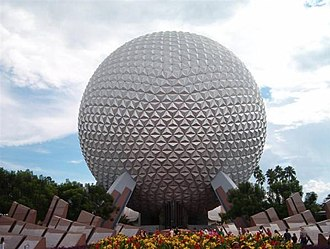
On October 1, 1982, one of the most famous geodesic domes, Spaceship Earth at Epcot in Walt Disney World Resort in Bay Lake, Florida, just outside of Orlando opened. The building and the ride inside of it are named with one of Buckminster Fuller's famous terms, Spaceship Earth, a world view expressing concern over the use of limited resources available on Earth and encouraging everyone on it to act as a harmonious crew working toward the greater good. The building is Epcot's icon, representing the entire park.
For the 1986 World's Fair (Expo 86), a Buckminster Fuller inspired Geodesic dome was designed by the Expo's chief architect Bruno Freschi to serve as the fair's Expo Centre. Construction began in 1984 and was completed by early 1985. The dome and the building now serve as an Arts, Science and Technology center, and has been named Science World.[9]
In 2000, the world's first fully sustainable geodesic dome hotel, EcoCamp Patagonia, was built in Chilean Patagonia,[10] opening the following year in 2001. The hotel's dome design is key to resisting the region's strong winds and is based on the dwellings of the indigenous Kaweskar people. Geodomes are also becoming popular as a glamping (glamorous camping) unit.
-