Helicopter


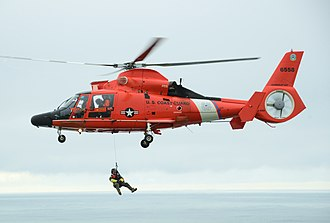
The helicopter, imagined by Da Vinci , and first developed by Sikorsky*, is an aircraft with horizontal rotors, capable of taking off and landing vertically, as well as remaining stationary in the air, and flying forwards, backwards and sideways (when the plane of the rotation of the rotor is tilted in the relevant direction).
As rotor motion causes the helicopter fuselage to turn in the opposite direction (because of torque), this is neutralized by the use of small tail rotor.
As the advancing main rotor moves forward, it is allowed to flap upwards, reducing the angle at which it meets the air and therefore reducing lift, while the retreating rotor flaps downwards, increasing the lift it produces to equal that of the forward-moving rotor. This prevents the helicopter from rolling over.
Apart from commercial passenger work, helicopters are used in a variety of roles in the military (when conditions preclude the use of fixed-wing aircraft): air-sea rescue, sonar-dipping anti-submarine, attack gunships, medivac, troop-carrying, and (very large) equipment transport.
Extra Connections:
In 1885, Thomas Edison was given US$1,000 (equivalent to $33,000 today) by James Gordon Bennett, Jr., to conduct experiments towards developing flight. Edison built a helicopter and used the paper for a stock ticker to create guncotton, with which he attempted to power an internal combustion engine. The helicopter was damaged by explosions and one of his workers was badly burned. Edison reported that it would take a motor with a ratio of three to four pounds per horsepower produced to be successful, based on his experiments.[41]
Ján Bahýľ, a Slovak inventor, adapted the internal combustion engine to power his helicopter model that reached a height of 0.5 meters (1.6 feet) in 1901. On 5 May 1905, his helicopter reached 4 meters (13 feet) in altitude and flew for over 1,500 meters (4,900 feet).[42] In 1908, Edison patented his own design for a helicopter powered by a gasoline engine with box kites attached to a mast by cables for a rotor,[43] but it never flew.[44]
BIBLIOGRAPHY: EB
Multimedia:
Connections 2 Episode 3 "Getting it Together"