Baird, John L 2
John Logie Baird FRSE (/ˈloʊɡi bɛərd/;[1] 13 August 1888 – 14 June 1946) was a Scottish inventor, electrical engineer, and innovator who demonstrated the world's first live working television system on 26 January 1926.[2][3][4] He went on to invent the first publicly demonstrated colour television system and the first viable purely electronic colour television picture tube.[5][6]
In 1928 the Baird Television Development Company achieved the first transatlantic television transmission.[5] Baird's early technological successes and his role in the practical introduction of broadcast television for home entertainment have earned him a prominent place in television's history.
In 2006, Baird was named as one of the 10 greatest Scottish scientists in history, having been listed in the National Library of Scotland's 'Scottish Science Hall of Fame'.[7] In 2015 he was inducted into the Scottish Engineering Hall of Fame.[8] In 2017, IEEE unveiled a bronze street plaque at 22 Frith Street (Bar Italia), London, dedicated to Baird and the invention of television.[9] In 2021, the Royal Mint unveiled a John Logie Baird 50p coin commemorating the 75th anniversary of his death.[10]
Early years
Baird was born on 13 August 1888 in Helensburgh, Dunbartonshire, and was the youngest of four children of the Reverend John Baird, the Church of Scotland's minister for the local St Bride's Church, and Jessie Morrison Inglis, the orphaned niece of a wealthy family of shipbuilders from Glasgow.[11][12]
He was educated at Larchfield Academy (now part of Lomond School) in Helensburgh; the Glasgow and West of Scotland Technical College; and the University of Glasgow. While at college, Baird undertook a series of engineering apprentice jobs as part of his course. The conditions in industrial Glasgow at the time helped form his socialist convictions but also contributed to his ill health. He became an agnostic, though this did not strain his relationship with his father.[13] His degree course was interrupted by the First World War and he never returned to graduate.
At the beginning of 1915 he volunteered for service in the British Army but was classified as unfit for active duty. Unable to go to the front, he took a job with the Clyde Valley Electrical Power Company, which was engaged in munitions work.[14][page needed]
Television experiments
In early 1923, and in poor health, Baird moved to 21 Linton Crescent, Hastings, on the south coast of England. He later rented a workshop in the Queen's Arcade in the town. Baird built what was to become the world's first working television set using items that included an old hatbox and a pair of scissors, some darning needles, a few bicycle light lenses, a used tea chest, and sealing wax and glue that he purchased.[15] In February 1924, he demonstrated to the Radio Times that a semi-mechanical analogue television system was possible by transmitting moving silhouette images.[16] In July of the same year, he received a 1000-volt electric shock but survived with only a burnt hand but, as a result, his landlord, Mr Tree, asked him to vacate the premises.[17] Soon after arriving in London, looking for publicity, Baird visited the Daily Express newspaper to promote his invention. The news editor was terrified and he was quoted by one of his staff as saying: "For God's sake, go down to reception and get rid of a lunatic who's down there. He says he's got a machine for seeing by wireless! Watch him—he may have a razor on him."[18]
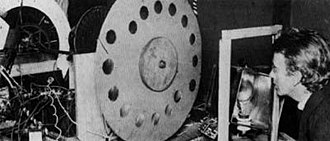
John Logie Baird with his television apparatus, circa 1925
In these attempts to develop a working television system, Baird experimented using the Nipkow disk. Paul Gottlieb Nipkow had invented this scanning system in 1884.[19] Television historian Albert Abramson calls Nipkow's patent "the master television patent".[20] Nipkow's work is important because Baird, followed by many others, chose to develop it into a broadcast medium.

Baird in 1926 with his televisor equipment and dummies "James" and "Stooky Bill"
In his laboratory on 2 October 1925, Baird successfully transmitted the first television picture with a greyscale image: the head of a ventriloquist's dummy nicknamed "Stooky Bill" in a 32-line vertically scanned image, at five pictures per second.[21] Baird went downstairs and fetched an office worker, 20-year-old William Edward Taynton, to see what a human face would look like, and Taynton became the first person to be televised in a full tonal range.[22]
In June 1924, Baird had bought from Cyril Frank Elwell a thallium sulphide (Thalofide) cell, developed by Theodore Case in the USA.[23] The Thalofide cell was part of the important new technology of 'talking pictures'. Baird's pioneering implementation of this cell allowed Baird to become the first person to produce a live, moving, greyscale television image from reflected light. Baird achieved this, where other inventors had failed, by applying two unique methods to the Case cell. He accomplished this by improving the signal conditioning from the cell, through temperature optimisation (cooling) and his own custom-designed video amplifier.[23]
First public demonstrations
Baird gave the first public demonstration of moving silhouette images by television at Selfridges department store in London in a three-week series of demonstrations beginning on 25 March 1925.[24]
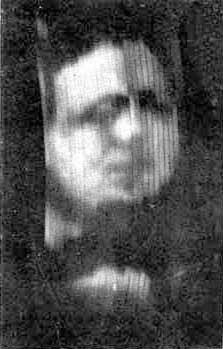
The first known photograph of a moving image produced by Baird's "televisor", as reported in The Times, 28 January 1926 (The subject is Baird's business partner Oliver Hutchinson.)
On 26 January 1926, Baird gave the first public demonstration of true television images for members of the Royal Institution and a reporter from The Times in his laboratory at 22 Frith Street in the Soho district of London, where Bar Italia is now located.[5][25][26][27] Baird initially used a scan rate of 5 pictures per second, improving this to 12.5 pictures per second c.1927. It was the first demonstration of a television system that could scan and display live moving images with tonal graduation.[3]

Blue plaque marking Baird's first demonstration of television at 22 Frith Street, Westminster, W1, London
He demonstrated the world's first colour transmission on 3 July 1928, using scanning discs at the transmitting and receiving ends with three spirals of apertures, each spiral with a filter of a different primary colour; and three light sources at the receiving end, with a commutator to alternate their illumination.[28][29] The demonstration was of a young girl, 8-year-old Noele Gordon, wearing different coloured hats. Miss Gordon went on to become a successful TV actress, famous for the soap opera Crossroads. That same year he also demonstrated stereoscopic television.[30]
Broadcasting
In 1927, Baird transmitted a long-distance television signal over 438 miles (705 km) of telephone line between London and Glasgow; Baird transmitted the world's first long-distance television pictures to the Central Hotel at Glasgow Central Station.[31] This transmission was Baird's response to a 225-mile, long-distance telecast between stations of AT&T Bell Labs.[32] The Bell stations were in New York and Washington, DC. The earlier telecast took place in April 1927, a month before Baird's demonstration.[20]

Baird demonstrating his mechanical television system in New York, 1931
Baird set up the Baird Television Development Company Ltd, which in 1928 made the first transatlantic television transmission, from London to Hartsdale, New York, and in 1929 the first television programmes officially transmitted by the BBC. In November 1929, Baird and Bernard Natan established France's first television company, Télévision-Baird-Natan.[33] Broadcast on the BBC on 14 July 1930, The Man with the Flower in His Mouth was the first drama shown on UK television.[34] The BBC transmitted Baird's first live outside broadcast with the televising of The Derby in 1931.[35][36] He demonstrated a theatre television system, with a screen two feet by five feet (60 cm by 150 cm), in 1930 at the London Coliseum, Berlin, Paris, and Stockholm.[37] By 1939 he had improved his theatre projection to televise a boxing match on a screen 15 ft (4.6 m) by 12 ft (3.7 m).[38]
From 1929 to 1935, the BBC transmitters were used to broadcast television programmes using the 30-line Baird system, and from 1932 to 1935 the BBC also produced the programmes in their own studio, first at Broadcasting House and then later at 16 Portland Place.[39] In addition, from 1933 Baird and the Baird Company were producing and broadcasting a small number of television programmes independent of the BBC from Baird's studios and transmitter at the Crystal Palace in south London.[40]
On 2 November 1936, from Alexandra Palace located on the high ground of the north London ridge, the BBC began alternating Baird 240-line transmissions with EMI's electronic scanning system, which had recently been improved to 405-lines after a merger with Marconi. The Baird system at the time involved an intermediate film process, where footage was shot on cinefilm, which was rapidly developed and scanned.[citation needed]

An early experimental television broadcast
The trial was due to last for 6 months but the BBC ceased broadcasts with the Baird system in February 1937, due in part to a disastrous fire in the Baird facilities at Crystal Palace. It was becoming apparent to the BBC that the Baird system would ultimately fail due in large part to the lack of mobility of the Baird system's cameras, with their developer tanks, hoses, and cables.[41] Commercially Baird’s contemporaries, such as George William Walton and William Stephenson, were ultimately more successful as their patents underpinned the early television system used by Scophony Limited who operated in Britain up to WWII and then in the US. "Of all the electro-mechanical television techniques invented and developed by the mid 1930s, the technology known as Scophony had no rival in terms of technical performance."[42][page needed] In 1948 Scophony acquired John Logie Baird Ltd.
Baird's television systems were replaced by the first fully electronic television system developed by the newly formed company EMI-Marconi under Sir Isaac Shoenberg, who headed a research group that developed an advanced camera tube (the Emitron) and a relatively efficient hard-vacuum cathode-ray tube for the television receiver.[43]
Philo T. Farnsworth's electronic "Image Dissector" camera was available to Baird's company via a patent-sharing agreement. However, the Image Dissector camera was found to be lacking in light sensitivity, requiring excessive levels of illumination. The Baird company used the Farnsworth tubes instead to scan cinefilm, in which capacity they proved serviceable though prone to drop-outs and other problems. Farnsworth himself came to London to the Baird Crystal Palace laboratories in 1936 but was unable to fully solve the problem; the fire that burned Crystal Palace to the ground later that year further hampered the Baird company's ability to compete.[44]
Fully electronic

This live image of Paddy Naismith was used to demonstrate Baird's first all-electronic colour television system, which used two projection CRTs. The two-colour image would be similar to the later Telechrome system.
Baird made many contributions to the field of electronic television after mechanical systems became obsolete. In 1939, he showed a system known today as hybrid colour using a cathode ray tube in front of which revolved a disc fitted with colour filters, a method taken up by CBS and RCA in the United States.[45]
As early as 1940, Baird had started work on a fully electronic system he called the "Telechrome". Early Telechrome devices used two electron guns aimed at either side of a phosphor plate. The phosphor was patterned so the electrons from the guns only fell on one side of the patterning or the other. Using cyan and magenta phosphors, a reasonable limited-colour image could be obtained. He also demonstrated the same system using monochrome signals to produce a 3D image (called "stereoscopic" at the time).[citation needed]
A Baird television advertisement circa 1949
In 1941, he patented and demonstrated this system of three-dimensional television at a definition of 500 lines. On 16 August 1944, he gave the world's first demonstration of a practical fully electronic colour television display.[46] His 600-line colour system used triple interlacing, using six scans to build each picture.[6][45] Similar concepts were common through the 1940s and 50s, differing primarily in the way they re-combined the colours generated by the three guns. One of them, the Geer tube, was similar to Baird's concept, but used small pyramids with the phosphors deposited on their outside faces, instead of Baird's 3D patterning on a flat surface.[citation needed]
In 1943, the Hankey Committee was appointed to oversee the resumption of television broadcasts after the war. Baird persuaded them to make plans to adopt his proposed 1000-line Telechrome electronic colour system as the new post-war broadcast standard. The picture resolution on this system would have been comparable to today's HDTV (High Definition Television). The Hankey Committee's plan lost all momentum partly due to the challenges of postwar reconstruction. The monochrome 405-line standard remained in place until 1985 in some areas, and the 625-line system was introduced in 1964 and (PAL) colour in 1967. A demonstration of large screen three-dimensional television by the BBC was reported in March 2008, over 60 years after Baird's demonstration.[47][page needed]
Other inventions
Some of Baird's early inventions were not fully successful. In his twenties he tried to create diamonds by heating graphite. Later Baird invented a glass razor, which was rust-resistant, but shattered. Inspired by pneumatic tyres he attempted to make pneumatic shoes, but his prototype contained semi-inflated balloons, which burst (years later this same idea was successfully adopted for Dr. Martens boots). He also invented a thermal undersock (the Baird undersock), which was moderately successful. Baird suffered from cold feet, and after a number of trials, he found that an extra layer of cotton inside the sock provided warmth.[15]
Between 1926 and 1928, he attempted to develop an early video recording device, which he dubbed Phonovision.[48] The system consisted of a large Nipkow scanning disk attached by a mechanical linkage to a record-cutting lathe. The result was a disc that could record a 30-line video signal. Technical difficulties with the system prevented its further development, but some of the original Phonovision discs have been preserved.[49][50]
Baird's other developments were in fibre-optics, radio direction finding, infrared night viewing and radar. There is discussion about his exact contribution to the development of radar, for his wartime defence projects have never been officially acknowledged by the UK government. According to Malcolm Baird, his son, what is known is that in 1926 Baird filed a patent for a device that formed images from reflected radio waves, a device remarkably similar to radar, and that he was in correspondence with the British government at the time.[51] The radar contribution is in dispute. According to some experts, Baird's "Noctovision" is not radar. Unlike radar (except Doppler radar), Noctovision is incapable of determining the distance to the scanned subject. Noctovision also cannot determine the coordinates of the subject in three-dimensional space.[52]
Death
From December 1944, Logie Baird lived at 1 Station Road, Bexhill-on-Sea, East Sussex, he later died there on 14 June 1946 after suffering a stroke in February.[53] The house was demolished in 2007 and the site is now occupied by apartments named Baird Court.[53] Logie Baird is buried beside his parents in Helensburgh Cemetery, Argyll, Scotland.[54]
Honours and portrayals

Blue plaque erected by Greater London Council at 3 Crescent Wood Road, Sydenham, London
Australian television's Logie Awards were named in honour of John Logie Baird's contribution to the invention of the television.
Baird became the only deceased subject of This Is Your Life when he was honoured by Eamonn Andrews at the BBC Television Theatre in 1957.[citation needed]
He was played by Michael Gwynn (and also by Andrew Irvine, who played him as a boy) in the 1957 TV film A Voice in Vision[55] and by Robert McIntosh in the 1986 TV drama The Fools on the Hill.[56]
In 2014, the Society of Motion Picture and Television Engineers (SMPTE) inducted Logie Baird into The Honor Roll, which "posthumously recognizes individuals who were not awarded Honorary Membership during their lifetimes but whose contributions would have been sufficient to warrant such an honor".[57]
On 26 January 2016, the search engine Google released a Google Doodle to mark the 90th anniversary of Logie Baird's first public demonstration of live television.[3]
See also
Baird, John Logie
ACHIEVEMENT(S): TV
DATE/PLACE OF BIRTH: 13 August 1888, at Helensburgh, Dunbarton, Scotland
DATE/PLACE/AGE AT DEATH: 14 June 1946, in Bexhill-on-Sea, Sussex, England. Aged 57
DISCIPLINE: Electrical engineer
FIELD: Television
LANGUAGE: English
EDUCATION: Larchfield Academy; Royal Technical College, Glasgow, 1908-11;
University of Glasgow, 1911-14
ASSESSMENT: The first person to assemble a television that actually worked.
MAJOR WORK: Television
LIFE AND TIMES: In 1922, after a nervous breakdown, Baird retired from business to Hastings on the Sussex coast, where he spent the next two years working on the problem of transmitting visual signals. In 1894, the German inventor Nipkow* had patented what became known as the Nipkow disc, a means by which both the scanning of the transmitter and the reassembling of the picture by the receiver could be accomplished by a powerful beam of light passing through small holes arranged in a spiral on two rapidly rotating and properly synchronized discs. Nipkow theorized that the spiral holes in the transmitter disc would form the necessary lines of light to scan the object, and the light signals could then be collected by a light-sensitive photoelectric cell that would create the electrical impulses for transmission, and the disc in the receiver would reverse the process, the resulting lines of light appearing on a small screen.
Boris Rosing's proposition that, in a television system which used mirror-scanning in the camera, a cathode-ray tube with a fluorescent screen should be fitted into the receiver, while in 1911 Swinton* had suggested that magnetically deflected cathode-rays should be used both in the camera and in the receiver.
Baird's great achievement was to take the Nipkow disc and other components of the system and combine them in such a way that a picture could actually be transmitted and received.
Having little money, his first apparatus was crude and makeshift, set up on a washstand in an attic room, with a tea-chest as the base of his motor, a biscuit tin housing the projection lamp, his discs cut out from cardboard, the lenses taken from cheap cycle-lamps, and the whole thing held together by sealing wax, sewing needles, and pieces of string. With this apparatus he succeeded early in 1923 in transmitting over a distance of a few feet the first very blurred and flickering television picture of the outline of a cross and a moving human hand. A patent was granted in May 1924.
At around the same time, Baird moved to Soho, London, and in 1925 he achieved the transmission of an image of a recognizable human face, and on 26 January 1926 he gave the first formal demonstration of television - the pictures being formed of only 30 lines, repeated approximately 10 times per second - to an audience of about 50 scientists at the Royal Institution, London.
Later in 1926, Baird's Television Development Company built the first television transmission station. By this time he had serious rivals in the United States, who in early 1927 successfully transmitted pictures of Herbert Hoover by radio and telephone line 200 miles from Washington D.C. to New York. In May 1927 Baird transmitted a visual picture across 438 miles of telephone line between London and Glasgow, and in February 1928 he made the first TV* broadcast using radio, between London and the S.S. 'Berengaria', halfway across the Atlantic Ocean.
A few weeks later he also made the first transatlantic television broadcast between Britain and the United States, when signals transmitted from the Baird station in Coulson, Kent were picked up by a receiver in Hartsdale, New York. In June 1928 he broadcasted the first television pictures taken outside in daylight, and in early July he sent out the first colour television image.
Baird's colour television was based on the simplest method of reproducing a colour image, which was to produce the red, blue and green primary images separately and then to superimpose them so that the eye merged the three images into one full-colour picture. Baird used three projection tubes arranged so that each one projected a picture on to the same screen, and used only one amplifier chain and one cathode-ray tube which sequentially amplified the red, blue and green signals and matched the three channels. He again used two rotating discs, but now each contained segments of red, green and blue light filters, rotating in synchronism, one in front of the camera tube and the other in front of the receiver tube, and each primary-coloured filter remained over the tube face for the period of one field.
In September 1929 the BBC allowed Baird to use its facilities for a series of experimental television broadcasts to the very few people who had television sets. At first, the sound and vision were transmitted alternately, but by 1930 it was possible to broadcast them simultaneously. Half-hour programmes were then shown regularly on five mornings a week, during which Baird gave the first live broadcast of the Derby horserace on 3 June 1931.
Meanwhile, since its invention by Braun* in 1897, several scientists had proposed that the cathode-ray tube could be used as a scanner in an all-electronic television system, and in the early 1930s an entirely electronic, high definition system was being developed both by Zworykin* for the Radio Corporation of America in the United States and by a team working for the Marconi-EMI Company in Great Britain.
In early 1935, the BBC agreed to a test period in which Baird's system and that developed by Marconi-EMI would broadcast alternately to determine which performed better, and for three months from November 1936, when the BBC started the world's first public high-definition service from Alexandra Palace, London, the two systems were broadcast on alternate weeks. However, by this stage the Marconi-EMI team had devised a completely mobile system with improved a picture quality to 405 horizontal lines with 25 pictures per second, and in February 1937 the BBC announced that it was dropping the Baird mechanical apparatus and would continue its television broadcasting with the Marconi-EMI system only. Baird continued his experimental work in color television, which in 1939 he demonstrated using a cathode-ray tube.
EXTRA-CONNECTIONS: His work related to that of Farnsworth*
1936 Crystal Palace fire, he suspected sabotage.
ONELINER: JL Baird, one inventor of TV
BIBLIOGRAPHY:
EB Collier's
Biographical Dictionary of Engineers and Inventors
Little, John E., "John Logie Baird", inNotable 20th CenturyScientists
McArthur, Tom, The Secret Life of John Logie Baird, London: Hutchinson, 1986
PARENTS: Reverend John Baird and Jessie Morrison Inglis
SIBLINGS: Three elder siblings
SPOUSE: Margaret Albu, married 1931
CHILDREN: One son and one daughter