De Leon, M
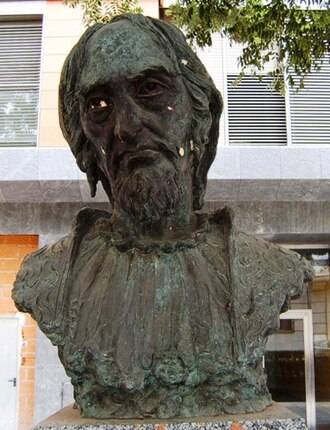
Name: Moses de Leon
Nickname/Alias: Moses ben Shemtob; Moshe ben Shem-Tov
Achievements: Presumed author of "Sefer ha-Zohar (Book of Splendor"), the most important work of Jewish mysticism
Born: c. 1240; Leon, Spain
Died: 1305; Arevalo, Spain (Aged about 65)
Field & Discipline: Religion
Language: Spanish; Hebrew
Father: Unknown
Mother: Unknown
Siblings: Unknown
Spouse: Unknown
Children: Unknown
Education: Unknown
Major Work:
"Sefer Ha-Zohar (Book of Splendor")
Life & Times:
Few details of de Leon's life are known, but it is almost certain he began his religious life as a follower of the 12th-century Jewish philosopher [a follower of] Maimonides*. (A Hebrew translation of Maimonides's "Guide to the Perplexed", has been discovered, dated 1264, and inscribed "For the erudite Rabbi Moses de Leon", who then would have been about 26).
In all probability, de Leon spent the 20 years from 1264 to 1286 in intensive theological study, taking an increasing interest in mysticism and [involved in] Cabbalism*. For many years, up until 1290, he lived in the Castile town of Guadalajara, then the Spanish center of Cabbalism
It is assumed that de Leon wrote the "Sefer Ha-Zohar (Book of Splendor"), the most important work of Jewish mysticism, and that he wrote it during the early 1280s, although the authorship and the date of the book have never been conformed. Historians agree that de Leon circulated the work after 1290, when he left Guadalajara and began to lead the life of a wanderer.
A significant part of the "Zohar" shows the influence of [influenced by] Gikatilla*, a medieval Spanish Cabbalist that de Leon met sometime during the 1270s. Gikatilla had been a zealous follower of the school of Prophetic Cabbalism, founded by [influenced by] Abulafia*, and in 1274 wrote a work, "Ginnath Egoz”(Nut Orchard), portions of which crop up in one way or another in the "Zohar".
Some of the key terminology in the Zohar is from the Nut Orchard, and de Leon's writings, particularly in Hebrew, reflect Gikatilla's ideas in their treatment of the mystic use of letters, and similar subjects. De Leon and Gikatilla never mentioned each other by name in their writings, but they were good friends, and Gikatilla became one of de Leon's closest disciples. Studies of their writings show that de Leon and Gikatilla considerably influenced each other.
On a trip to Valladolid in 1304, de Leon met a Palestinian Cabbalist, Isaac ben Samuel of Acre, to whom, according to Isaac's diary, he confided that he possessed the "centuries-old", original manuscript of the Zohar and had been circulating copies since the 1280s. Because the author of the Zohar was generally believed to be the 2nd-century Palestinian rabbinic teacher Simeon ben Yohai, a reputed worker of miracles, the original manuscript would have been of great interest and value. Isaac wrote that de Leon promised to show him the manuscript later at his home in Avila, but de Leon died before he could keep his promise.
The Zohar was for the most part written in a strange, artificial, literary Aramaic and was primarily a series of mystical commentaries on the Pentateuch (the "Five Books of Moses"). Against the backdrop of an invented Palestine, the Zohar told the story of Yohai and his disciples who, in a series of dialogues, disclosed that God had revealed himself in ten descending-value forms, or “sefirot” (e.g., "love" of God, "beauty" of God, "kingdom" of God, etc.).
De Leon came from a 13th-century world of philosophic rationalism that he eventually fought against. In his youth, he brooded over Maimonides's "Guide to the Perplexed". He was attracted by the mystical side of Judaism and gradually began to ponder the mystery of the Godhead as presented by the Cabbalists. He studied, altered, selected, and developed the Cabbalistic ideas and combined them with his own thoughts on a mystical theory of morals: thoughts which play a large part in the Zohar as well as in all his writings.
Taken as a whole, the Zohar must be regarded as the complete antithesis of the now-familiar system of Abulafia, which consisted of a pragmatic philosophy of ecstasy for the elect, and proclaimed that meditation was the only way to know God. By contrast, the Zohar was chiefly concerned with the object of meditation, that is, the mysteries of the world, was more accessible, and appealed to the general reader.
One reason for its enduring popularity was that it remained closely bound to Scripture. For a number of centuries the Zohar's influence among Jews rivalled that of the Old Testament and the Talmud, the rabbinical compendium of law, lore, and commentary.
De Leon spent his last 10 years in Avila, possibly lured there by the news in 1295 that a Jewish prophet had appeared. The stir caused by this announcement was short lived, and no prophet came to be identified.
Extra Connections: His work linked to that of Spanish Jewish philosopher [work linked to] Crescas*
He influenced the thought of [influenced] Spinoza*
Assessment: With the Zohar, de Leon attempted to reassert the authority of traditional religion, giving its doctrines and rituals a fresh, compelling reinterpretation and ascribing this reinterpretation to an old, mythically revered authority.
Oneliner: Moses de Leon, medieval Spanish Jewish theologian
Bibliography:
- Encyclopedia Britannica.
- Scholem, Gershom, Major Trends in Jewish Mysticism, New York: Schocken Books, 1974.
- Sirat, C., A History of Jewish Philosophy in the Middle Ages, New York, 1985.