Abulafia
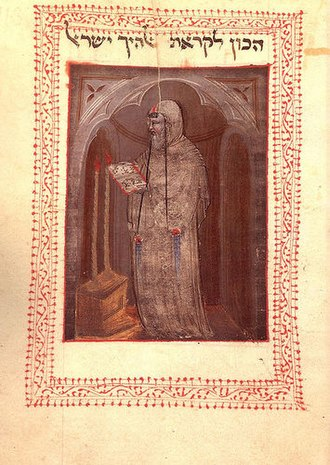
Achievements: A major figure in Jewish Kabbala mysticism
Born: 1240; Saragossa, Aragon, Spain
Died: 1291; possibly Sicily (Aged 51)
Field & Discipline: Religion; Teacher
Language: Hebrew
Father: Samuel
Mother: Unknown
Siblings: Unknown
Spouse: Name unknown
Children: Unknown
Education: At home
Major Work:
"Sefer ha-Maftehot" (commentary on the Torah)
"Hayye ha-Olam ha-Ba"
"Or ha-Sekel"
"Imre Sefer"
Life & Times:
Abulafia was brought up in Saragossa and then Tudela, Spain. He left home aged 20 and travelled to Israel to search for the mythical River Sambatyon. He moved on to Greece, where he married, then to Italy. In Capua, Italy, he studied philosophy, especially the "Guide of the Perplexed" by philosopher/physician [influenced by] Maimonides.* He eventually returned to Spain and settled in Catalonia.
Abulafia began to take an interest in Kabbala / Cabbalism, which he had earlier rejected. Kabbala (Hebrew: "tradition"), the name given to esoteric Jewish mysticism, grew out of speculation about God, Creation, and man's relation to God, and was an attempt to explain these mysteries. Because it went beyond the orthodox rabbinical interpretation of the Bible, not all Jews were [a member of] Kabbalists*. Though it had existed in Judaism since the first century AD, in Abulafia's time it was particularly prominent among Spanish Jewry.
Abulafia began his Kabbalist studies by reading commentaries on the "Sefer Yetzira” (“Book of Creation"), an ancient esoteric text. The "Yetzira" stated that God was the creator of the universe and showed how the 10 numbers of decimal notation (the "sefirot") and the 22 letters of the Hebrew alphabet were the key to mystic contemplation. Those who studied the "sefirot" in a serious and scholarly manner and observed its teaching would be led to a true knowledge of God.
Abulafia developed his own brand of Kabbala in opposition to that of the main group of Spanish Kabbalists, who resided mainly in Catalonia. He became an itinerant ecstatic visionary, interpreting the "sefirot" in terms of human actions and psychological states. In this way, he removed the esoteric aura from the "sefirot" and challenged the idea that only those steeped in ancient tradition could understand the mysteries of God. This rejection of the arcane nature of Kabbala was later echoed in the work of [influenced] Pico della Mirandola*, the Italian Renaissance scholar who was the first to use Kabbala in support of Christian theology.
Abulafia advocated a theology similar to that of Maimonides, who held that God was intelligible, suggesting a possible union between human and divine intellect. He also differed from other Spanish Kabbalists in the methods he used to spread knowledge of the mysteries of God. The traditional belief of Judaism was that observation of the divine commandments was the way to enlightenment. Abulafia employed techniques which included calling on the names of God, singing, special breathing, and movements of the head, none of which could be considered part of the Judaic tradition. He also encouraged speculation on the letters of the Hebrew script, and used numerology and letter-combinations as codes revealing mystic truths.
In 1270, Abulafia had a vision in which he was commanded to meet the Pope. Soon after, he began a nomadic existence. He first went to Castile, Spain, where he taught: "The Perplexed Guide" to [taught] Gikatilla* and Moses ben Simeon of Burgos, two leading Castilian Kabbalists. During the latter part of the 1270s, he was in Greece, where he taught the "Guide" in Thebes and Patros. In 1279, he was in Capua, Italy, teaching the work of Maimonides. But because his views were unorthodox, he was regarded with suspicion by Jews wherever he went.
Abulafia was a prolific author, writing numerous pamphlets on such subjects as the interpretation of classical Jewish texts, and his method of attaining mystical ecstasy. He also wrote innumerable prophetic works, poems, and letters. In 1280, in spite of Pope Nicholas III's threat to burn him at the stake, Abulafia went to the Pope's palace in Soriano, near Rome. Luckily for Abulafia, the Pope died soon after he got there and a short jail sentence was substituted for the stake. On his release, Abulafia went to Sicily where he built up a following of enthusiastic students. But his messianic prophecies alarmed the authorities and he was exiled.
Assessment: His teachings and techniques for finding God through ecstasy disturbed the Jewish establishment of the day, but by the 17th century he was regarded as an important influence in Jewish mysticism
Oneliner: Abraham Abulafia, early Kabbalist
Bibliography:
- Idel, Moshe, trans. Chipman, Jonathan, "The Mystical Experience in Abraham Abulafia", State University of New York Press, 1988.