De La Warr
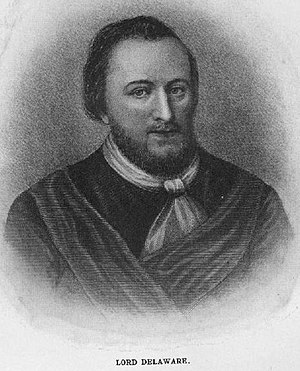
ACHIEVEMENTS: Expedition to Virginia
ALIAS: real name was Thomas West
DATE AND PLACE OF BIRTH: July 9, 1577, Hampshire, England
DATE/PLACE OF DEATH/AGE AT DEATH: June 7, 1618, off the North American coast. Aged 41
DISCIPLINE: Administrator
FIELD: Exploration
LANGUAGE: English
PARENTS: Thomas West, Baron De la Warr; Anne Knollys
SIBLINGS: Several, among whom: Robert
SPOUSE: Cecilia Shirley
CHILDREN: Seven, among whom: Henry (eldest)
EDUCATION: Queen's College, Oxford
MAJOR WORK: None
LIFE AND TIMES:
In 1595, after leaving university, De la Warr traveled for some time in Europe. In 1597 he became a Member of Parliament. The following year it is believed he served in the Spanish-occupied Netherlands, where England was supporting the Protestant forces against the Catholics.
In 1599, he joined the Earl of Essex*s forces in Ireland, where he was knighted by Essex. But in 1601, after Essex tried to start a rebellion against the government of Queen Elizabeth* De la Warr was imprisoned briefly. His father's plea and Essex's assurance before he was put to death that De la Warr knew nothing about the plot got De la Warr out of jail.
Soon after, on the death of his father, De la Warr inherited his father's title and was appointed to the Privy Council.
De la Warr joined the movement for the colonization of America, adding his voice to those of an increasing number of merchants and public figures like Raleigh* and geographer Hakluyt*. Elizabeth was tempted by the idea, but finally said no, unwilling to commit large sums to an enterprise that seemed to her risky. (A previous attempt to set up a colony in Virginia had failed.)
After Elizabeth died, the new King, James, granted a charter in 1606, and 144 settlers established Jamestown, Virginia in May, 1607. In 1609, De la Warr agreed to sit on the council of the Virginia Company, which had recently been founded to encourage settlement in and trade with North America. But sitting on a council in England was not enough for De la Warr. He wanted a first-hand view.
Getting himself appointed Governor of the colony and Captain-General for life, he arranged for a ship to take him, 150 more colonists, and fresh supplies to Jamestown, where he arrived in June, 1610. He was appalled at what he found. The settlers were living in constant fear of hostile Indians, fighting among themselves, and suffering from disease, hunger, polluted water, and lack of food and shelter.
De la Warr set to work. He appointed a council and sent out expeditions in search of food.
He wrote to England pleading for support and recommended more care be put into the selection of colonists. On his return to England in 1611, he wrote an optimistic report about the colony for the Virginia Company. The infinite trade possibilities were obvious and De la Warr pointed out that a new merchant fleet could also serve as part of the English navy. He suggested further explorations could seek out precious metals, reminding Council members that the Spanish had become fabulously wealthy from their mines in South America.
And he emphasized that planting a colony of English Protestant settlers in North America would be an important deterrent against the expansionist plans of the Catholic Spanish in South America.
Council members were convinced, and voted to continue the project. With De la Warr's encouragement, and the Council's support, the colony began to thrive. In 1613, settler Rolfe* exported his first shipment of tobacco, and tobacco production would become the colony's main industry.
De la Warr left for another expedition to Virginia in 1618, but died on the voyage off the North American coast. His name was given to the state of Delaware, Delaware Bay, and the Delaware river.
ASSESSMENT: De la Warr's arrival in 1610 undoubtedly saved the Jamestown colony in Virginia from extinction
EXTRA CONNECTIONS:
In the Autumn of 1616, Baron De La Warr and his wife Cecilia Shirley West, introduced John Rolfe and his wife, Pocahontas, into English society.
He was a great-grandson of Mary Boleyn, sister of Anne, who lost her head over Henry VIII
ONELINER: De la Warr, supporter of the Virginia colony
BIBLIOGRAPHY:
DNB
Thomas West, 3rd Baron De La Warr - Wikipedia