Optical Character Recognition
In 1917 an 18-year-old Mary Jameson demonstrates the Optophone. Light from a printed page reflects on a selenium cell, and the machine lets out a musical chord. Ms. Jameson, who is blind, can read the print at a record-breaking speed of one word per minute. It’s a good start, but the future has better toys in store.
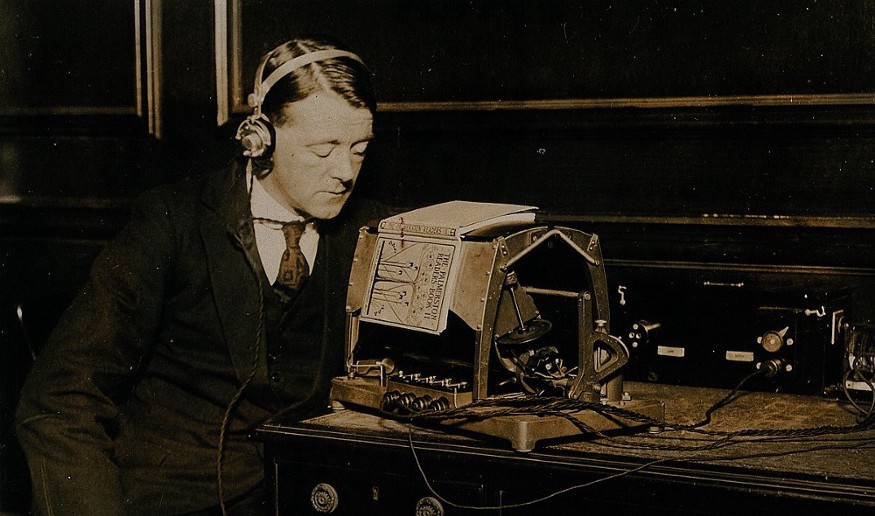
A man demonstrates the Optophone circa. 1921.

David Hammond Shepard(September 30, 1923 – November 24, 2007) was an American inventor, who invented among other things, the first optical character recognition device, first voice recognition system and the Farrington B numeric font used on credit cards.[1]
Shepard was born September 30, 1923 in Milwaukee. His father died when he was 2 and his mother when he was 10. His guardian was Laurens Hammondwho invented the Hammond organ.[1] He graduated in electrical engineering from Cornell in 1945 and then University of Michigan with a master's degree in Mathematics in 1947.[2] He worked during World War II for the Armed Forces Security Agency (now National Security Agency) on **cryptanalysis**, breaking Japanese codes. His nickname was "D-Shep" and "Party Shep."
After the war he built an optical character recognition device (reading machine) in his attic with Harvey Cook Jr. called "Gismo". In 1952 he formed Intelligent Machines Research Corporation to commercialize the invention with William Lawless Jr. in Arlington, Virginia.[3] His Intelligent Machines Research Corp. developed and sold the first dozen optical-character-recognition systems to companies like AT&T; First National City Bank and most major oil companies.
IBM licensed the machine, but never put it into production. OCR Used by the Postal Service. The US Postal Service still delivers roughly 30 million handwritten envelopes every day. The USPS has used OCR for years to analyze the text and properly sort the mails that is delivered to your mailbox on a daily basis.
In 1974 Robert Kurzweil Technologies releases the CCD flatbed scanner, the first omni-font optical character recognition system. Before 1974, OCR could only read fonts specially designed for machine readability. In the 70s, the scope of OCR is widening, and the technological universe is beginning to imagine its future impact.
The Newton MesssagePad is launched on May 29th 1992, venturing into a complicated realm of OCR technology called handwriting recognition. The Newton is a failure commercially, killed by Steve Jobs a year after he came back after having been fired. Google is using AI/neural networks to improve.
Shepard designed the Farrington B numeric font now used on most credit cards. Mr. Shepard sketched out the familiar boxy numbers on credit cards, called the Farrington B numeric font, on a cocktail napkin at the Waldorf-Astoria Hotel, his wife said.Recognition was more reliable on a simple and open font, to avoid the effects of smearing at gasoline station pumps. Reading credit cards was the first major industry use of OCR, although today the information is read magnetically from the back of the cards.
In 1962 Shepard founded Cognitronics Corporation. In 1964 his patented "Conversation Machine" was the first to provide telephone Interactive voice response access to computer stored data using speech recognition. The first words recognized were "yes" and "no".
Since the 1980s he worked on high altitude wind power,harnessing winds at high altitudes to generate power. He founded Sky WindPower Corporation with Australian Bryan William Roberts of the University of Sydney.[4] Shepard died in San Diego of bronchiectasis on November 24, 2007, at the age of 84.[1]