IBM
 | 1947–1956 |
|---|---|
 | 1956–1972 |
 | Since 1972 |
NAME: IBM (International Business Machines)
ALTERNATIVE NAME: Big Blue
LANGUAGE: English
TIME: 1911 (to present day)
LOCATION: Worldwide
CATEGORY:
US manufacturer of computers and other office equipment
DISCIPLINE:
Information Technology
SHORT DESCRIPTION:
Manufacturer of business machines and one of the largest industrial corporations in the world.
DESCRIPTION:
IBM had its genesis in the merging of three companies to form the Computing-Tabulating-Recording Company in 1911.
One of those three companies was the Tabulating-Machine Company set up by <started under Hollerith*. In the 1880's Hollerith had invented punched-card tabulating equipment which transformed the recording and retrieval of data. His system was the basis of the early data-processing industry and was adopted by business interests and government departments including the Census Bureau.
The merger of the three companies was organised by the financier Charles Ranlett Flint, well-known as a speculator and promoter of industrial mergers. The other two companies were the International Time Recording Company and the Computing Scale Company of America.
The three companies sold similar products, and all of them made products which were sold directly to other businesses. Flint saw the possibilities for marketing benefits and also hoped for technological advantages since all the companies were dependent on new inventions.
In 1914 Thomas J Watson was appointed general manager of the Computing-Tabulating-Recording Company (he came from the National Cash Register Company and was hired for his sales and management skills). Watson understood the importance of patents and he emphasised the need for product development by hiring an engineer to act as overall technical adviser and setting up a research laboratory.
In 1924 the company name was changed to International Business Machines (IBM). The company grew, and introduced the first electric typewriter It had by now become the largest manufacturer of time clocks in the country.
At the end of the decade IBM’s market expanded into the scientific and academic communities, which were beginning to use Hollerith machines to calculate mathematical and astronomical tables.
During the Great Depression of the 1930's, Watson went on producing equipment, which he stored in warehouses.
In 1935 the Social Security Act introduced new data-processing equirement and created an unprecedented demand for punched-card equipment. By World War II (1939-45) IBM was the dominant firm in data-processing during the pre-electronic period of electromechanical equipment. In 1940 Watson put all IBM facilities at the disposal of the government. A new subsidiary, the Munitions Manufacturing Corporation, was formed, and at the end of 1941 started the production of mass-produced ordnance.
Mobile recording units were supplied to the Army and their personnel were trained by IBM. The German High Command gave special instructions for the capture (they failed) of such units from the American Fifth Army in Italy.
In 1944 at Harvard the company financed and helped construct the first major stored-programme computer: the Mark I. In 1945 the first IBM laboratory devoted to pure science was established in response to competition from university science departments.
In 1946 they introduced the first electrically-operated punched-card calculators, but these were relatively slow to enter the market. When the first electronic computer, UNIVAC, was installed by <influenced by> Eckert* and <influenced by> Mauchly* for the US Bureau of Census, IBM began to switch to electronic computers with magnetic tape storage and high-speed printers.
Their success gave them the resources to plough money into research and Development, and they put their first business computer on the market in 1953. In 1956 they developed SAGE (Semi-Automatic Ground Environment) , the first major computer for a new national electronic air defense network.
SAGE was followed by SABRE (produced in co-operation with American Airlines): the first commercial airline reservation system.
In 1964 the company introduced its first major third-generation electronic Computer using microelectronic circuits known as “chips.”
By the mid 1960's they were producing around ten times as many computers as their nearest competitor, Remington Rand, a division of Sperry Rand. During the 1970's IBM's position was threatened by several companies, including Apple, who introduced personal computers (PC)s).
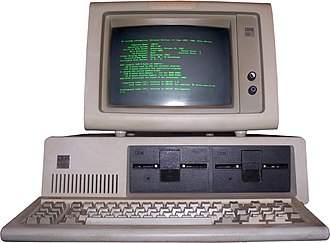
In 1980 IBM established an independent business unit (IBU) to develop and manufacture an IBM PC. IBM's first personal computer was announced in 1981 and immediately faced competition from lower priced IBM-compatible clones.
ONELINER: IBM, information technology company
Extra Connections:
The company has scientists, engineers, consultants, and sales professionals in over 175 countries. IBM employees have earned five Nobel Prizes, four Turing Awards, five National Medals of Technology, and five National Medals of Science.
1939–1945: World War II
|
 [Browning Automatic Rifle]

Main article: IBM during World War II
In the decades leading up to the onset of WW2 IBM had operations in many countries that would be involved in the war, on both the side of the Allies and the Axis. IBM had a lucrative subsidiary in Germany, which it was the majority owner of, as well as operations in Poland, Switzerland, and other countries in Europe. As with most other enemy-owned businesses in Axis countries, these subsidiaries were taken over by the Nazis and other Axis governments early on in the war. The headquarters in New York meanwhile worked to help the American war effort.
IBM in America
IBM's product line[82] shifted from tabulating equipment and time recording devices to Sperry and Norden bombsights, Browning Automatic Rifles and the M1 Carbine, and engine parts – in all, more than three dozen major ordnance items and 70 products overall. Watson set a nominal one percent profit on those products and used the profits to establish a fund for widows and orphans of IBM employee war casualties.[83]
Allied military forces widely used IBM's tabulating equipment for mobile records units, ballistics, accounting and logistics, and other war-related purposes. There was extensive use of IBM punched-card machines for calculations made at Los Alamos National Laboratory during the Manhattan Project for developing the first atomic bombs.[84] During the War, IBM also built the Automatic Sequence Controlled Calculator, also known as the Harvard Mark I for the U.S. Navy – the first large-scale electromechanical calculator in the U.S.
In 1933 IBM had acquired the rights to Radiotype, an IBM Electric typewriter attached to a radio transmitter.[85] "In 1935 Admiral Richard E. Byrd successfully sent a test Radiotype message 11,000 miles from Antarctica to an IBM receiving station in Ridgewood, New Jersey"[86] Selected by the Signal Corps for use during the war, Radiotype installations handled up to 50,000,000 words a day.[87]
To meet wartime product demands, IBM greatly expanded its manufacturing capacity. IBM added new buildings at its Endicott, New York plant (1941), and opened new facilities in Poughkeepsie, New York (1941), Washington, D.C. (1942),[88] and San Jose, California (1943).[89] IBM's decision to establish a presence on the West Coast took advantage of the growing base of electronics research and other high technology innovation in the southern part of the San Francisco Bay Area, an area that came to be known decades later as Silicon Valley.
IBM was, at the request of the government, the subcontractor for the Japanese internment camps' punched card project.[90]
IBM punched card equipment was used for cryptanalysis (code breaking) by US Army and Navy organizations, Arlington Hall and OP-20-G and similar Allied organizations, including the (Central Bureau and the Far East Combined Bureau).
IBM in Germany and Nazi-occupied Europe
The Nazis made extensive use of Hollerith equipment and IBM's majority-owned German subsidiary, Deutsche Hollerith Maschinen GmbH (Dehomag), supplied this equipment from the early 1930s. This equipment was critical to Nazi efforts to categorize citizens of both Germany and other nations that fell under Nazi control through ongoing censuses. This census data was used to facilitate the round-up of Jews and other targeted groups, and to catalog their movements through the machinery of the Holocaust, including internment in the concentration camps.
As with hundreds of foreign-owned companies that did business in Germany at that time, Dehomag came under the control of Nazi authorities prior to and during World War II. A Nazi, Hermann Fellinger, was appointed by the Germans as an enemy-property custodian and placed at the head of the Dehomag subsidiary.
Journalist and historian Edwin Black asserts in IBM and the Holocaust that the seizure of the German subsidiary was a ruse. He writes, "The company was not looted, its leased machines were not seized, and [IBM] continued to receive money funneled through its subsidiary in Geneva."[91] In his book he argues that IBM was a supplier to the Nazi regime long after they should have stopped dealing with them. IBM continued to service and expand services to the Third Reich[91] until the seizure of Dehomag after the 1941 United States Declaration of War with Germany.
IBM responded that the book was based upon "well-known" facts and documents that it had previously made publicly available and that there were no new facts or findings.[92] IBM also denied withholding any relevant documents.[93] Writing in the New York Times, Richard Bernstein argued that Black overstates IBM's culpability.[94] Other historians also argue about IBM's implicit knowledge and even Nazi use of tabulating machines in the manner that Black claims.[95]
1997: Deep Blue. The 32-node IBM RS/6000 SP supercomputer, Deep Blue, defeats World Chess Champion Garry Kasparov in the first known instance of a computer beating a reigning world champion chess player in a tournament-style competition.
2011: Watson. IBM's supercomputer Watson won on the TV game show Jeopardy! against Ken Jennings and Brad Rutter. The competition was presented by PBS.
BIBLIOGRAPHY:
Pugh, Emerson W, Building IBM, Shaping an Industry and Its Technology, MIT Press, London, 1995.
Sandbox (extensive)
Multimedia:
Connections 2: Episode 3) "Getting it Together" – James Burke explains the relationship between hot air balloons and laughing gas, and goes on to surgery, hydraulic-water gardens, hydraulic rams, tunnelling through the Alps, the Orient Express, nitroglycerin, heart attacks and headaches, aspirin, carbolic acid, disinfectants, Maybach-Gottlieb Daimler-Mercedes, carburetors, helicopters](https://app.thebrain.com/brain/f3e16344-7cd9-4fa3-ae1d-59876e128474/64640390-33c1-54a3-ad23-88f27a701efd), typewriters, punch cards, and IBM**.