Hepplewhite
NAME: Hepplewhite, George
ACHIEVEMENTS:
One of the leading eighteenth-century furniture makers
NICKNAME/ALIAS:
None
DATE AND PLACE OF BIRTH:
Unknown
DATE AND PLACE OF DEATH AND AGE AT DEATH:
1786, London, England. Age unknown
DISCIPLINE: Cabinet-maker
FIELD: Furniture
LANGUAGE: English
PARENTS:
Father: name unknown
Mother: name unknown
SIBLINGS:
Unknown
SPOUSE:
Alice
CHILDREN:
1 son: George, and ?
EDUCATION:
Unknown
MAJOR WORK:
“The Cabinet Maker and Upholsterer’s Guide” (1788)
LIFE AND TIMES:
Virtually nothing is known of Hepplewhite’s life. He was apprenticed to Robert Gillow, a furniture maker in Lancaster, in the north of England. Gillow was a successful craftsman and a designer who established a firm of cabinet-makers and in 1760 opened a business in Oxford Street in London.
At some stage, Hepplewhite established himself as a cabinet-maker at St Giles’s Cripplegate, in London. There are no records of sales to important people and the recognition Hepplewhite receives today as one of the foremost English furniture designers of the eighteenth century is due to his book, the “Cabinet-Maker and Upholsterer’s Guide” which was published in 1788, two years after his death.
Although he employed many of the same classical motifs of urns, swags, medallions and festoons that had been introduced by the designer <work related to> Adam*, Hepplewhite’s designs were a simplified and robust interpretation of the neo-classical style introduced by Adam earlier in the century.
Like all good cabinet-makers, Hepplewhite respected his material and he produced functional designs that made for handsome, plain furniture. The characteristics of his design are simplicity of form and line and a restrained use of ornament. He has been described as democratizing neo-classicism.
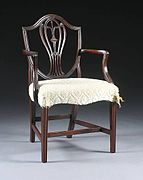
There were over a hundred designs in his book and its purpose was to supply a template for cabinet-makers. He produced numerous designs for chair backs and for sofas, which he designed in a more severely streamlined fashion than those of Adam. Hepplewhite is credited with inventing the shield-back, which could be filled with canework or with curved splats radiating from the base of the shield.
He also designed bow-fronted chests and sideboards, beds with fluted or turned pillars, wardrobes, tallboys and bureau-bookcases. They were usually made in mahogany, plainly decorated with bands of inlay or light relief carving.
He also designed smaller items such as tea trays. These were made either in mahogany or satinwood, decorated with inlays of woods such as willow which could be stained with color, or in the heavily varnished wood known as japanned ware which had been invented by <used product by> Thomas Allgood* in the seventeenth century.
Compared with Adam, Hepplewhite produced more designs for ordinary domestic use and not so many for display in great halls or libraries. He was not swayed by fashionable novelty or whim and when <a competitor was> Sheraton* produced the first volume of his designs (in 1791) he wrote that many of Hepplewhite’s designs were out of date.
ASSESSMENT: Hepplewhite was a leading furniture designer who first demonstrated that the Adam’s neo-classical design could be adapted for the general public.
EXTRA CONNECTIONS: None
ONELINER: George Hepplewhite, famous early furniture-maker
BIBLIOGRAPHY:
Gloag, John, British Furniture Makers, William Collins of London, 1935
Gloag, John, Georgian Grace, A Social History of Design from 1660-1830, Spring Books, London, 1956
Musgrave, Clifford, Adam and Hepplewhite, and other neo-classical Furniture, Faber and Faber Ltd., London, 1966.