Scharnhorst
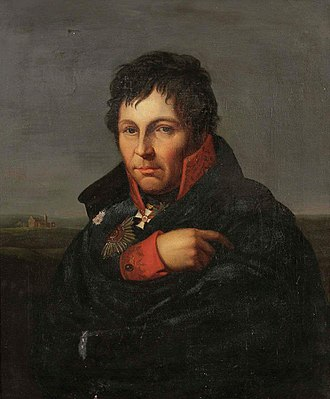
General Gerhard Johann David Waitz von Scharnhorst
Achievements: Succeeded in taking transforming the model for European Continental Armies.
Born: November 12, 1755; Bordenau, Hanover, Germany
Died: June 28, 1813, Prague, Czech Republic
Field & Discipline: Military
Language: German
Father: (farmer and former Sergeant in Service of Hanover)
Mother: Unknown
Siblings: Unknown
Spouse: Clara Schmalz (sister to the 1st director of Berlin University)
Children: Unknown
Education: Self educated as a youth before attending the Military Academy at Wilhemstein.
Major Work:
“Die Ursachen des Glucks der Franzosen im Revolutionskrieg” (“The Origins of the Good Fortune of the French in the Revolutionary War”)
“Verteidigung der Stadt Menin” (“Defense of the Town of Menin”)
Committee for the reorganization of the Prussian Army following the collapse of 1806
Life & Times:
Self-educated as a youth, Gerhard Scharnhorst would eventually secure admission to the military academy of Count William of Schaumberg Lippe, beginning a career that would establish him as one of the preeminent military minds of the Napoleonic Era.
By 1778 he would secure a commission in the army of Hanover then join the Hanoverian contingent to the First Coalition against the French Republic, this would be the first of many times over the next three and half decades that Scharnhorst would face the French Army on the field of battle.
During the course of the War of the First Coalition, as a young officer Scharnhorst distinguished himself, successfully attracting the attention of numerous allied armies as he served under the Duke of York in 1793 and then under General Rudolf Hammerstein (during the defense and breakout from the Belgian town of Menin in 1794).
At Menin, Scharnhorst would organize the defense of the town by 2400 allied soldiers (using well placed trenches and barricades) against massed French Armies surrounding the town. Having successfully defended the town against initial assaults, Scharnhorst spearheaded the breakout. The action at Menin would inspire his book: Defense of the town of Menin, and lead to his promotion to Major in the Army of Hanover.
It was also during the events at Menin that Scharnhorst came to recognize the changing nature of war and armies on the continent of Europe, as he witnessed the espirit de corps of the France’s civilian army. Scharnhorst saw that France’s revolution had brought about common cause between the military, the civilian government and the populace. He wrote that France’s revolution had “…set in motion new means and new forces” that would change the face of warfare. Scharnhorst would eventually set these observations in literary form in another great work: The Origins of the Good Fortune of the French in the Revolutionary War.
Following his participation in the 1st Coalition Scharnhorst was in great demand for the staffs of numerous former allies. King Frederick William III of Prussia obtained his services with the offer of a doubled salary, promotion to Lt. Colonel, and, most notably, Patents of Nobility (an attractive idea to a self-educated farmer’s son). Scharnhorst quickly adapted to Berlin’s military life, joining the staff of the War Academy of Berlin, where he taught Carl Philippe Gottlieb von [teacher of] Clausewitz * (who years later would pen the military masterpiece On War) and founded the prestigious Berlin Military Society (ever popular in a militarized society like that of 18th century Prussia).
By 1806 Scharnhorst would find himself facing the French again as a member of the staff of the Duke of Brunswick, against [fought against] Napoleon* in a war that found the Prussian in prolonged retreat just nineteen days after it mobilized. Before Prussian forces capitulated in the War of the 4th Coalition against France, Scharnhorst joined the staff of Gen. Field Marshal Gerhard Lebrecht von [served with] Blűcher*, bringing 34 additional cannon to Blucher’s army.
Blűcher held out longer than the other Prussian forces, but eventualkly he too was forced to surrender after the Battle of Patiku on November 6, 1806. Scharnhorst went into short-lived captivity and was involved in a prisoner exchange. He then joined the cavalry of General Wilhelm von L’Estocq’s Prussian Corps in Russian service. The Prussian Corps last only until July 1807 and the Peace of Tilsit, but not before Scharnhorst had earned Prussia’s highest military honor, Pour la Merite, at the Battle of Eylau.
During the relative peace that followed the Treaty of Tilsit, Scharnhorst was promoted to Major General, returned to Berlin and formed a Committee with the express purpose of reforming the Prussian army, hoping to save the Prussian Army from repeating the collapse of 1806. The Military Reorganization Committee included officers that later would figure prominently in Prussian history: Karl Grolman, Leopold Ludwig von Boyen, and August Wilhelm von [worked with] Gneisenau*, but it was when Baron von Stein joined the group that Scharnhorst gained direct contact with the king and a chance to make his mark on the Prussian Army.
Rising to the position of Aid-de-Camp General to the Emperor, Scharnhorst embarked on a series of reforms that would include the removal of mercenary elements from the Prussian Army, conversion to a conscripted citizen army, based on short-period service, which would provide readiness in the event of war, and purged more than 200 ineffective officers.
Scharnhorst’s reforms in Prussian drew the attention of Napoleon who demanded the Prussians immediately suspend or reverse many of Scharnhorst’s reforms, and issued a decree on Sept 25, 1810 requiring all foreigners to leave Prussian arm service. This was partly in reaction to (foreigner) Scharnhorst’s agitation for a war of revenge against France. Scharnhorst managed to avoid dismissal by successfully appealing directly to Napoleon.
Having avoided involuntary retirement under Napoleon’s 1810 decree, Scharnhorst was in any case voluntarily to retire less than a year later, when Prussia was forced into an alliance with France against Russia.
Unwilling to fight for the Napoleonic cause, Scharnhorst retired to writing and produced manual on firearms, before being recalled by Emperor Frederick William III. Scharnhorst chose to serve as Chief-of-Staff to Blűcher and then became Chief-of-Staff to Russian Prince Peter Khristianovich Wittgenstein, as another alliance pursued Napoleon following his retreat from Moscow.
Once again Scharnhorst was party to a defeat at the hands of the French, as Russian forces were forced into retreat after the Battle of Lutzen, in which he was wounded. The Russian retreat to Dresden and a festering wound would lead to Scharnhorst’s death in Prague, while he was convalescing and negotiating with Prince Charles Philip of Schwarzenberg and Count John Joseph Wenceslaus Radetzky for Austrian intervention on the Prussian side against Napoleon.
After his death the Prussian Emperor commissioned his statue, by sculptor Christian Daniel Rauch, to be displayed in Berlin. Two 20th century warships were named for him, as was a district in the city of Dortmund.
Assessment: Serving in the armies of Hanover and Prussia during the Napoleonic Wars, Scharnhorst, formally trained in the shadow of the Seven Years War, would advance military science. Ultimately, Scharnhorst principles would transform European armies from a tool of monarchs to a body of citizen soldiers fighting for national principles.
Oneliner: Gerhard Scharnhorst, 19th century German General
Bibliography:
- “Scharnhorst’s Clarity about War as it Actually is”. McNair Paper No. 52. Chapter 3. Institute for National Strategic Studies.
- “Joint Advanced Warfighting School”. Davis, Jon M., Bowen, Lt. Col. Kelvin C., Schonenberg, CDR Lee W., Joint Forces Staff College, Joint and Combined Staff Officer School. February 28, 2003.
- Byers, Paula K. ed. Encyclopedia of World Biography Vol. 13. Detroit, MI: Gale Research, 1998.
- Dwyer, Philip G. ed. The Rise of Prussia. Harlow, England: Longman Pearson Education, 2000.
- Clark, Christopher. Iron Kingdom: The Rise and Downfall of Prussia 1600-1947. Cambridge, MA: Harvard University Press, 2006.