Napoleon 2
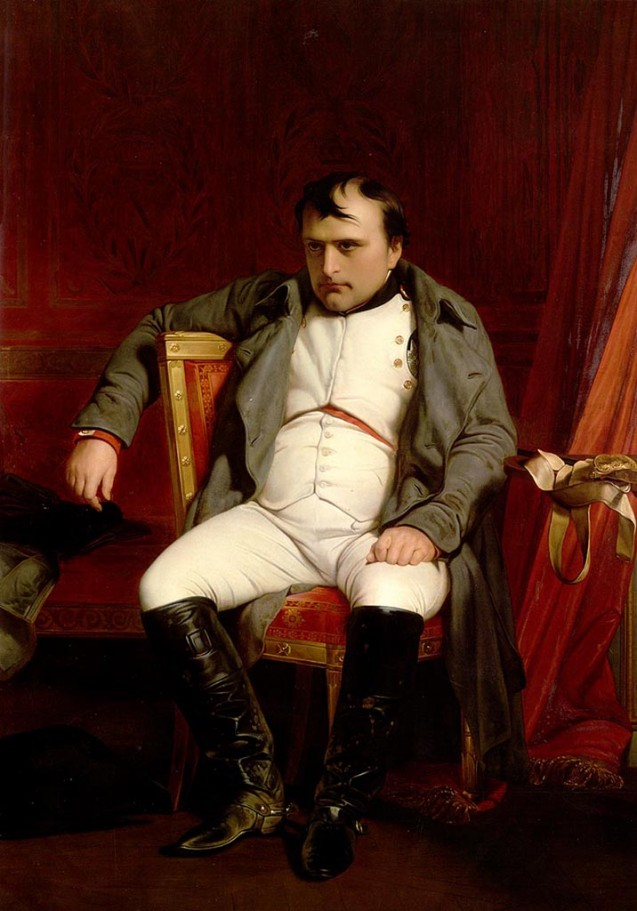
From Wikipedia, the free encyclopedia|
|
| Emperor of the French | Emperor of the French |
|---|---|
| Reign18 | May 1804 – 11 April 1814 20 March 1815 – 22 June 1815 |
| Coronation | 2 December 1804 |
| PredecessorNone | (himself as First Consul of the French First Republic; previous ruling monarch was Louis XVI) |
| Successor | Louis XVIII (de jure in 1814) |
| King of Italy | King of Italy |
| Reign17 | March 1805 – 11 April 1814Coronation26 |
| May 1805PredecessorNone | |
| (himself as President of the Italian Republic; previous ruling monarch was Emperor Charles V) | |
| SuccessorNone | (kingdom disbanded, next king of Italy was Victor Emmanuel II) |
| Spouse | |
| Issue | Issue |
| Napoleon II | Napoleon II |
| Full nameNapoleon | Full nameNapoleon |
| Bonaparte | Bonaparte |
| House | House of Bonaparte |
| Father | Carlo Buonaparte |
| Mother | Letizia Ramolino |
| Born15 | August 1769 |
| Died5 | May 1821 (aged 51) |
| Burial | Les Invalides, Paris, France |
| Signature |  |
| ReligionRoman | Catholicism (see Religions section) |
Napoleon Bonaparte (French: Napoléon Bonaparte [napoleɔ̃ bɔnɑpaʁt], Italian: Napoleone Buonaparte; 15 August 1769 – 5 May 1821) was a French military and political leader who rose to prominence during the latter stages of the French Revolution and its associated wars in Europe.
As Napoleon I, he was Emperor of the French from 1804 to 1815, the first monarch of France bearing the title emperor since the reign of Charles the Fat (881-887). His legal reform, the Napoleonic Code, has been a major influence on many civil law jurisdictions worldwide, but he is best remembered for his role in the wars led against France by a series of coalitions, the so-called Napoleonic Wars.
He established hegemony over most of continental Europe and sought to spread the ideals of the French Revolution, while consolidating an imperial monarchy which restored aspects of the deposed Ancien Régime. Due to his success in these wars, often against numerically superior enemies, he is generally regarded as one of the greatest military commanders of all time, and his campaigns are studied at military academies worldwide.[1]
Napoleon was born at Ajaccio in Corsica in a family of noble Italian ancestry which had settled Corsica in the 16th century. He trained as an artillery officer in mainland France. He rose to prominence under the French First Republic and led successful campaigns against the First and Second Coalitions arrayed against France. He led a successful invasion of the Italian peninsula.
In 1799, he staged a coup d'état and installed himself as First Consul; five years later the French Senate proclaimed him emperor, following a plebiscite in his favour. In the first decade of the 19th century, the French Empire under Napoleon engaged in a series of conflicts—the Napoleonic Wars—that involved every major European power.[1] After a streak of victories, France secured a dominant position in continental Europe, and Napoleon maintained the French sphere of influence through the formation of extensive alliances and the appointment of friends and family members to rule other European countries as French client states.
The Peninsular War and 1812 French invasion of Russia marked turning points in Napoleon's fortunes. His Grande Armée was badly damaged in the campaign and never fully recovered. In 1813, the Sixth Coalition defeated his forces at Leipzig; the following year the Coalition invaded France, forced Napoleon to abdicate and exiled him to the island of Elba. Less than a year later, he escaped Elba and returned to power, but was defeated at the Battle of Waterloo in June 1815. Napoleon spent the last six years of his life in confinement by the British on the island of Saint Helena. An autopsy concluded he died of stomach cancer, but there has been some debate about the cause of his death, as some scholars have speculated that he was a victim of arsenic poisoning.
Origins and education...
http://www.conflicthistory.com/#/period/1808-1814/conflict/+en+napoleonic_wars
See main Napoleon Node
Knowledge Web Content
Nickname/Alias: born: Napoleone Buonaparte; Napoleon I, Emperor of France; Le Corse (The Corsican); Le Petit Caporal (The Little Corporal)
Achievements: French Emperor.
Born: August 15, 1769; Ajaccio, Corsica
Died: May 5, 1821; the island of St. Helena, Atlantic Ocean (Aged 51)
Field & Discipline: Politics; Military; Emperor
Language: French; Corsican dialect
Father: Carlo Buonaparte
Mother: Letizia Ramolino.
Siblings: 7 surviving siblings: Joseph; Lucien; Louis; Jerome; Eliza; Pauline; Caroline
Spouse: 1) Josephine de Beauharnais (m. 1796-1809); 2) Archduchess Marie-Louise (m. 1810)
Children: Francois Charles Joseph Bonaparte
Education: College d'Autun (1778-79); Brienne Military Academy (1779-84); Ecole Militaire, Paris (1784-85)
Life & Times:
After graduating from military school in 1785, Napoleon became a Second-Lieutenant of Artillery in the regiment of La Fere, garrisoned at Valence, in southern France where he studied military tactics and strategy and the philosophical works of [studied] Voltaire* and [studied] Rousseau*.
Napoleon was in Paris on 10th August 1793, when [career affected by] Louis XVI* was dethroned and, in September, took part in the siege of the naval base at Toulon, which was in the hands of anti-Revolutionaries. Toulon was taken on 19th December, Napoleon was promoted to Brigadier General and, the following February, given command of the artillery in the French Army in Italy.
In 1795, he returned to Paris where, in October, there was a Royalist uprising against the government, which turned to him to put down the rebellion by seizing all available artillery and placing his troops at critical points throughout Paris. He was given overall command of the French army in Italy in 1796 and, before going off to war, he married Josephine de Beauharnais.
Between March 1796 and April 1797, Napoleon had achieved a number of impressive Italian victories, in spite of being outnumbered by the combined Piedmontese-Austrian forces. These victories were, in part, thanks to the development of superior artillery by the French military engineer [served by] Gribeauval* and the life saving skills of the military surgeon [served by] Larrey*.
In October 1797 Napoleon concluded a treaty with Austria which left Britain virtually alone in the war against France. The British navy had almost complete domination over the seas so, early in 1798, Napoleon began a campaign to take Egypt. His plan was to use Egypt as the base for an attack on the British in India. When [defeated by] Nelson*’s fleet defeated the French in the Battle of the Nile, on 1st August 1798, Napoleon was already organising Egypt as a French protectorate.
By the time the Egyptian campaign failed Napoleon had surrounded himself with the leading French scientists, including the physicist [co-opted] Monge*, the chemist [co-opted] Berthollet*, the mathematician [co-opted] Fourier*, zoologist [co-opted] Saint-Hilaire* and the inventor [co-opted] Conte*. Napoleon began to behave like an independent sovereign, since he was far away from the rule of government, and was seen by the French nation as a romantic hero.
He returned from Egypt to organize the revolution of 9th November 1799, drew up a new constitution and was given the position of First Consul for ten years.
He reorganized his armies, defeated Austria, signed a concordat with Pope Pius VII, by which the Roman Catholic Church recognised the French Republic and the Church was restored to France. Then, in March 1802, he negotiated the Treaty of Amiens with Britain, which brought the Revolutionary Wars to a close.
Napoleon took advantage of an uneasy peace to set up the Bank of France, stabilise the franc, and regulate the collection of taxes by employing paid officials. He improved the structure of local Government and the judicial system by introducing a system of prefects and sub-prefects, while at the same time taking authority away from locally elected councils.
He also worked to improve secondary education and to create a single workable legal code, now known as the Napoleonic Code. As a result of improved economic and political stability in France, his popularity with the people grew and, on 1st August 1802, he was made Consul for life. On 18th May 1804, he was proclaimed Emperor and crowned in the Cathedral of Notre Dame in Paris.
During the 1800s, Napoleon created an Imperial court and administration in France, in which both émigré aristocrats and new men of talent were given positions of authority. Among those were the chemist, Claude-Louis Berthollet, the scientist, [co-opted] Fourcroy*, the inventor [rewarded] Appert*, the physician [promoted] Corvisart* and the painter [commissioned] David*, who painted the 'Coronation of Napoleon'.
In May 1803, the same year that he banished the writer [exiled] de Stael* from Paris, war broke out again with Britain, Austria, Russia, Sweden and Naples. Napoleon wanted to invade Britain, but he couldn’t break the British Navy and, in the Battle of Trafalgar, on 21st October 1805, his fleet was destroyed.
Despite this, his Grand Army dominated the Continent and, by June 1807, Napoleon was King of Italy, Mediator of the Swiss Confederation and Protector of the Confederation of the Rhine. His brothers also held regal positions, with Joseph in Naples, Louis in Holland and Jerome in Westphalia.
Unable to defeat Britain at sea, Napoleon ordered the European states under his control to boycott British goods, a mistake that caused great resentment among the satellite countries.
In 1808, he refused to help the disgraced American statesman, [refused help to] Aaron Burr*, in his plan to conquer Florida with French aid. Instead, he intervened in Spanish affairs and forced the abdication of Charles IV, then promoted his brother Joseph to the throne of Madrid.
Then he made the mistake of annexing the States of the Church, imprisoning the Pope and earning himself excommunication. The Spanish uprising against this "enemy of the Pope" was fierce and, for the first time in fifteen years of war, a French army surrendered almost without a fight, at Baylen, in July 1808. The following month, in Spain, in what was known as the Peninsular War, the Anglo-Spanish allies, led by the [defeated by] Duke of Wellington*, defeated the French at the Battle of Vimeiro.
In 1809, Napoleon heavily defeated Austria again. In the same year, he divorced the childless Josephine. The Austrian chancellor [marriage arranged by] Metternich*, negotiated Napoleon’s marriage to the Austrian Emperor's daughter, the Archduchess Marie Louise, a year later. In 1811, Francois Charles Joseph, the future Napoleon II, was born.
Strangely, in 1810, Napoleon allowed the medal of the French Institute to be awarded to the English chemist [honoured] Davy*, despite the fact that England and France were at war. In 1811, Russia opened her ports to neutral shipping, which convinced Napoleon that the Tsar was going to join in an alliance with Britain.
In June 1812, he made the most serious tactical error of his life and invaded Russia. By October, with his lines of supply critically over-extended, his troops exhausted and Russia's harsh winter setting in, Napoleon realised that he couldn’t win and retreated from Moscow. His most disastrous campaign, of the 600,000 troops of the Grand Army that went into Russia, only 24,000 came out.
In 1813, Wellington forced the French out of Spain, having defeated them on 21st June at Vitoria. By this time, Napoleon’s allies were beginning to desert him. At the "Battle of the Nations" near Leipzig, October 16-19, the French suffered a major defeat at the hands of the Prussian Army, which had been reorganised by Generals [defeated by] Gniesenau* and [defeated by] Scharnhorst*. They had united with the Russians, who were supported by the Swedes, led by [defeated by] Bernadotte*, Napoleon's old ally.
The allies took Paris on 31st March 1814 and, at Fontainebleau, Napoleon was forced to abdicate by his own marshals on 11th April. Under the Treaty of Fontainebleau, he was allowed to rule Elba, an island off the coast of Italy near Corsica, as a mini-kingdom. He was permitted to retain the title of Emperor and was given an income by the French government.
The following year, Napoleon knew that the coalition government had little support in France so, on 26th February 1815, he sailed from Elba with 1,500 men bound for France. On 20th March, the start of the 'Hundred Days', he and his little army entered Paris.
Over the next few weeks, he raised a new Grand Army with [served by] Ney* in command. He defeated the Prussians, led by [defeated] Blucher*, in June 1815 but, two days later, he was beaten at Waterloo in Belgium by the Anglo-Dutch forces led by Wellington.
On June22 , in Paris, the new Assembly accepted Napoleon’s second abdication and the accession of his son as Napoleon II, who was formally deposed just five days later. Napoleon threw himself on the mercy of the British and surrendered to Captain Maitland, commander of the Royal Naval ship H.M.S. 'Bellerophon', at Rochefort on 15th July 1815.
The British exiled Napoleon to the island of St. Helena, off the coast of Africa, on 15th October 1815, where he remained until his death, from either liver disease or cancer of the stomach, in 1821.
Extra Connections: He met [met] Alexander von Humboldt*; Napoleonic armies triggered [triggered work of] Pestalozzi*’s educational work.
He affected the lives of [influenced] Laplace*, [influenced] Chappe*, [influenced] Archibald Cochrane*, [influenced] Sir William Congreve*, [influenced] Bichat*, [influenced] RJ Hauy*, [influenced] D’Arblay*, [influenced] Jomini*, [influenced] Careme*, and [influenced] Napoleon III*
He authorized the [authorized] Louisiana Purchase* and did the deal with [did Louisiana Purchase deal with] Robert R Livingston*,
He was publicly opposed by [publicly opposed by] Kotzebue*
He fought against the Corsican nationalist [fought] Paoli*
His sale of Louisiana involved Queen [gave throne to]Maria Louisa of Etruria*
He was the subject of an ode by Italian writer Ugo [ode to him written by]Foscolo*
Assessment: One of history’s greatest figures who dominated most of Europe for a quarter of a century.
Oneliner: Napoleon Bonaparte, French Emperor
Bibliography:
- Chamber's Encyclopaedia.
- Collier's Encyclopaedia.
- Encyclopedia Britannica.
- Harris, Nathaniel, Napoleon, London, B.T. Batsford Ltd., 1988.