Tea
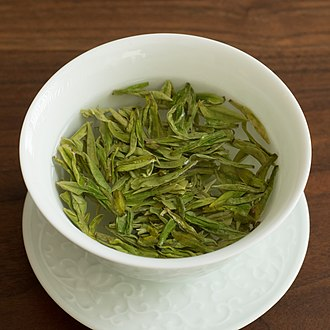
Tea is an aromatic beverage prepared by pouring hot or boiling water over cured or fresh leaves of Camellia sinensis, an evergreen shrub native to East Asia which probably originated in the borderlands of southwestern China and northern Myanmar.[3][4][5] Tea is also made, but rarely, from the leaves of Camellia taliensis.[6][7][8] After plain water, tea is the most widely consumed drink in the world.[9] There are many different types of tea; some have a cooling, slightly bitter, and astringent flavour,[10] while others have profiles that include sweet, nutty, floral, or grassy notes. Tea has a stimulating effect in humans primarily due to its caffeine content.[11]
An early credible record of tea drinking dates to the third century AD, in a medical text written by Chinese physician Hua Tuo.[12] It was popularised as a recreational drink during the Chinese Tang dynasty, and tea drinking subsequently spread to other East Asian countries. Portuguese priests and merchants introduced it to Europe during the 16th century.[13] During the 17th century, drinking tea became fashionable among the English, who started to plant tea on a large scale in British India.
The term herbal tea refers to drinks not made from Camellia sinensis. They are the infusions of fruit, leaves, or other plant parts, such as steeps of rosehip, chamomile, or rooibos. These may be called tisanes or herbal infusions to prevent confusion with tea made from the tea plant.
Etymology
Main article: Etymology of tea
The etymology of the various words for tea reflects the history of transmission of tea drinking culture and trade from China to countries around the world.[14] Nearly all of the words for tea worldwide fall into three broad groups: te, cha and chai, present in English as tea, cha or char, and chai. The earliest of the three to enter English is cha, which came in the 1590s via the Portuguese, who traded in Macao and picked up the Cantonese pronunciation of the word.[15][16]
The more common tea form arrived in the 17th century via the Dutch, who acquired it either indirectly from the Malay teh, or directly from the tê pronunciation in Min Chinese.[15] The third form chai (meaning "spiced tea") originated from a northern Chinese pronunciation of cha, which travelled overland to Central Asia and Persia where it picked up a Persian ending yi.
Origin and history
Further information: History of tea and History of tea in China
Botanical origin
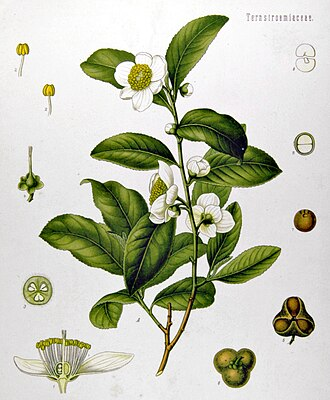
Tea plant (Camellia sinensis) from Köhler's Medicinal Plants, 1897.
Tea plants are native to East Asia and the probable center of origin of tea is near the source of the Irrawaddy River from where it spread out fan-wise into southeast China, Indo-China and Assam. Thus, the natural home of the tea plant is considered to be within the comparatively small fan-shaped area between Nagaland, Manipur and Mizoram along the Burma frontier in the west, through China as far as the Chekiang Province in the east, and from this line generally south through the hills to Burma and Thailand to Vietnam. The west–east axis indicated above is about 2,400 km long extending from longitude 95°-120°E. The north–south axis covers about 1,920 km, starting from the northern part of Burma, latitude 29°N passing through Yunnan, Tongkin, Thailand, Laos and on to Annan, reaching latitude 11°N.[17]
Chinese (small-leaf) type tea (C. sinensis var. sinensis) may have originated in southern China possibly with hybridization of unknown wild tea relatives. However, since there are no known wild populations of this tea, its origin is speculative.[18][19]
Given their genetic differences forming distinct clades, Chinese Assam-type tea (C. sinensis var. assamica) may have two different parentages – one being found in southern Yunnan (Xishuangbanna, Pu'er City) and the other in western Yunnan (Lincang, Baoshan). Many types of Southern Yunnan Assam tea have been hybridized with the closely related species Camellia taliensis.
Unlike Southern Yunnan Assam tea, Western Yunnan Assam tea shares many genetic similarities with Indian Assam-type tea (also C. sinensis var. assamica). Thus, Western Yunnan Assam tea and Indian Assam tea both may have originated from the same parent plant in the area where southwestern China, Indo-Burma, and Tibet meet. However, as the Indian Assam tea shares no haplotypes with Western Yunnan Assam tea, Indian Assam tea is likely to have originated from an independent domestication. Some Indian Assam tea appears to have hybridized with the species Camellia pubicosta.[18][19]
Assuming a generation of 12 years, Chinese small-leaf tea is estimated to have diverged from Assam tea around 22,000 years ago, while Chinese Assam tea and Indian Assam tea diverged 2,800 years ago. The divergence of Chinese small-leaf tea and Assam tea would correspond to the last glacial maximum.[18][19]
Early tea drinking
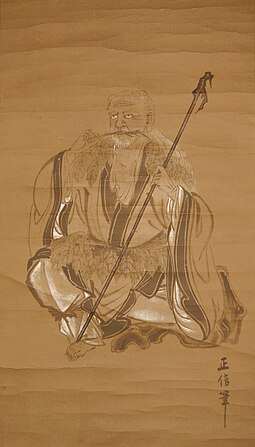
A 19th-century Japanese painting depicting Shennong: Chinese legends credit Shennong with the invention of tea.
People in ancient East Asia ate tea for centuries, perhaps even millennia, before ever consuming it as a beverage. They would nibble on the leaves raw, add them to soups or greens, or ferment them and chew them as betel is chewed.[21][page ^needed]
Tea drinking may have begun in the region of Yunnan during the Shang dynasty, where it was used for medicinal purposes. It is also believed that in Sichuan, "people began to boil tea leaves for consumption into a concentrated liquid without the addition of other leaves or herbs, thereby using tea as a bitter yet stimulating drink, rather than as a medicinal concoction."[5]
Chinese legends attribute the invention of tea to the mythical Shennong (in central and northern China) in 2737 BC, although evidence suggests that tea drinking may have been introduced from the southwest of China (Sichuan/Yunnan area).[20] The earliest written records of tea come from China. The word tú 荼 appears in the Shijing and other ancient texts to signify a kind of "bitter vegetable" (苦菜), and it is possible that it referred to many different plants such as sow thistle, chicory, or smartweed,[22] as well as tea.[23]
In the Chronicles of Huayang, it was recorded that the Ba people in Sichuan presented tu to the Zhou king. The Qin later conquered the state of Ba and its neighbour Shu, and according to the 17th century scholar Gu Yanwu who wrote in Ri Zhi Lu (日知錄): "It was after the Qin had taken Shu that they learned how to drink tea."[2] Another possible early reference to tea is found in a letter written by the Qin dynasty general Liu Kun who requested that some "real tea" to be sent to him.[24]
The earliest known physical evidence[25] of tea was discovered in 2016 in the mausoleum of Emperor Jing of Han in Xi'an, indicating that tea from the genus Camellia was drunk by Han dynasty emperors as early as the second century BC.[26] The Han dynasty work, "The Contract for a Youth", written by Wang Bao in 59 BC,[27] contains the first known reference to boiling tea. Among the tasks listed to be undertaken by the youth, the contract states that "he shall boil tea and fill the utensils" and "he shall buy tea at Wuyang".[2]
The first record of tea cultivation is also dated to this period, during which tea was cultivated on Meng Mountain (蒙山) near Chengdu.[28] Another early credible record of tea drinking dates to the 3rd century AD, in a medical text by Hua Tuo, who stated, "to drink bitter t'u constantly makes one think better."[29] However, before the Tang dynasty, tea-drinking was primarily a southern Chinese practice centered in Jiankang.[30] Tea was disdained by the Northern dynasties aristocrats, who describe it as inferior to yogurt.[31][32] It became widely popular during the Tang dynasty, when it also spread to Korea, Japan, and Vietnam. The Classic of Tea, a treatise on tea and its preparations, was written by the 8th century Chinese writer, Lu Yu. He was known to have influenced tea drinking on a large part in China.[33][unreliable ^source?]
Developments
 Tea with ingredients, China
Through the centuries, a variety of techniques for processing tea, and a number of different forms of tea, were developed. During the Tang dynasty, tea was steamed, then pounded and shaped into cake form,[34] while in the Song dynasty, loose-leaf tea was developed and became popular. During the Yuan and Ming dynasties, unoxidized tea leaves were first stirred in a hot dry pan, then rolled and air-dried, a process that stops the oxidation process that would have turned the leaves dark, thereby allowing tea to remain green. In the 15th century, oolong tea, in which the leaves are allowed to partially oxidize before being heated in the pan, was developed.[30] Western tastes, however, favoured the fully oxidized black tea, and the leaves were allowed to oxidize further. Yellow tea was an accidental discovery in the production of green tea during the Ming dynasty, when apparently careless practices allowed the leaves to turn yellow, which yielded a different flavour.[35]
Worldwide spread
 Tea-weighing station north of Batumi, Russian Empire, before 1915
Tea was first introduced to Western priests and merchants in China during the 16th century, at which time it was termed chá.[13] The earliest European reference to tea, written as chiai, came from Delle navigationi e viaggi written by Venetian Giambattista Ramusio in 1545.[36] The first recorded shipment of tea by a European nation was in 1607 when the Dutch East India Company moved a cargo of tea from Macao to Java, then two years later, the Dutch bought the first assignment of tea which was from Hirado in Japan to be shipped to Europe.[37] Tea became a fashionable drink in The Hague in the Netherlands, and the Dutch introduced the drink to Germany, France, and across the Atlantic to New Amsterdam (New York).[38]
In 1567, Russian people came in contact with tea when the Cossack Atamans Petrov and Yalyshev visited China.[39] The Mongolian Khan donated to Tsar Michael I four poods (65–70 kg) of tea in 1638.[40] According to Jeremiah Curtin,[41] it was possibly in 1636[42] that Vassili Starkov was sent as envoy to the Altyn Khan. He was given 250 pounds of tea as a gift to the tsar. Starkov at first refused, seeing no use for a load of dead leaves, but the Khan insisted. Thus was tea introduced to Russia. In 1679, Russia concluded a treaty on regular tea supplies from China via camel caravan in exchange for furs. It is today considered the de facto national beverage.
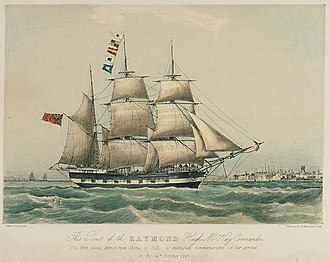
The Raymond, Hugh Mckay Commander. The first vessel direct from China to Hull on her arrival on 14 October 1843 with a cargo of tea. see later [Clipper ships].
The first record of tea in English came from a letter written by Richard Wickham, who ran an East India Company office in Japan, writing to a merchant in Macao requesting "the best sort of chaw" in 1615. Peter Mundy, a traveller and merchant who came across tea in Fujian in 1637, wrote, "chaa – only water with a kind of herb boyled in it".[43][44]
Tea was sold in a coffee house in London in 1657, Samuel Pepys tasted tea in 1660, and Catherine of Braganza took the tea-drinking habit to the English court when she married Charles II in 1662. Tea, however, was not widely consumed in the British Isles until the 18th century and remained expensive until the latter part of that period. English drinkers preferred to add sugar and milk to black tea, and black tea overtook green tea in popularity in the 1720s.[45] Tea smuggling during the 18th century led to the general public being able to afford and consume tea. The British government removed the tax on tea, thereby eliminating the smuggling trade, by 1785.[46] In Britain and Ireland, tea was initially consumed as a luxury item on special occasions, such as religious festivals, wakes, and domestic work gatherings.
The price of tea in Europe fell steadily during the 19th century, especially after Indian tea began to arrive in large quantities; by the late 19th century tea had become an everyday beverage for all levels of society.[47] The popularity of tea played a role in historical events – the Tea Act of 1773 provoked the Boston Tea Party that escalated into the American Revolution. The need to address the issue of British trade deficit because of the trade in tea resulted in the Opium Wars. The Qing Kangxi Emperor had banned foreign products from being sold in China, decreeing in 1685 that all goods bought from China must be paid for in silver coin or bullion.[48]
Traders from other nations then sought to find another product, in this case opium, to sell to China to earn back the silver they were required to pay for tea and other commodities. The subsequent attempts by the Chinese Government to curtail the trade in opium led to war.[49]
Chinese small-leaf-type tea was introduced into India in 1836 by the British in an attempt to break the Chinese monopoly on tea.[50] In 1841, Archibald Campbell brought seeds of Chinese tea from the Kumaun region and experimented with planting tea in Darjeeling. The Alubari tea garden was opened in 1856, and Darjeeling tea began to be produced.[51]
In 1848, Robert Fortune was sent by the Honourable East India Company on a mission to China to bring the tea plant back to Great Britain. He began his journey in high secrecy as his mission occurred in the lull between the First Opium War and the Second Opium War.[52] The Chinese tea plants he brought back were introduced to the Himalayas, though most did not survive. The British had discovered that a different variety of tea was endemic to Assam and the northeast region of India, which was then hybridized with Chinese small-leaf-type tea. Using Chinese planting and cultivation techniques, the British colonial government established a tea industry by offering land in Assam to any European who agreed to cultivate it for export.[50]
Tea was originally consumed only by Anglo-Indians; however, it became widely popular in India in the 1950s because of a successful advertising campaign by the India Tea Board.[50] The British introduced tea industry to Sri Lanka (then Ceylon) in 1867.[53]
Chemical composition
See also: Phenolic content in tea
Physically speaking, tea has properties of both a solution and a suspension. It is a solution of all the water-soluble compounds that have been extracted from the tea leaves, such as the polyphenols and amino acids, but is a suspension when all of the insoluble components are considered, such as the cellulose in the tea leaves.[citation ^needed] Tea infusions are among most consumed beverages globally.[54]
Caffeine makes up about 3% of tea's dry weight, which translates to between 30 and 90 milligrams per 250-millilitre (8+1⁄2 US fl oz) cup depending on the type, brand,[55] and brewing method.[56] A study found that the caffeine content of one gram of black tea ranged from 22 to 28 mg, while the caffeine content of one gram of green tea ranged from 11 to 20 mg, reflecting a significant difference.[57] Tea also contains small amounts of theobromine and theophylline, which are xanthines and stimulants, similar to caffeine.[58]
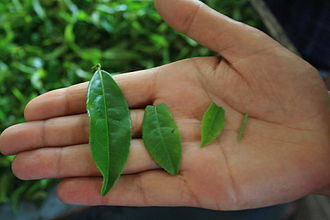
 Fresh tea leaves in various stages of growth
The astringency in tea can be attributed to the presence of polyphenols. These are the most abundant compounds in tea leaves, making up 30–40% of their composition.[59] Polyphenols in tea include flavonoids, epigallocatechin gallate (EGCG), and other catechins.[60][61] Although there has been preliminary clinical research on whether green or black teas may protect against various human diseases, there is no evidence that tea polyphenols have any effect on health or lowering disease risk.[62][63]
Health effects
Main article: Health effects of tea
Although health benefits have been assumed throughout the history of *Camellia sinensis*'s consumption, there is no high-quality evidence showing that tea consumption gives significant benefits other than possibly increasing alertness, an effect caused by caffeine in the tea leaves.[64][65] In clinical research conducted in the early 21st century, it was found there is no scientific evidence to indicate that consuming tea affects any disease or improves health.[64]
Black and green teas contain no essential nutrients in significant amounts, with the exception of the dietary mineral manganese, at 0.5 mg per cup or 26% of the Reference Daily Intake (RDI).[66] Fluoride is sometimes present in tea; certain types of "brick tea", made from old leaves and stems, have the highest levels, enough to pose a health risk if much tea is drunk, which has been attributed to high levels of fluoride in soils, acidic soils, and long brewing.[67]
Cultivation and harvesting
Tea plantation workers in Sri Lanka
Camellia sinensis is an evergreen plant that grows mainly in tropical and subtropical climates.[68] Some varieties can also tolerate marine climates and are cultivated as far north as Cornwall in England,[69] Perthshire in Scotland,[70] Washington in the United States,[71] and Vancouver Island in Canada.[72] In the Southern Hemisphere, tea is grown as far south as Hobart in Tasmania[73][74] and Waikato in New Zealand.[75]
Tea plants are propagated from seed and cuttings; about 4 to 12 years are needed for a plant to bear seed and about three years before a new plant is ready for harvesting.[68] In addition to a zone 8 climate or warmer, tea plants require at least 127 cm (50 in) of rainfall per year and prefer acidic soils.[76] Many high-quality tea plants are cultivated at elevations of up to 1,500 m (4,900 ft) above sea level. Though at these heights the plants grow more slowly, they acquire a better flavour.[77]
[ ](https://en.wikipedia.org/wiki/File:2DU_Kenya16_%285367334314%29.jpg) Women picking tea in Kenya
Two principal varieties are used: Camellia sinensis var. sinensis, which is used for most Chinese, Formosan and Japanese teas, and C. sinensis var. assamica, used in Pu-erh and most Indian teas (but not Darjeeling). Within these botanical varieties, many strains and modern clonal varieties are known. Leaf size is the chief criterion for the classification of tea plants, with three primary classifications being: Assam type, characterised by the largest leaves; China type, characterised by the smallest leaves; and Cambodian type, characterised by leaves of intermediate size.
The Cambodian-type tea (C. assamica subsp. lasiocaly) was originally considered a type of Assam tea. However, later genetic work showed that it is a hybrid between Chinese small-leaf tea and Assam-type tea.[79] Darjeeling tea also appears to be a hybrid between Chinese small-leaf tea and Assam-type large-leaf tea.[80]
....
Sandbox (extensive)
Research Notes
9.5Tea
Supply of Tea
China had been the major supplier of tea to Britain. Tea was cultivated in small plots of land by peasant farmers, whose output proved inadequate to meet the surge in demand. The slow increase in production together with the political inwardness in China after 1840 led to the search for alternative production centers. Plantations appeared to be an attractive alternative. British experiments with the tea plant in south Asia were successful and led to the development of plantations in Eastern India and in Ceylon (Sir Lanka) from the middle of the nineteenth century.
The tea companies attracted investment from Britain and were managed by British agents. By 1860, more than fifty companies were producing tea in Eastern India. Tea companies in India and Ceylon were registered either in London or in Calcutta and Colombo and run by British agents on the basis of long-term agency contracts. The British agents had local counterparts who were responsible for the day-to-day functioning. A typical managing agent owned shares in several companies and was responsible for their management.
Consequently, despite the presence of a few hundred companies in India and Ceylon by the early twentieth century, decision making in the industry was in the hands of a few British agents. In 1879, over 70 percent of the teas sold in London were from China. By 1900 China’s share had dramatically declined to 10 percent and the black teas from India and Ceylon constituted the bulk of the market. Table 2 shows market share of the main exporting countries between 1928 and 1940.