Pepys, Samuel
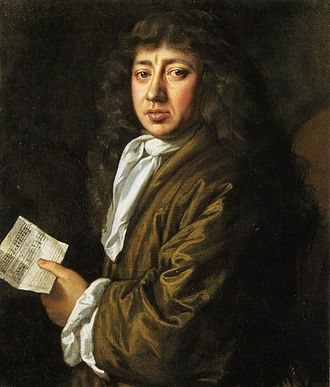
Achievements: Kept famous diary.
Born: February 23, 1633; London, England
Died: May 26, 1703; London, England (Aged 70)
Field & Discipline: Literature; Military; Diarist; Naval Administrator
Language: English
Education: Huntingdon Grammar School; St. Paul's School, London; Cambridge University, England
Major Work:
"Diary"
Life & Times:
After university, Pepys took a job as personal assistant to his cousin, Edward Montagu, Treasury Commissioner and in high favor with the Lord Protector, [worked for] Cromwell*. In 1656, when Montagu was made joint commander (with Admiral Blake) of the English battle fleet, Pepys acted as his agent during his absences. In 1658, Pepys was made a clerk in the Exchequer under George Downing (after whom Downing Street was later named).
The death of Cromwell in 1658 left England in political turmoil, and Pepys decided to keep a diary of what was going on and what he thought about it. For nine years, from January 1, 1660, he meticulously recorded the events leading to and following the Restoration of the monarchy, also giving an account of the daily life, the scandals of the court, and his own interests, weaknesses, and intimate feelings. (The diary, however was not published until 1825, 122 years after his death.)
When Montagu was put in charge of the entire British fleet in 1660, he asked Pepys to join him in The Hague as his secretary to negotiate the return of King [negotiated return of] Charles II* and his brother, James (who would become James II).
Pepys stayed in The Hague from May to July and after his return was appointed Clerk of the Acts to the Navy Board. The new position marked the beginning of Pepys' climb to public esteem and fortune. During the next few years, he became a clerk of the Privy Seal, a Justice of the Peace, a Commissioner for Tangier, and the Surveyor of Naval Victualing (food and drink supplies, sea biscuits). He also was elected a member of the Royal Society.
During the Second Dutch War (1665-67), he remained at his post even though the Great Plague (1665-66) was taking many lives and most officials had fled London. During the 1666 Great Fire of London , he raised the alarm with the King and arranged for the evacuation of the Navy Office, in effect, saving it.
In 1667, after the defeat in the Anglo-Dutch War, Pepys brilliantly defended the conduct of the Navy Office, speaking before a crowded House of Commons for three hours. Even the King congratulated him on his speech.
From 1670, Pepys threw himself into preparations for the inevitable Third Dutch War (1672-74), equipping the British fleet to aid the French against the Dutch. In 1673, the King promoted him to Secretary to the Office of the Lord High Admiral of England, effectively making him administrative head of the Royal Navy. The same year, he was elected a Member of Parliament.
During his six years in office, he worked to restore order to the formerly chaotic state of the Navy and to eliminate corruption. He also established the bases for professional naval service, improved the Navy’s signalling system, and started the largest shipbuilding programs England had known.
Pepys' career suffered an abrupt setback in March, 1679, when he was imprisoned in the Tower of London for four months on suspicion of selling naval secrets to France. He was released on bail, and spent the next year preparing his defense, but in 1680 the charges were dropped.
However, Pepys did not get an Admiralty post for about another five years and watched as the Navy, in his view, "went to ruin", dwindling from 76 ships and 12,000 men in 1679 to 24 ships and 3,000 men by 1684.
Anxious to regain a Navy position, Pepys persuaded Charles II(https://app.thebrain.com/brain/f3e16344-7cd9-4fa3-ae1d-59876e128474/a11e4a70-7300-4ef9-b8e1-5f187e7974b1) to form a special commission for the recovery of the Navy, and in 1684, the King appointed Pepys Secretary for Admiralty Affairs. Over three years, Pepys increased the Navy's effective strength by 92 ships and restored the spirit and discipline of its men.
In 1684, he was elected President of the Royal Society, a position he held for several years. Amongst his closest friends were [a pal of] Newton*, [a pal of] Sloane*, fellow diarist [a pal of] Evelyn*, and [a pal of] Wren*.
After Charles II died in 1685, Pepys remained in the favor of James II until the 1688 Revolution, when the Catholic King fled abroad and Protestant William of Orange succeeded him. Like all public servants in high office, Pepys was forced to retire.
He spent much of his retirement organizing his collection of ship models, maps and prints, and putting his extensive library in order, which by his death amounted to 3,000 books. He bequeathed them to Cambridge University. In 1690, he published his "Memoires Relating to the State of the Royal Navy".
Extra Connections:
Met famous actress Nell [met] Gwyn*, mistress to Charles II, when she was starring in John Dryden's new play, "Secret Love."
Dined with [dined with] Dampier*.
His signalling system was not improved until [signals improved by] Kempenfelt*.
Worked with [worked with] Wilkins*
[work dedicated by] Ray* dedicated work to him
He complained about [complained about] Prince Rupert*
He admired [a fan of] Cotton*
He was friends with Newtonian mathematician David [a pal of] Gregory*
In 1669, the abbey was visited by the diarist Samuel Pepys, who saw the body of the 15th-century queen Catherine de Valois. She had been buried in the 13th-century Lady chapel in 1437, but was exhumed during building work for the Henry VII Chapel and not reburied in the intervening 150 years. Pepys leaned into the coffin and kissed her on the mouth, writing "This was my birthday, thirty-six years old and I did first kiss a queen." She has since been re-interred close to her husband, Henry V.[57]
Assessment: His diary provides a fascinating insight into the world of his time.
Oneliner: Samuel Pepys, English diarist and naval reformer
Bibliography:
- Collier’s Encyclopedia.
- Dictionary of National Biography.
- Encyclopedia Britannica.
- Trease, Geoffrey, Samuel Pepys and His World, London: Thames and Hudson, 1972.
Father: John Pepys
Mother: Margaret Kite
Siblings: 10, of whom 3 survived to maturity: Thomas; Paulina; John
Spouse: Elizabeth St. Michel
Children: None