Lord Mountbatten
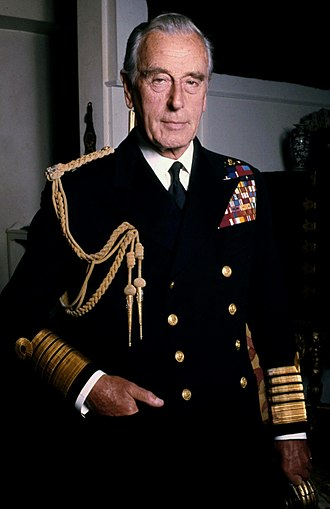
Admiral of the Fleet Albert Victor Nicholas Louis Francis Mountbatten, 1st Earl Mountbatten of Burma[1][2][n 1] (25 June 1900 – 27 August 1979) was a British statesman, naval officer, colonial administrator and close relative of the British royal family. Mountbatten, who was of German descent, was born in the United Kingdom to the prominent Battenberg family. He was a maternal uncle of Prince Philip, Duke of Edinburgh, and a second cousin of King George VI. He joined the Royal Navy during the First World War and was appointed Supreme Allied Commander, South East Asia Command, in the Second World War. He later served as the last Viceroy of India and briefly as the first Governor-General of the Dominion of India.
Mountbatten attended the Royal Naval College, Osborne, before entering the Royal Navy in 1916. He saw action during the closing phase of the First World War, and after the war briefly attended Christ's College, Cambridge. During the interwar period, Mountbatten continued to pursue his naval career, specialising in naval communications.
Following the outbreak of the Second World War, Mountbatten commanded the destroyer HMS *Kelly* and the 5th Destroyer Flotilla. He saw considerable action in Norway, in the English Channel, and in the Mediterranean. In August 1941, he received command of the aircraft carrier HMS *Illustrious*. He was appointed chief of Combined Operations and a member of the Chiefs of Staff Committee in early 1942, and organised the raids on St Nazaire and Dieppe. In August 1943, Mountbatten became Supreme Allied Commander South East Asia Command and oversaw the recapture of Burma and Singapore from the Japanese by the end of 1945. For his service during the war, Mountbatten was created viscount in 1946 and earl the following year.
In February 1947, Mountbatten was appointed Viceroy and Governor-General of India and oversaw the Partition of India into India and Pakistan. He then served as the first Governor-General of the Union of India until June 1948. In 1952, Mountbatten was appointed commander-in-chief of the British Mediterranean Fleet and NATO Commander Allied Forces Mediterranean. From 1955 to 1959, he was First Sea Lord, a position that had been held by his father, Prince Louis of Battenberg, some forty years earlier. Thereafter he served as chief of the Defence Staff until 1965, making him the longest-serving professional head of the British Armed Forces to date. During this period Mountbatten also served as chairman of the NATO Military Committee for a year.
In August 1979, Mountbatten was assassinated by a bomb planted aboard his fishing boat in Mullaghmore, County Sligo, Ireland, by members of the Provisional Irish Republican Army. He received a ceremonial funeral at Westminster Abbey and was buried in Romsey Abbey in Hampshire.
Early life
Mountbatten, then named Prince Louis of Battenberg, was born on 25 June 1900 at Frogmore House in the Home Park, Windsor, Berkshire.[3] He was the youngest child and the second son of Prince Louis of Battenberg and his wife Princess Victoria of Hesse and by Rhine.[4] Mountbatten's maternal grandparents were Louis IV, Grand Duke of Hesse, and Princess Alice of the United Kingdom, who was a daughter of Queen Victoria and Prince Albert of Saxe-Coburg and Gotha. His paternal grandparents were Prince Alexander of Hesse and by Rhine and Julia, Princess of Battenberg.[5] Mountbatten's paternal grandparents' marriage was morganatic because his grandmother was not of royal lineage; as a result, he and his father were styled "Serene Highness" rather than "Grand Ducal Highness", were not eligible to be titled Princes of Hesse, and were given the less exalted Battenberg title. Mountbatten's elder siblings were Princess Alice of Battenberg (later Princess Andrew of Greece and Denmark, mother of Prince Philip, Duke of Edinburgh), Princess Louise of Battenberg (later Queen Louise of Sweden), and Prince George of Battenberg (later George Mountbatten, 2nd Marquess of Milford Haven).[5]...
Following the war, Mountbatten was known to have largely shunned the Japanese for the rest of his life out of respect for his men killed during the war and, as per his will, Japan was not invited to send diplomatic representatives to his funeral in 1979, though he did meet Emperor Hirohito during his state visit to Britain in 1971, reportedly at the urging of the Queen.[55]
Last Viceroy of India
Main article: Partition of India
Mountbatten's experience in the region and in particular his perceived Labour sympathies at that time led to Clement Attlee advising King George VI to appoint him Viceroy of India on 20 February 1947[56][57] charged with overseeing the transition of British India to independence no later than 30 June 1948. Mountbatten's instructions were to avoid partition and preserve a united India as a result of the transfer of power but authorised him to adapt to a changing situation in order to get Britain out promptly with minimal reputational damage.[58][59] Mountbatten arrived in India on 22 March 1947 by air, from London. In the evening, he was taken to his residence and, two days later, he took the Viceregal Oath. His arrival saw large-scale communal riots in Delhi, Bombay and Rawalpindi. Mountbatten concluded that the situation was too volatile to wait even a year before granting independence to India. Although his advisers favoured a gradual transfer of independence, Mountbatten decided the only way forward was a quick and orderly transfer of power before 1947 was out. In his view, any longer would mean civil war.[60] Mountbatten also hurried so he could return to his senior technical Navy courses.[61][62]

Lord and Lady Mountbatten at Mussoorie with Congress leader Sardar Patel, his daughter Manibehn Patel and Nehru in the background
[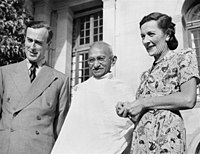 ]
Lord and Lady Mountbatten with Mahatma Gandhi, 1947
Mountbatten was fond of Congress leader Jawaharlal Nehru and his liberal outlook for the country. He felt differently about the Muslim League leader Muhammad Ali Jinnah, but was aware of his power, stating "If it could be said that any single man held the future of India in the palm of his hand in 1947, that man was Mohammad Ali Jinnah."[62] During his meeting with Jinnah on 5 April 1947,[63] Mountbatten tried to persuade him of a united India, citing the difficult task of dividing the mixed states of Punjab and Bengal, but the Muslim leader was unyielding in his goal of establishing a separate Muslim state called Pakistan.[64]
Given the British government's recommendations to grant independence quickly, Mountbatten concluded that a united India was an unachievable goal and resigned himself to a plan for partition, creating the independent nations of India and Pakistan.[26] Mountbatten set a date for the transfer of power from the British to the Indians, arguing that a fixed timeline would convince Indians of his and the British government's sincerity in working towards a swift and efficient independence, excluding all possibilities of stalling the process.[65]

Mountbatten's proposed flag for India, consisting of the flag of the Indian National Congress defaced with a Union Jack in the canton. It was rejected by Nehru, as he felt that the more extremist members of Congress would see the inclusion of the Union Jack on an Indian flag as pandering to the British.[66]

Mountbatten's proposed flag for Pakistan, consisting of the flag of the Muslim League defaced with a Union Jack in the canton. It was rejected by Jinnah, as he felt that a flag featuring a Christian Cross alongside the Islamic Crescent would be unacceptable to the Muslims of Pakistan.[66]
Among the Indian leaders, Mahatma Gandhi emphatically insisted on maintaining a united India and for a while successfully rallied people to this goal. During his meeting with Mountbatten, Gandhi asked Mountbatten to invite Jinnah to form a new central government, but Mountbatten never uttered a word of Gandhi's ideas to Jinnah.[67] When Mountbatten's timeline offered the prospect of attaining independence soon, sentiments took a different turn. Given Mountbatten's determination, Nehru and Sardar Patel's inability to deal with the Muslim League and, lastly, Jinnah's obstinacy, all Indian party leaders (except Gandhi) acquiesced to Jinnah's plan to divide India,[68] which in turn eased Mountbatten's task. Mountbatten also developed a strong relationship with the Indian princes, who ruled those portions of India not directly under British rule. His intervention was decisive in persuading the vast majority of them to see advantages in opting to join the Indian Union.[69] On one hand, the integration of the princely states can be viewed as one of the positive aspects of his legacy[70] but on the other, the refusal of Hyderabad, Jammu and Kashmir, and Junagadh to join one of the dominions led to future wars between Pakistan and India.[71]
Mountbatten brought forward the date of the partition from June 1948 to 15 August 1947.[72] The uncertainty of the borders caused Muslims and Hindus to move into the direction where they felt they would get the majority. Hindus and Muslims were thoroughly terrified, and the Muslim movement from the East was balanced by the similar movement of Hindus from the West.[73] A boundary committee chaired by Sir Cyril Radcliffe was charged with drawing boundaries for the new nations. With a mandate to leave as many Hindus and Sikhs in India and as many Muslims in Pakistan as possible, Radcliffe came up with a map that split the two countries along the Punjab and Bengal borders. This left 14 million people on the "wrong" side of the border, and very many of them fled to "safety" on the other side when the new lines were announced.[60][74]
[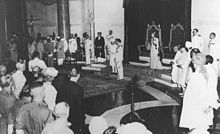 ])Mountbatten with Jawaharlal Nehru, the first Prime Minister of sovereign India, in Government House. Lady Mountbatten is standing to their left.
When India and Pakistan attained independence at midnight of 14–15 August 1947, Mountbatten was alone in his study at the Viceroy's house saying to himself just before the clock struck midnight that for still a few minutes, he was the most powerful man on Earth. At 11:58 PM, as a last act of showmanship, he created Joan Falkiner, the Australian wife of the Nawab of Palanpur, a highness, an act that was apparently one of his favourite duties that was annulled at the stroke of midnight.[75]
Mountbatten remained in New Delhi for 10 months, serving as the first governor-general of an independent India until June 1948.[76] On Mountbatten's advice, India took the issue of Kashmir to the newly formed United Nations in January 1948. This issue would become a lasting thorn in his legacy and one that is not resolved to this day.[77] Accounts differ on the future which Mountbatten desired for Kashmir. Pakistani accounts suggest that Mountbatten favoured the accession of Kashmir to India, citing his close relationship to Nehru. Mountbatten's own account says that he simply wanted the maharaja, Hari Singh, to make up his mind. The viceroy made several attempts to mediate between the Congress leaders, Muhammad Ali Jinnah and Hari Singh on issues relating to the accession of Kashmir, though he was largely unsuccessful in resolving the conflict.[78] After the tribal invasion of Kashmir, it was on his suggestion that India moved to secure the accession of Kashmir from Hari Singh before sending in military forces for his defence.[79]
 Lord and Lady Mountbatten with Muhammad Ali Jinnah
Notwithstanding the self-promotion of his own part in Indian independence – notably in the television series The Life and Times of Admiral of the Fleet Lord Mountbatten of Burma, produced by his son-in-law Lord Brabourne, and Freedom at Midnight by Dominique Lapierre and Larry Collins (of which he was the main quoted source) – his record is seen as very mixed. One common view is that he hastened the process of independence unduly and recklessly, foreseeing vast disruption and loss of life and not wanting this to occur on his watch, but thereby actually helping it to occur (albeit in an indirect manner), especially in Punjab and Bengal.[80]
John Kenneth Galbraith, the Canadian-American Harvard University economist, who advised governments of India during the 1950s and was an intimate of Nehru who served as the American ambassador from 1961 to 1963, was a particularly harsh critic of Mountbatten in this regard.[81] However, another view is that the British were forced to expedite the partition process to avoid involvement in a potential civil war with law and order having already broken down and Britain with limited resources after the Second World War.[82][83] According to historian Lawrence James, Mountbatten was left with no other option but to cut and run, with the alternative being involvement in a potential civil war that would be difficult to get out of.[82]
The creation of Pakistan was never emotionally accepted by many British leaders, among them Mountbatten.[84] Mountbatten clearly expressed his lack of support and faith in the Muslim League's idea of Pakistan.[85] Jinnah refused Mountbatten's offer to serve as Governor-General of Pakistan.[86] When Mountbatten was asked by Collins and Lapierre if he would have sabotaged the creation of Pakistan had he known that Jinnah was dying of tuberculosis, he replied, "Most probably".[87]
After his tenure as Governor-General concluded, Mountbatten continued to enjoy close relations with Nehru and the post-Independence Indian leadership, and was welcomed as a former governor-general of India on subsequent visits to the country, including during an official trip in March 1956. The Pakistani government, by contrast, never forgave Mountbatten for his perceived hostile attitude towards Pakistan and deemed him Persona non grata, barring him from transiting their airspace during the same visit.[88]
Career after India
[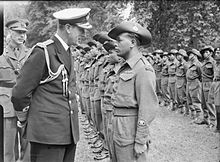 ])Mountbatten inspects Malayan troops in Kensington Gardens in 1946
After India, Mountbatten served as commander of the 1st Cruiser Squadron in the Mediterranean Fleet and, having been granted the substantive rank of vice-admiral on 22 June 1949,[89] he became Second-in-Command of the Mediterranean Fleet in April 1950.[76] He became Fourth Sea Lord at the Admiralty in June 1950. He then returned to the Mediterranean to serve as Commander-in-Chief, Mediterranean Fleet and NATO Commander Allied Forces Mediterranean from June 1952.[76] He was promoted to the substantive rank of full admiral on 27 February 1953.[90] In March 1953, he was appointed Personal Aide-de-Camp to the Queen.[91]
 Mountbatten arrives on board HMS *Glasgow* at Malta to assume command of the Mediterranean Fleet, 16 May 1952
Mountbatten served his final posting at the Admiralty as First Sea Lord and Chief of the Naval Staff from April 1955 to July 1959, the position which his father had held some forty years before. This was the first time in Royal Naval history that a father and son had both attained such high office.[92] He was promoted to Admiral of the Fleet on 22 October 1956.[93]
In the Suez Crisis of 1956, Mountbatten strongly advised his old friend Prime Minister Anthony Eden against the Conservative government's plans to seize the Suez Canal in conjunction with France and Israel. He argued that such a move would destabilize the Middle East, undermine the authority of the United Nations, divide the Commonwealth and diminish Britain's global standing. His advice was not taken. Eden insisted that Mountbatten not resign. Instead, he worked hard to prepare the Royal Navy for war with characteristic professionalism and thoroughness.[94][95][96]
Despite his military rank, Mountbatten was ignorant as to the physics involved in a nuclear explosion and had to be reassured that the fission reactions from the Bikini Atoll tests would not spread through the oceans and blow up the planet.[97] As Mountbatten became more familiar with this new form of weaponry, he increasingly grew opposed to its use in combat yet at the same time he realised the potential for nuclear energy, especially with regard to submarines. Mountbatten expressed his feelings towards the use of nuclear weapons in combat in his article "A Military Commander Surveys The Nuclear Arms Race", which was published shortly after his death in International Security in the Winter of 1979–1980.[98]
After leaving the Admiralty, Mountbatten took the position of Chief of the Defence Staff.[76] He served in this post for six years during which he was able to consolidate the three service departments of the military branch into a single Ministry of Defence.[99] Ian Jacob, co-author of the 1963 Report on the Central Organisation of Defence that served as the basis of these reforms, described Mountbatten as "universally mistrusted in spite of his great qualities".[100] On their election in October 1964, the Wilson ministry had to decide whether to renew his appointment the following July. The Defence Secretary, Denis Healey, interviewed the forty most senior officials in the Ministry of Defence; only one, Sir Kenneth Strong, a personal friend of Mountbatten, recommended his reappointment.[100] "When I told Dickie of my decision not to reappoint him," recalls Healey, "he slapped his thigh and roared with delight; but his eyes told a different story."[100]
Mountbatten was appointed Colonel of The Life Guards and Gold Stick in Waiting on 29 January 1965[101] and Life Colonel Commandant of the Royal Marines the same year.[102] He was Governor of the Isle of Wight from 20 July 1965[103] and then the first Lord Lieutenant of the Isle of Wight from 1 April 1974.[104]
[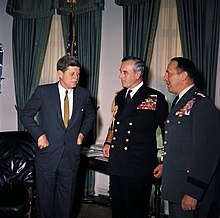 ])Mountbatten with John F. Kennedy in the Oval Office, Washington, D.C., 11 April 1961[
 ]
Mountbatten was elected a Fellow of the Royal Society[26] and had received an honorary doctorate from Heriot-Watt University in 1968.[105]
In 1969, Mountbatten tried unsuccessfully to persuade his second cousin, the Spanish pretender Infante Juan, Count of Barcelona, to ease the eventual accession of his son, Juan Carlos, to the Spanish throne by signing a declaration of abdication while in exile.[106] The next year Mountbatten attended an official White House dinner during which he took the opportunity to have a 20-minute conversation with Richard Nixon and Secretary of State William P. Rogers, about which he later wrote, "I was able to talk to the President a bit about both Tino [Constantine II of Greece] and Juanito [Juan Carlos of Spain] to try and put over their respective points of view about Greece and Spain, and how I felt the US could help them."[106] In January 1971, Nixon hosted Juan Carlos and his wife Sofia (sister of the exiled King Constantine) during a visit to Washington and later that year The Washington Post published an article alleging that Nixon's administration was seeking to persuade Franco to retire in favour of the young Bourbon prince.[106]
From 1967 until 1978, Mountbatten was president of the United World Colleges Organisation, then represented by a single college: that of Atlantic College in South Wales. Mountbatten supported the United World Colleges and encouraged heads of state, politicians, and personalities throughout the world to share his interest. Under his presidency and personal involvement, the United World College of South East Asia was established in Singapore in 1971, followed by the United World College of the Pacific in Victoria, British Columbia, in 1974. In 1978, Mountbatten passed the presidency of the college to his great-nephew, Charles, Prince of Wales.[107]
Mountbatten also helped to launch the International Baccalaureate; in 1971 he presented the first IB diplomas in the Greek Theatre of the International School of Geneva, Switzerland.[108][109][110]
In 1975 Mountbatten finally visited the Soviet Union, leading the delegation from UK as personal representative of Queen Elizabeth II at the celebrations to mark the 30th anniversary of Victory Day in Second World War in Moscow.[111]
Alleged plots against Harold Wilson
Main article: Harold Wilson conspiracy theories § The 1968 plot
....
Louis Mountbatten, 1st Earl Mountbatten of Burma - Wikipedia