Carson Rachel
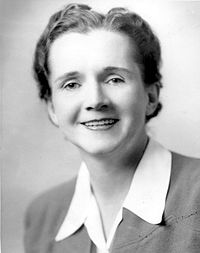
BIRTH: 27 May 1907, Springfield, Pennsylvania, United States
DEATH: 14 April 1964, Silver Spring, Maryland, United States
CATEGORY: Environment
DISCIPLINE: Author
ASSESSMENT: Carson is considered to be the primary inspiration for and source of the environmental protection movement.
LANGUAGE: English
EDUCATION: Pennsylvania College for Women (now Chatham College) and Johns Hopkins University
ACHIEVEMENTS: Wrote Silent Spring, a highly influential book which led to environmental protection laws and the modern environmental movement
MAJOR WORK: Silent Spring
PARENTS: Maria McLean Carson; Robert Warden Carson
SPOUSE: none
SIBLINGS: Robert M.; Marian
CHILDREN: Roger Christie
Details: Rachel Louise Carson was born in Springfield, Pennsylvania in the United States on May 27, 1907. Her father was an insurance agent and her mother was a teacher. By the time she graduated from high school Carson was a practiced naturalist with an impressive literary skill. She became a student at Pennsylvania College for Women in Pittsburgh, Pennsylvania and graduated magna cum laude in 1929, with a degree in English and biology.
Carson next did research work at the Woods Hole Marine Biological Laboratory in Massachusetts in fisheries biology, R.P. Cowles. In 1929 she began graduate work at Johns Hopkins University. While in graduate school she worked for a year as a laboratory assistant to the geneticist Raymond Pearl, and in 1932 she earned a masters degree in marine zoology.
In 1936 Carson took a position with the US Bureau of Fisheries, as a junior aquatic biologist in the Division of Scientific Inquiry, under the direction of Elmer Higgins. At that time Carson was one of only two female professionals in the bureau. Her responsibilities included the writing of pamphlets, brochures and, later, radio broadcasts for the bureau’s public information projects. A piece that she wrote about the ecology of the sea, Undersea, appeared in the magazine Atlantic in 1937.
The popular science writer Hendrik Wilhem van Loon, and the editor in chief at Simon & Schuster, Quincy Howe, were so impressed by the article that they encouraged her to write a book. The result, a natural history of sea life, was entitled Under the Sea-Wind, published in 1941. Carson’s writing had a strong ecological emphasis, and her style of prose was lyrical and literary, a style of writing that was very unusual and almost unprecedented in the field of science. The book received enthusiastic reviews, including praise from science writers, including oceanographer William Beebe*.
However, very few copies of the book were sold because of World War II, which began just after publication. Carson’s next book, The Sea Around Us, was serialized before publication in the New Yorker magazine, to very positive reviews. Once again she focused on the interconnectedness of life. When The Sea Around Us was published in book form, in 1951, it became an immediate bestseller and Carson became an international literary celebrity. The book royalties that she earned, as well as a Guggenheim fellowship, allowed Carson to resign from her job in 1952. Her next book, a natural history of seashore life in the intertidal zone was called Edge of the Sea. It appeared in 1955, and once again she achieved best seller status.
By the 1950s synthetic hydrocarbon pesticides, chief among them DDT, had revolutionized agriculture. DDT's insecticidal properties were discovered in the late 1930s by a chemist named Paul Muller*, who was awarded the Nobel Prize in 1948. In January 1950 Carson’s friend, Olga Owens Huckins, brought to her attention the harmful effect that a mosquito control program had had on the bird population in an area of Massachusetts.
The chemical used was called DDT. During the next four years Carson did research which revealed a great deal of evidence that pesticide spraying had lead to widespread environmental damage. Her research findings led her to begin writing her next book, originally entitled “The Control of Nature”, in which she compared the effect of pesticides to that of atomic radiation. The completed book, now called Silent Spring, was serialized before publication in the New Yorker magazine, and it caused an immediate controversy. Carson wrote that she was not opposed to all pesticide use, but that she was opposed to an insensitivity to the natural balance and complex interactions in the environment, and to the loss of wild habitat and species in an attempt to eliminate insect pests.
She explained how the interconnected “web of life” was affected, including groundwater pollution, the concentration of chemicals in the food chain, and the death of birds. She showed that man, like other species, was a vulnerable part of the ecosystem of the earth. Carson’s ecological ideas were not radical. She linked Charles Elton’s views on food chains and interconnectivity to the views of such ecologists as Aldo Leopold.
The lyrical quality of her writing and her popularity with the public were used by the chemical industry and agribusiness to portray her as a sentimental, nonprofessional nature lover, and a hysterical woman who was frightening the public unnecessarily. Velsicol Chemical Corporation*, a manufacturer of two of the chemicals that featured prominently in the book, claimed that Carson was a communist, who wanted to reduce the US food. The company threatened legal action against the publisher of Silent Spring, although ultimately no such action was taken.
The debate reached a national level and Carson became a subject of headlines, editorials and popular culture. The controversy captured the attention of President John F. Kennedy*, who directed his Science Advisory Committee to investigate the matter. In 1963 the Committee’s report on pesticides supported her arguments, as did the Secretary of the Interior Stewart Udall*, during congressional hearings. The banning of DDT, in 1972, and the eventual passage of federal environmental protection laws were among the eventual outcomes.
In all of her books Carson popularized the relatively new science of ecology. Her central view was that humans were only one part of nature, with the power to alter it, in some cases irreversibly. Her work was to inspire activists to demand that the government regulate activities that affect the environment. Her writing also helped expand the definition of environmental protection, encouraging conservation organizations to develop a broader ecological orientation that included wilderness, habitat and species preservation. Carson is generally credited as being the inspiration for and the source of the environmental movement.
Rachel Carson died in 1964, 18 months after the publication of Silent Spring. in 1980 she was posthumously awarded the Presidential Medal of Freedom by President Jimmy Carter.
Bibliography:'
Gillispie, Charles C., editor in chief. Dictionary of Scientific Biography. New York: Charles Scribner's Sons, 1970-1980. 16 vols. Supplement II, edited by Frederic Lawrence Holmes, 2 vols., 1990
Garraty, John A.; Carnes, Mark C. editors in chief. American National Biography; New York; Oxford University Press, 1926-1937. 24 vols.
William Souder (audio), author,"On a Farther Shore: The Life and Legacy of Rachel Carson.
Researcher: Robert De Vito
Research Date: January 2009
Proposed Connections: none
Audio/Visual:The Life and Legacy of Rachel Carson
www.rachelcarson.org
2017 PBS Documentary see also Rachel Carson's Silent Spring
Rachel Carson Homestead www.rachelcarsonhomestead.org
Wikipedia
Rachel Louise Carson (May 27, 1907 – April 14, 1964) was an American marine biologist and conservationist whose book Silent Spring and other writings are credited with advancing the global environmental movement.
Carson began her career as an aquatic biologist in the U.S. Bureau of Fisheries, and became a full-time nature writer in the 1950s. Her widely praised 1951 bestseller The Sea Around Us won her a U.S. National Book Award,[2] recognition as a gifted writer, and financial security. Her next book, The Edge of the Sea, and the reissued version of her first book, Under the Sea Wind, were also bestsellers. This sea trilogy explores the whole of ocean life from the shores to the depths.
Late in the 1950s, Carson turned her attention to conservation, especially some environmental problems that she believed were caused by synthetic pesticides. The result was the book Silent Spring (1962), which brought environmental concerns to an unprecedented share of the American people. Although Silent Spring was met with fierce opposition by chemical companies, it spurred a reversal in national pesticide policy, which led to a nationwide ban on DDT and other pesticides, and it inspired a grassroots environmental movement that led to the creation of theU.S. Environmental Protection Agency.[3] Carson was posthumously awarded the Presidential Medal of Freedom by Jimmy Carter.
Contents
...