NASA (Apollo)
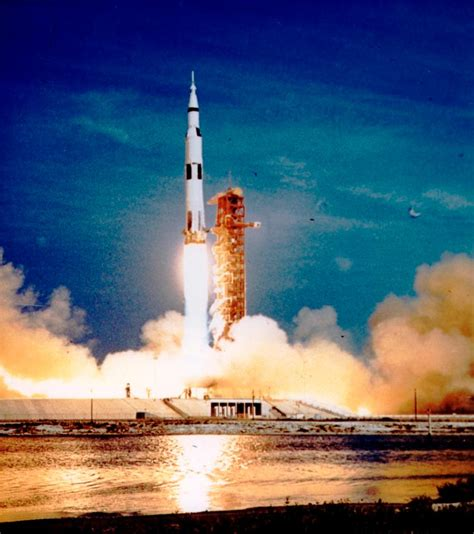
ALTERNATIVE NAME: Moon-flights
TIME: Project started in 1961, mission flights undertaken 1968-72.
LOCATION: John F Kennedy Space Center, Cape Canaveral, FL.
CATEGORY: Lunar landings.
DISCIPLINE: Exploration.
SHORT DESCRIPTION: Space missions designed to put a man on the Moon for the first time.
DESCRIPTION: On 25 May 1961, President Kennedy* announced the plan to put a man on the Moon and bring him safely back to Earth within the next ten years. Six weeks before, on 12 April, the Soviets had succeeded in putting the first man into space. Interviews with Yuri Gagarin, the Soviet cosmonaut, had been given world-wide coverage and the Soviets were seen to be ahead in the space race.
Kennedy's announcement was received with enthusiasm by the American people, and the race for the Moon was on. The National Aeronautics and Space Administration, NASA, needed massive increases in its share of the federal budget and the extra money was found, with the help of Lyndon B Johnson*, who had become president in 1963, after the assassination of Kennedy.
Scientists working for NASA had heated debates about the right way of going about reaching the Moon. At the Marshall Space Flight Center, Wernher von Braun 2* (whose used his wartime experience with the V-2 missile*) was in favour of the Earth-orbit approach, which involved putting the major components of the spacecraft needed into orbit above the earth, where they would be assembled, refuelled and sent on to the Moon. The scientists at Langley Research Center, led by John C Houbolt, disagreed. They wanted to use the lunar-orbit rendezvous method, which meant sending all of the spacecraft up in one launch.
When the craft reached the Moon's orbit, a landing module would be detached and sent to the Moon's surface.
Houbolt’s plan (possibly inspired by earlier work of Oberth*)was the simpler method, but the more risky, because timing would be so critical and complicated flying adjustments would have to be made after the spacecraft had been committed to a lunar orbit. After a lot of argument and planning, the lunar-orbit method was selected. Over the next few years, three basic Apollo modules were built, the command module, to fly the astronauts to the Moon and back, the service module, carrying fuel and power for the spacecraft, and the lunar module which would land the astronauts on the Moon.
Construction work on the spacecraft began in November 1961. An estimated 400,000 people worked on the Apollo project, the majority of them involved in private industry, research institutions and universities. Over the next seven years, tests were carried out on the ground and in sub-orbital and orbital flights with the Mercury and Gemini missions. The Apollo programme’s first major tragedy occurred in January 1967 when, during routine tests of Apollo 1 on the launch pad, an electrical fault caused a fire, in which three astronauts, Virgil Grissom, Edward White and Roger B Chaffee, were killed.
Apollos 4-6 were unmanned test flights. The first manned Earth-orbit mission, to test out the Command and Service Module (the mother ship): Apollo 7, was launched aboard a Saturn 1B on October 11, 1968, crewed by Shirra (Commander), Eisele and Cunningham The flight made 163 orbits, and during that time live telecasts were made from the spaceship. Splashdown: October 22 (all Apollo splashdowns were in the Pacific).
Apollo 8, the first manned spacecraft to circle the Moon, and crewed by Borman (Cdr), Lovell, and Anders, was launched by the lunar mission launch vehicle, the Saturn V, on 21 December 1968. Three days later, the spacecraft entered lunar orbit and the astronauts were able to observe the Moon's surface. After ten lunar orbits, the astronauts came back to Earth and safely splashed down 27 December.
Apollo 9, crewed by McDivitt (Cdr), Scott (Lunar Module Pilot : LMP), and Schweikart (Command Module Pilot: CMP) launched March 13 1969, to test the combined Command Module and Lunar module through both Earth-orbit-assembly and lunar-orbit-rendezvous maneuvers, during 151 Earth orbits. Splashdown occurred March 13.
May 18 1969, Apollo 10 launched carrying Stafford (Cdr), Cernan (LMP) and Young (CMP), and went into lunar orbit about 60 miles above the surface. Stafford and Cernan rehearsed a lunar landing by flying the LM to within 50,000 feet of the surface, visually inspecting the landing site chosen for Apollo 11.. The journey back up to the command module was a test run for a lunar lift-off. Splashdown: May 12.
The historic Apollo 11 mission (launched July 16 1969) landed a man on the Moon for the first time. Crew: Armstrong (Cdr), Aldrin (LMP) and Collins (CMP). The LM (“Eagle”) landed at Tranquillity Base with 30 secs. of fuel remaining. Armstrong set foot on the Moon's surface on 20 July and spoke the famous words: ‘That's one small step for a man, one giant leap for mankind’. 21 ½ hrs on lunar surface. Splashdown: July 24. November 14 1969: Apollo 12 launch. Crew Conrad (Cdr), Bean LMO) and Gordon (CMP) The crew visited the Surveyor 3 probe on the lunar surface and brought back sample of its structure. Splashdown: November 24.
April 11 1970: Apollo 13 carried Lovell(Cdr), Haise (LMP) and Sweigert (CMP). Late in the evening of 13 April, one of the oxygen tanks in the service module exploded and the command module's electrical and life-supply systems rapidly began to fail. The craft had swing round the Moon to get back to Earth, but there wasn’t enough air, water or electricity in the Command and Service Module to keep the crew alive for that length of time. They used the lunar module in ‘lifeboat’ mode, using its power and air supplies and firing its engines to make course corrections. With life support systems critically low, on 17 April the crew splashed down safely.
Apollo 14 launched January 31 1971: Shepard (Cdr) Mitchell (LMP) and Roosa (CMP). First extensive trips on foot from LM to collect lunar samples. Splashdown: 9 February.
Apollo 15, launched July 26 1971 carrying first Lunar Rover vehicle. Crew: Scott (Cdr) Irwin (LMP) and Worden (CMP). Visited spectacular site at Hadley Rille. Three extensive vehicular trips totalling over 27 kilometers. On way home Worden carried out the first Apollo Extra Vehicular Activity (space walk). Splashdown: 7 August.
Apollo 16 launched April 16 1972, with Lunar Rover. Three extensive lunar rover excursions. Crew Young (Cdr), Drake (LMP) and Mattingly (CMP). Splashdown: 27 April.
Apollo 17 launched 7 December 1972 with Lunar Rover. Crew: Cernan (Cdr), Schmitt (LMP and geologist) and Evans (CMP). Three lunar rover excursions and, with Schmitt’s geological expertise, highly successful geologic sampling. The mission was remarkable for the discovery of a layer of orange-coloured soil which suggested previous volcanic activity on the Moon. The astronauts returned to Earth with 275 pounds of lunar rocks and soil. Splashdown: 19 December. This was the final Apollo lunar mission.
ONELINER: Apollo Moon missions
OTHER CONNECTIONS: The mission rockets were developed from the early wartime German V-2 missile*
James Burke provided coverage for the BBC
BIBLIOGRAPHY:
Launius, Roger D, NASA: A History of the US Civil Space Program, Krieger Publishing Company, Malabar, Florida, 1994.
Multimedia:
BBC anniversary coverage (includes James Burke video interviews)
NASA online sources (http://www.nasa.gov):
Apollo Spacecraft Diagrams. Watch for this upcoming new site that will feature images of various technical views of the Apollo spacecraft.
Moonport: A History of Apollo Launch Facilities and Operations, Charles D. Benson and William Barnaby Faherty.
"Where No Man has Gone Before"
Pantheon Neil Armstrong