India
India, officially the Republic of India (ISO: Bhārat Gaṇarājya),[21] is a country in South Asia. It is the seventh-largest country by area; the most populous country as of June 2023;[22][23] and from the time of its independence in 1947, the world's most populous democracy.[24][25][26] Bounded by the Indian Ocean on the south, the Arabian Sea on the southwest, and the Bay of Bengal on the southeast, it shares land borders with Pakistan to the west;[j] China, Nepal, and Bhutan to the north; and Bangladesh and Myanmar to the east. In the Indian Ocean, India is in the vicinity of Sri Lanka and the Maldives; its Andaman and Nicobar Islands share a maritime border with Thailand, Myanmar, and Indonesia.
Modern humans arrived on the Indian subcontinent from Africa no later than 55,000 years ago.[27][28][29] Their long occupation, initially in varying forms of isolation as hunter-gatherers, has made the region highly diverse, second only to Africa in human genetic diversity.[30] Settled life emerged on the subcontinent in the western margins of the Indus river basin 9,000 years ago, evolving gradually into the Indus Valley Civilisation of the third millennium BCE.[31] By 1200 BCE, an archaic form of Sanskrit, an Indo-European language, had diffused into India from the northwest.[32][33] Its evidence today is found in the hymns of the Rigveda. Preserved by an oral tradition that was resolutely vigilant, the Rigveda records the dawning of Hinduism in India.[34]
The Dravidian languages of India were supplanted in the northern and western regions.[35] By 400 BCE, stratification and exclusion by caste had emerged within Hinduism,[36] and Buddhism and Jainism had arisen, proclaiming social orders unlinked to heredity.[37] Early political consolidations gave rise to the loose-knit Maurya and Gupta Empires based in the Ganges Basin.[38] Their collective era was suffused with wide-ranging creativity,[39] but also marked by the declining status of women,[40] and the incorporation of untouchability into an organised system of belief.[k][41] In South India, the Middle kingdoms exported Dravidian-languages scripts and religious cultures to the kingdoms of Southeast Asia.[42]
In the early medieval era, Christianity, Islam, Judaism, and Zoroastrianism became established on India's southern and western coasts.[43] Muslim armies from Central Asia intermittently overran India's northern plains,[44] eventually founding the Delhi Sultanate, and drawing northern India into the cosmopolitan networks of medieval Islam.[45] In the 15th century, the Vijayanagara Empire created a long-lasting composite Hindu culture in south India.[46] In the Punjab, Sikhism emerged, rejecting institutionalised religion.[47] The Mughal Empire, in 1526, ushered in two centuries of relative peace,[48] leaving a legacy of luminous architecture.[l][49]
Gradually expanding rule of the British East India Company followed, turning India into a colonial economy, but also consolidating its sovereignty.[50] British Crown rule began in 1858. The rights promised to Indians were granted slowly,[51][52] but technological changes were introduced, and modern ideas of education and the public life took root.[53] A pioneering and influential nationalist movement emerged, which was noted for nonviolent resistance and became the major factor in ending British rule.[54][55] In 1947 the British Indian Empire was partitioned into two independent dominions,[56][57][58][59] a Hindu-majority Dominion of India and a Muslim-majority Dominion of Pakistan, amid large-scale loss of life and an unprecedented migration.[60]
India has been a federal republic since 1950, governed through a democratic parliamentary system. It is a pluralistic, multilingual and multi-ethnic society. India's population grew from 361 million in 1951 to almost 1.4 billion in 2022.[61] During the same time, its nominal per capita income increased from US$64 annually to US$2,601, and its literacy rate from 16.6% to 74%. From being a comparatively destitute country in 1951,[62] India has become a fast-growing major economy and a hub for information technology services, with an expanding middle class.[63]
India has a space programme with several planned or completed extraterrestrial missions. It is the fourth country to land a craft on the moon and the first to do so within 600 kilometres (370 mi) of the Lunar south pole.[64] Indian movies, music, and spiritual teachings play an increasing role in global culture.[65] India has substantially reduced its rate of poverty, though at the cost of increasing economic inequality.[66] India is a nuclear-weapon state, which ranks high in military expenditure. It has disputes over Kashmir with its neighbours, Pakistan and China, unresolved since the mid-20th century.[67]
Among the socio-economic challenges India faces are gender inequality, child malnutrition,[68] and rising levels of air pollution.[69] India's land is megadiverse, with four biodiversity hotspots.[70] Its forest cover comprises 21.7% of its area.[71] India's wildlife, which has traditionally been viewed with tolerance in India's culture,[72] is supported among these forests, and elsewhere, in protected habitats.
- Etymology
- History
- Geography
- Biodiversity
- Politics and government
- Foreign, economic and strategic relations
- Economy
- Demographics, languages and religion
- Culture
- See also
- Notes
- References
- Bibliography
- External links
Etymology
Main article: Names for India
According to the Oxford English Dictionary (third edition 2009), the name "India" is derived from the Classical Latin India, a reference to South Asia and an uncertain region to its east. In turn the name "India" derived successively from Hellenistic Greek India (Ἰνδία), ancient Greek Indos (Ἰνδός), Old Persian Hindush (an eastern province of the Achaemenid Empire), and ultimately its cognate, the Sanskrit Sindhu, or "river", specifically the Indus River and, by implication, its well-settled southern basin.[73][74] The ancient Greeks referred to the Indians as Indoi (Ἰνδοί), which translates as "The people of the Indus".[75]
The term Bharat (Bhārat; pronounced [ˈbʱaːɾət] ^ⓘ), mentioned in both Indian epic poetry and the Constitution of India,[76][77] is used in its variations by many Indian languages. A modern rendering of the historical name Bharatavarsha, which applied originally to North India,[78][79] Bharat gained increased currency from the mid-19th century as a native name for India.[76][80] In 2023, India's ruling party advocated officially renaming the country Bharat. At the G-20 summit, Prime Minister Narendra Modi sat under a sign with this name.[81]
...
History:
Anatomically modern humans first arrived on the Indian subcontinent between 73,000 and 55,000 years ago.[1] The earliest known human remains in South Asia date to 30,000 years ago. Sedentariness began in South Asia around 7000 BCE;[2] by 4500 BCE, settled life had increasingly spread,[2] and gradually evolved into the Indus Valley civilisation, which flourished between 2500 BCE and 1900 BCE in present-day Pakistan and north-western India.[3] Early in the second millennium BCE, persistent drought caused the population of the Indus Valley to scatter from large urban centres to villages. Indo-Aryan tribes moved into the Punjab from Central Asia in several waves of migration.
The Vedic Period (1500–500 BCE) was marked by the composition of their large collections of hymns (Vedas). The social structure was stratified via the varna system, which persists till this day. The pastoral and nomadic Indo-Aryans spread from the Punjab into the Gangetic plain. Around 600 BCE, a new, interregional culture arose; then, small chieftaincies (janapadas) were consolidated into larger states (mahajanapadas). A second urbanisation took place, which came with the rise of new ascetic movements and religious concepts,[4] including the rise of Jainism and Buddhism. The latter was synthesised with the preexisting religious cultures of the subcontinent, giving rise to Hinduism.

Indian cultural influence (Greater India)[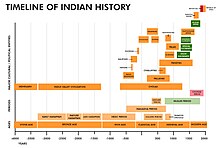 ]
)Timeline of Indian history
Chandragupta Maurya overthrew the Nanda Empire and established the first great empire in ancient India, the Maurya Empire. The Maurya Empire would collapse in 185 BCE, on the assassination of the then-emperor Brihadratha by his general Pushyamitra Shunga. Shunga would go on to form the Shunga Empire in the north and northeast of the subcontinent, while the Greco-Bactrian Kingdom would claim the northwest and found the Indo-Greek Kingdom. Various parts of India were ruled by numerous dynasties, including the Gupta Empire, in the 4th to 6th centuries CE. This period, witnessing a Hindu religious and intellectual resurgence, is known as the Classical or Golden Age of India.
Aspects of Indian civilisation, administration, culture, and religion spread to much of Asia, which led to the establishment of Indianised kingdoms in the region, forming Greater India.[5][6] The most significant event between the 7th and 11th century was the Tripartite struggle centred on Kannauj. Southern India saw the rise of multiple imperial powers from the middle of the fifth century. The Chola dynasty conquered southern India in the 11th century.[7][8] In the early medieval period Indian mathematics, including Hindu numerals, influenced the development of mathematics and astronomy in the Arab world, including the creation of the Hindu-Arabic numeral system.[9]
Islamic conquests made limited inroads into modern Afghanistan and Sindh as early as the 8th century,[10] followed by the invasions of Mahmud Ghazni.[11] The Delhi Sultanate was founded in 1206 CE by Central Asian Turks who ruled a major part of the northern Indian subcontinent in the early 14th century, but declined in the late 14th century,[12] and saw the advent of the Deccan sultanates.[13] The wealthy Bengal Sultanate also emerged as a major power, lasting over three centuries.[14] This period also saw the emergence of several powerful Hindu states, notably the Vijayanagara Empire and Rajput states. The 15th century saw the advent of Sikhism.
The early modern period began in the 16th century, when the Mughal Empire conquered most of the Indian subcontinent,[15] signaling the proto-industrialization, becoming the biggest global economy and manufacturing power.[16][17][18] The Mughals suffered a gradual decline in the early 18th century, which provided opportunities for the Marathas, Sikhs, Mysoreans, Nizams, and Nawabs of Bengal to control large regions of the Indian subcontinent.[19][20]
From the mid-18th to the mid-19th century, large regions of India were gradually annexed by the East India Company, acting as a sovereign power on behalf of the British government. Dissatisfaction with company rule in India led to the Indian Rebellion of 1857. India was afterwards ruled directly by the British Crown, in the British Raj. After World War I, a nationwide struggle for independence was launched by the Indian National Congress, led by Mahatma Gandhi. Later, the All-India Muslim League would advocate for a separate Muslim-majority nation state. The British Indian Empire was partitioned in August 1947 into the Dominion of India and Dominion of Pakistan, each gaining its independence....