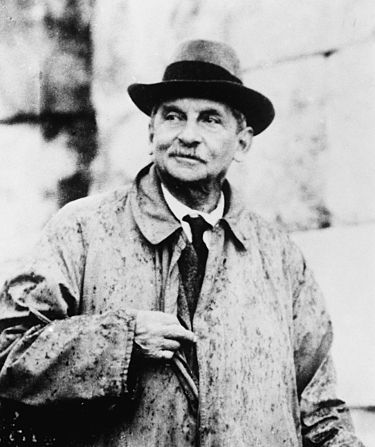
Evans Sir A
ACHIEVEMENTS:
Discovered Minoan civilisation at Knossos, Crete
NICKNAME/ALIAS:
None
DATE AND PLACE OF BIRTH:
8 July 1851, Nash Mills, Herefordshire, England
DATE AND PLACE OF DEATH AND AGE AT DEATH:
11 July 1941, Youlbury, Oxfordshire, England. Aged 90
DISCIPLINE:
Archeologist
FIELD:
Archeology
LANGUAGE:
English
PARENTS:
Father: John Evans
Mother: Harriet Dickinson
SIBLINGS:
2 brothers
2 sisters
SPOUSE:
Margaret Freeman
CHILDREN:
None
EDUCATION:
Harrow school, Harrow
Brasenose College, Oxford
University of Gottingen
MAJOR WORK:
“Scripta Minoa” (1906)
“Palace of Minos” (1921-36)
LIFE AND TIMES:
In 1883 Evans traveled to Greece where he met the German archeologist Schliemann* in Athens and visited the site of Schliemann’s excavations at Mycenae. Evans was intrigued by the workmanship and artistic refinement of the Mycenean artifacts and in particular the markings on seal-stones which convinced him that the Myceneans must have been able to write and had been influenced by an earlier advanced society. During the five months he spent in Greece he was constantly looking for evidence of a civilization which had preceded the Myceneans.
Back in England, he was appointed curator of Oxford University’s Ashmolean Museum in in 1884, whose collection was built around the closet of rarities made by the naturalist John Tradescant in the seventeenth century. His assistant at the Ashmolean sometime later was Woolley*. Evans lectured and traveled throughout his fourteen-year tenure and energetically revived the neglected museum. In the ten years since he had visited Mycenae, he had become more and more certain of the existence of a pre-Mycenean civilization which had existed outside the Greek mainland, probably in the Aegean, and possibly on the island of Crete.
In 1894 he visited Crete for the first time and negotiated with the Turkish rulers for a quarter share of the site at Kephala under which he believed Knossos was buried. He had thus prevented anyone else from excavating there, and back in England he published a book entitled “Cretan Pictographs and Pre-Phoenician Script” and set about raising support for his project. In 1898 the Turks left Crete and Evans, who had written articles supporting the Cretan rebellion, had no trouble securing the site he wanted when he returned to the island in 1999.
On March 23 1900 excavation began at Kephala. On day two, his workmen uncovered an ancient house and fragments of frescoes. On day three, they found large quantities of pottery and huge storage jars. There was still nothing tying the site into mainland Greece but at the end of the first week of digging, Evans found evidence of a prehistoric writing system on a clay tablet; by the end of the first season’s dig, over a thousand such tablets had been excavated.
Most characters were linear and there were two different types of ‘writing’ which Evans called Linear A and Linear B. A few of the characters were pictographic: in one chamber a series of pictographs showed chariots and horses’ heads, in other there were pictographs of vases. This appeared to suggest the keeping of an inventory or records of a large establishment.
In April 1900, they discovered fragments of a brightly-colored fresco depicting a huge figure unlike anything seen before. Before the end of the season they had uncovered a throne room and Evans could confidently declare that the palace of Minos had been found. Pottery decorated with marine creatures was further evidence which bore out the statement of Thucydides in the fifth century BC, who wrote that on the island of Crete in ancient times there existed a maritime people whose king, Minos, was a ruler of the Greek waters and the first colonizer of the Greek islands.
The final discovery of the first season was the remains of a painted stucco bull. The bulls seemed to pervade Knossos with wonderful frescoes of girl acrobats leaping over them. Iron wheelbarrows were imported from England and more advanced methods were used on site, such as the use of a sieve. Evans was one of the first archeologists to employ an architect on the site at all times. More than two acres of palace had been uncovered by the end of the first season, and the architect was able to draw up an overall architectural plan. It was clear that the palace was a huge, complex structure and Evans spent the next twenty-five years excavating at Knossos.
In the first season he uncovered a palace of the late Bronze Age (c1700-1400) and below that earlier buildings containing Kamares pottery (c2000) and below Bronze Age level he found evidence of a Neolithic settlement. The exact dates Evans ascribed to his finds have been questioned in the light of more modern research but he did establish the existence of a cultured bronze age civilization which he called the Minoan civilization, after the legendary King Minos.
Around 2000 BC something had happened on Crete because, as was demonstrated by excavations in other areas of the island, large palaces were erected at that time; they were always in most fertile plains, and their inhabitants used cups of gold and silver, and huge copper cooking vessels. Daily objects, such as the jars in which wines and oil was stored were beautifully decorated, and at Knossos Evans found cups as thin as eggshell. Jewelry and carved ivory were also found but the most exciting finds were the painted frescoes. Evans commissioned a Swiss artists (Emile Gillieron) to restore them.
It was the discovery of Egyptian artifacts from known periods that helped to establish the periods of Minoan civilization. Immediately above the Neolithic level at Knossos Evans had found the distinctive Kamares pottery. Kamares pottery had also been found in 1890 by Flinders Petrie at Kahun in Egypt; the pottery shards at Kahun could be dated accurately from contemporary records concerning the house in which they were found. It was therefore possible to establish that sometime between 1906 BC and 1888 BC Minoan ships had taken the pottery to Egypt.
In 1906 Evans built himself a house near Knossos. It was called the Villa Ariadne and eventually became the headquarters for students of the British School of Archeology in Athens. In 1908 Evans became extremely rich when he inherited a fortune from his maternal grandfather. He could now afford to fund Knossos and was able to resign from the Ashmolean.
In 1909 he published volume I of his work on the linear scripts, entitled “Scripta Minoa”. At the end of World War I, Evans hosted secret meetings of Slav leaders in the lead-up to the peace talks. Tomas Masaryk*, later the first president of the new republic of Czechoslovakia, was one of those who attended.
The four volumes of his definitive work on the Knossos excavations, “Palace of Minos” came out between 1921-36. In 1936 Evans gave lecture on the linear scripts which inspired Michael Ventris to pursue his research on the subject. In the same year, he was knighted.
In his old age he was visited by many friends who came to stay, including the poets Robert Bridges and John Masefield, the classicist Gilbert Murray* and Woolley.
ASSESSMENT: Evans was responsible one of the most important archeological finds ever made which established the existence of the Minoan civilization.
EXTRA CONNECTIONS: None
ONELINER: Sir Arthur Evans, archeologist discoverer of Knossos
BIBLIOGRAPHY:
Horwitz, Sylvia L., The Find of a Lifetime, Sir Arthur Evans and the Discovery of Knossos, Weidenfield and Nicolson, London, 1981.