Bardeen, John
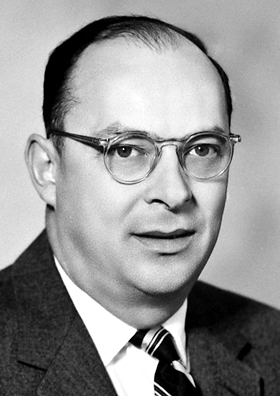
Achievements: Twice co-winner of the Nobel Prize for Physics: for the joint invention of the transistor (1956), and for the development of the theory of superconductivity (1972).
Born: May 23, 1908; Madison, WI.
Died: January 30. 1991; Boston, Massachusetts (Aged 82)
Field & Discipline: Science; Physics; Physicist
Language: English
Father: Charles Russell Bardeen
Mother: Althea Harmer
Siblings: Thomas; William; Helen; one half-sister
Spouse: Jane Maxwell (m. 1938)
Children: James Maxwell; William Allen; Elizabeth Ann
Education: Madison elementary schools; University High School; Madison; Central High School (to 1923); University of Wisconsin (1924-29)
Major Work:
“Understanding Superconductivity” (1964)
Life & Times:
In 1945, Bardeen joined the Bell Telephone Laboratories at Murray Hill, New Jersey, where he was assigned to work with [collaborated with] Shockley* and [collaborated with] Brattain*, who had been studying the properties of semiconductors for many years. Shockley and Brattain, among others, were convinced that the solution to the problem affecting existing electronic systems - which depended on bulky, fragile vacuum tubes that consumed large amounts of electrical power - lay in the use of semiconductors, such as silicon and germanium, that possess electrical resistance between that of insulators (such as rubber and plastics) and metal conductors, as devices that could rectify and amplify electrical signals.
During the late 1930s, the properties of semiconductors had been revealed with the discovery of the role of low concentrations of impurities in controlling the number of mobile charge carriers. Shockley had conceived of using semiconductors as amplifiers as early as 1939; his idea was to apply an external electric field to a semiconductor that would influence and control the flow of electrons in a region of the semiconductor, thereby modulating the current flowing through the device.
This, he believed, would create a device (later known as a field-effort transistor) that would be
capable of amplifying an electric signal because a small signal applied (applied voltage) would produce a large flow through the semiconductor - however, the war had intervened and six years later his team had not succeeded in producing a model along these lines that actually worked.
Bardeen studied the problem, and suggested that atoms (i.e. a layer of electrons) trapped on the surface of the semiconductor might be acting as a barrier to incoming electrical signals, preventing the material from behaving as Shockley had expected.
This idea led the team to approach the problem via an extensive study of the fundamental properties of the surface of semiconductors in electric fields, and resulted in 1947 in the construction by Bardeen and Brattain of the first working transistor.
This first working device was a point-contact transistor, in which two small wires (or "cat's whiskers,” called the emitter and collector) were attached to one end of a germanium block, serving as electrical contacts for the current, with a third wire as a contact at the bottom of the block (the base).
Instead of an externally applied electric field, the point-contact transistor used a small current flowing between the emitter and the base to control a larger current flowing from the emitter to the collector. In a later design, the junction transistor (1950), Bardeen and Brattain eliminated the point contacts, and instead constructed the emitter and collector from semiconductor materials "doped" with small amounts of specific impurities that increased the density of "electrons and holes.”
(Shockley's field-effect transistors did not become practical until silicon replaced germanium as the base material for semiconductors). Bardeen and Brattain's transistors function in a manner similar to vacuum tubes, as the transistor allows a very small signal in one circuit to control a relatively large current in another circuit. Because they are small, robust, relatively cheap to produce, and require a low amount of energy, they rapidly replaced vacuum tubes in all applications except those requiring the control of very large amounts of power, and entirely
revolutionized electronics, initiating the age of micro-miniature electronic parts.
For their work, the three Bell scientists were jointly awarded the 1956 Nobel Prize in physics - Shockley for his fundamental theoretical work, and Bardeen and Brattain for producing a working model of Shockley's theory.
Meanwhile, in 1951 Bardeen had left Bell Labs in order to accept a dual appointment as Professor of Electrical Engineering and Physics at the University of Illinois, Urbana. Here he turned to the problem of superconductivity, which had been discovered by the Dutch physicist [influenced by] Kamerlingh Onnes* in 1911 when he observed that some metals lose much resistance to the flow of electricity when their temperature is lowered to a few degrees above absolute zero. This heightened conductivity derives from a free flow of electrons in the metal, but the surprising aspect of Onnes' discovery was that resistance completely disappeared when some thermal
vibration remained (i.e. when the temperature was above absolute zero).
This phenomenon held great promise for the electronics industry as a means of greatly reducing the huge amount of energy wasted in overcoming electrical resistance, but the practical problem posed by the necessary low temperature required for superconductivity remained (by 1951, the highest temperature at which superconductivity had been observed was still only about 20 degrees above absolute zero).
For years there was no explanation of this phenomenon, although in 1933-35 it was established by the German physicists Walther Meissner and Fritz London that superconductors are perfectly diamagnetic - i.e. they prevent the penetration of a magnetic field to their interior - and that this was in all probability a quantum effect somehow manifested by an entire body of material.
These ideas were given a degree of confirmation in 1950, when several American researchers discovered that isotopes of some metals would become superconductors at different temperatures, and that the critical temperature producing the effect was inversely proportional to the atomic
mass.
From previous studies, Bardeen knew that the only effect of different atomic masses on the properties of a solid body were variations in the propagation of vibrational motions within the body, and he therefore suggested that superconductivity of a metal might involve an interaction between conduction of electrons (those relatively free to move as an electric current) and the vibration of the atoms in the metal body - and that this link (of the conductive electrons to atomic vibration) coupled the electrons to each other.
To test this theory, Bardeen established a research project at Illinois, to which he assigned a postdoctoral associate, Leon Cooper, and a graduate student, J. Robert Schrieffer, as his co-workers. In 1956, Cooper made an important discovery when he showed that an electron moving through a metal crystal attracts nearby positively charged atoms, slightly deforming the
crystal and momentarily increasing the concentration of positive charge.
This increased positive charge attracts a second electron, and the two electrons become paired, indirectly bound together through the local distortion of the crystal lattice. In this way, many electrons throughout the metal become joined into pairs (now known as "Cooper pairs"), but the
difficulty remained in showing how these pairs could be used to explain the free flow of all valence electrons in a superconductor.
In 1958, Bardeen, Schrieffer and Cooper were then able to show that the Cooper pairs interact to compel many of the free electrons in a superconductor to flow in unison - i.e. the superconducting electrons (as Fritz London had supposed) form a single quantum state that encompasses the
entire metal body - and that the critical temperature at which superconductivity appears represents the degree of reduction of thermal vibrations required to allow the influence of Cooper pairs to predominate in coordinating the movement of free electrons.
As the deviation of even one electron from the common stream would necessarily effect all others participating in superconduction, and thus destroy the integrity of the quantum state, such a disturbance becomes highly unlikely - instead, the superconducting electrons drift collectively with no loss of energy.
In 1958, Bardeen, Cooper and Schrieffer used this remarkably complete theory (known as the BSC theory of superconductivity, in honour of its three creators) to predict superfluidity (the absence of viscosity and surface tension) in liquid helium 3 at temperatures near absolute zero, which was confirmed experimentally in 1962 - overthrowing the theory that superfluidity was impossible in isotopes with an odd number of nuclear particles.
In 1972, Bardeen, Cooper and Schrieffer shared the Nobel Prize for physics for a theory which has had far-reaching effects on the theory of electronic technology, and has often been described as one of the most important developments in theoretical physics since quantum theory.
In particular, the development of materials that become superconducting at higher temperatures or withstand strong magnetic fields has made possible the construction of extremely powerful superconducting electromagnets, now used in the study of nuclear fusion, in magnetohydrodynamics, in high-energy particle accelerators, in frictionless trains lifted
magnetically above their rails, in biological and physical research on the interactions of atoms and electrons with strong magnetic fields, and in the construction of compact, powerful electric generators."
In 1959, Bardeen transferred to the Center for Advanced Study at the University of Illinois, where he continued his research in solid-state and low-temperature physics. On retiring in 1975 he was designated professor emeritus of physics.
Extra Connections: Some of his work was anticipated by [anticipated by] Braun*
Assessment: His achievements have had far-reaching scientific and technological consequences.
Oneliner: John Bardeen, co-inventor of the transistor
Bibliography:
- Encyclopedia Britannica.
- Nobel Prize Winners.
- Notable 20th-Century Scientists.
- Biographical Dictionary of Physicists.